
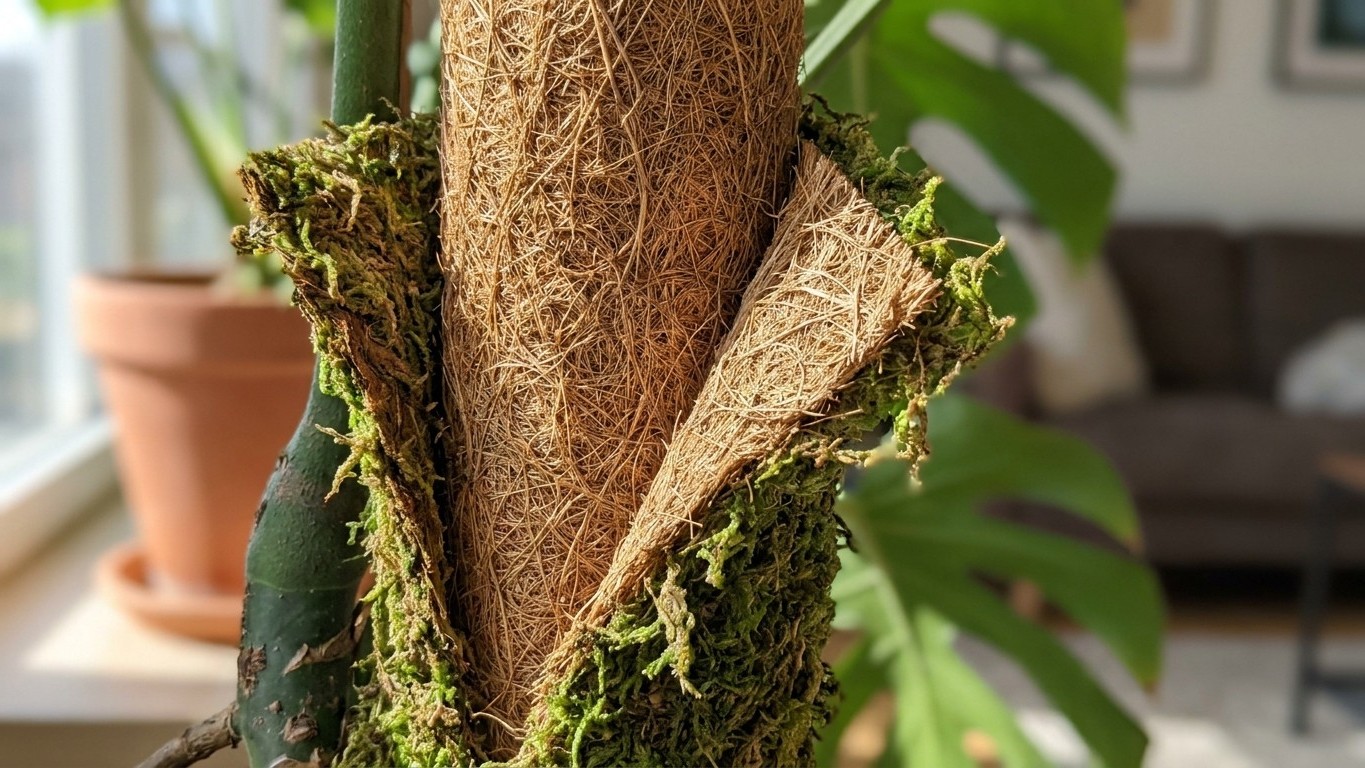
Two years of daily misting, and the moss pole looked perfect from the outside. Dense, uniformly green, always slightly damp to the touch. The Monstera was growing, producing leaves regularly, but something was off. Every new leaf that unfurled came out entirely green. No splits. No fenestrations. Just solid, juvenile-looking foliage on a plant that was already nearly five feet tall.
The answer was hiding inside the pole. When I finally pulled it away from the trunk to repot, the interior was dry, compacted, and almost woody in texture. The outer inch of sphagnum was holding moisture beautifully. The core? Bone dry. The aerial roots, which had pushed into the pole seeking moisture and anchorage, had found neither, so they stopped developing. And without well-developed aerial roots to signal maturity to the plant, the Monstera kept producing leaves as if it were still a juvenile climbing a rain forest floor.
Key takeaways
- A moss pole’s outer layer can stay wet while its core remains bone dry, stopping aerial root development completely
- Without properly anchored aerial roots, Monsteras keep producing small, unfenestrated leaves regardless of plant size
- A simple center pipe or wick system delivers moisture where it actually matters—at the core
What aerial roots actually need from a moss pole
Monstera deliciosa is a hemiepiphyte. It germinates in the soil, then spends years climbing toward the forest canopy using aerial roots that anchor into bark and organic debris. Those roots are doing two things simultaneously: stabilizing the plant and absorbing moisture and some nutrients directly from the surface they’re attached to. A moss pole is meant to replicate that bark-and-debris surface, but only if it stays consistently moist all the way through.
The aerial roots of a Monstera are remarkably sensitive to moisture gradients. They will grow toward humidity and stop dead when they encounter dry material. If only the outer layer of a moss pole is wet, the roots colonize that outer layer and then stall. They never achieve the penetration depth that triggers the physiological shift toward maturity. The plant’s response is conservative: keep producing smaller, unfenestrated leaves until conditions improve. That’s not a growth problem. That’s survival logic.
This is why surface misting, however diligent, is almost always insufficient. A standard sphagnum pole that’s six inches in diameter needs moisture at its center to function as intended. Daily surface misting delivers maybe the outer half-inch of reliable hydration. The rest stays dry unless you’re using a different method entirely.
The watering method that actually reaches the core
The most reliable approach, and one that many serious growers have converged on independently, is a center pipe. Before assembling a moss pole, insert a narrow PVC or bamboo pipe down the middle, something with a diameter of about half an inch. Leave it flush with the top of the pole. When you water, pour directly into that central tube. The moisture radiates outward from the core rather than trying to penetrate inward from the surface. The sphagnum stays uniformly damp, and aerial roots that reach the interior of the pole encounter consistent hydration.
A simpler variation works for poles that are already built: slow-drip irrigation. A thin dripper line inserted into the top of the pole, connected to a timer, delivers small amounts of water continuously. The pole never dries out completely, and the moisture distribution is far more even than any manual misting routine. Some growers use a wick system, a length of cotton rope threading through the center, with one end sitting in the pot’s water reservoir. Capillary action does the rest.
The type of material also matters more than most beginners expect. Coco coir poles are popular because they hold their shape and look clean, but their moisture retention is genuinely inferior to quality sphagnum moss. Sphagnum can hold up to 20 times its dry weight in water, coco coir manages roughly 8 to 10 times. For a plant that’s relying on that pole as a moisture source, the difference is substantial.
Why fenestration stalls, and what actually triggers it
The connection between aerial root development and leaf fenestration is not fully understood at a molecular level, but the horticultural evidence is consistent. Plants that climb successfully, with aerial roots well-anchored and absorbing moisture, produce larger and more complex leaves faster than plants growing in identical conditions without proper support. The current leading hypothesis involves light optimization: in the wild, a Monstera climbing a tree trunk produces fenestrated leaves so that sunlight can pass through to lower leaves rather than being blocked entirely. The plant essentially only invests in that complex leaf architecture when it’s actually climbing, not when it’s sitting in a pot on a shelf.
Height plays a role too. A study tracking Monstera growth in controlled conditions found that plants grown on adequately moistened supports began producing split leaves at a significantly lower node count than unsupported plants of the same age. The pole isn’t just cosmetic. It’s actively communicating to the plant that climbing conditions are favorable, which triggers the developmental shift.
After I rebuilt my pole with a center pipe and spent about four months maintaining genuine core moisture, the next three leaves all came out with fenestrations. The fourth had both splits and holes. The plant hadn’t changed. The conditions finally had.
Practical fixes for an existing setup
Rebuilding a pole mid-growth is disruptive but doable. The aerial roots that have already attached themselves will need to be gently detached, they’re usually more flexible than they look. Soaking the old pole before removal helps significantly. If the roots have truly embedded themselves, cut the pole apart rather than ripping the roots free.
For growers who don’t want to dismantle anything, the wick method is the lowest-effort retrofit. Drill or push a thin rod through the existing pole from top to bottom, thread a cotton cord through, and let the lower end sit in standing water in the pot’s saucer. Check the moisture at the core after a week, not at the surface, but by pressing a thin skewer into the center. If it comes out dry, the wick diameter needs to increase.
One detail worth knowing: sphagnum that has been allowed to dry out completely and then re-wetted becomes hydrophobic for a period. The fibers lose their capillary structure temporarily. If your pole has gone bone dry multiple times, a full soak in a bucket for 30 minutes before reinstalling will reset it far more effectively than misting ever could.