
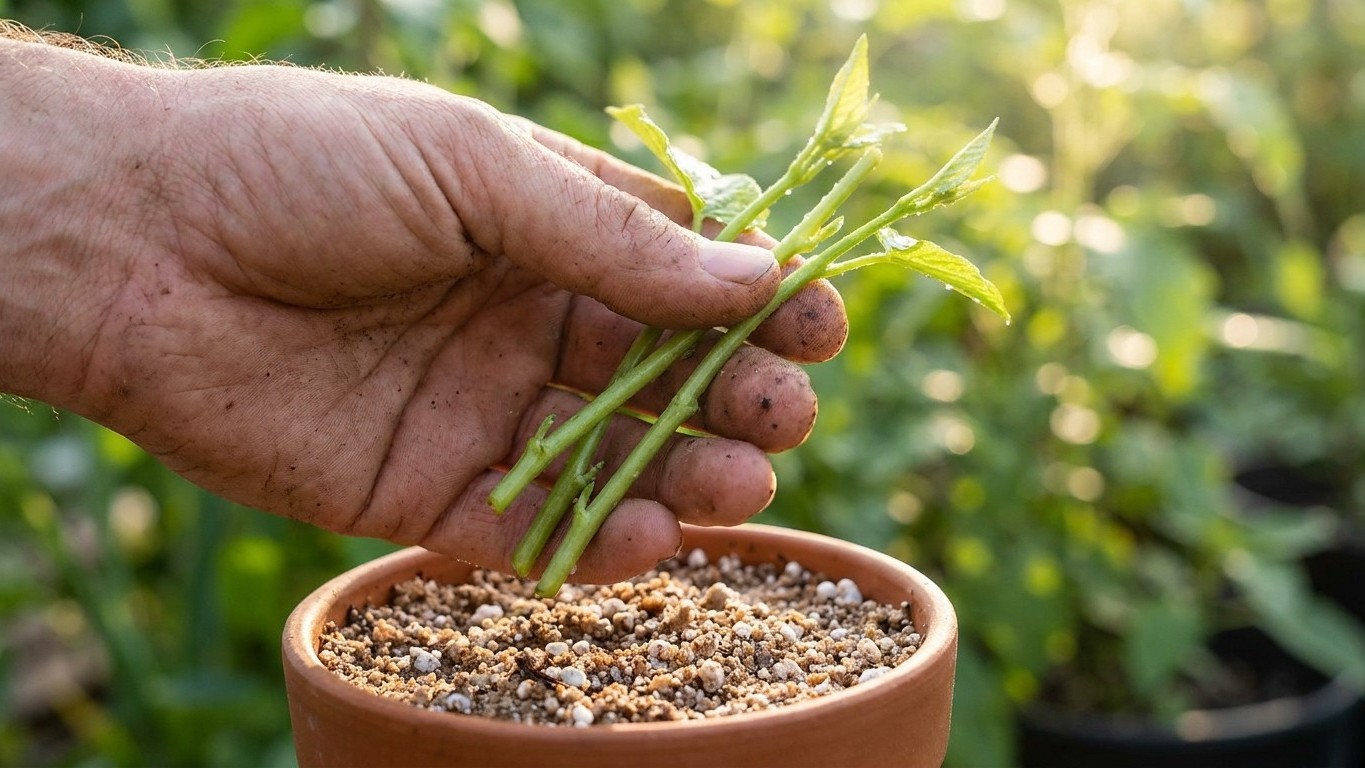
For 15 years, the cuttings kept dying. Lavender, hydrangea, rosemary, forsythia, a graveyard of wilted stems stuck hopefully into pots of sandy compost, then quietly thrown out two months later. The problem wasn’t technique. The snips were clean, the node placement correct, the humidity tent dutifully placed over every pot. The problem was the calendar.
Grandmother’s rule was simple: wait until the plant knows what it’s doing, then take your piece. Cryptic, old-fashioned, and completely right. What she was describing, without the botanical vocabulary, is the difference between softwood, semi-hardwood, and hardwood cuttings. Three categories. Three distinct windows. Get them confused and you’re fighting the plant’s own biology every single time.
Key takeaways
- Why the perfect technique still fails without understanding the hidden calendar that controls rooting success
- The one seasonal window that 90% of gardeners completely miss—and why it’s the sweet spot for stubborn plants
- How a single morning versus afternoon cut, or a diagonal versus straight edge, compounds into the difference between total failure and 100% success
Why Timing Is the Variable Nobody Talks About
Most beginner guides focus on technique: how deep to insert the stem, whether to use rooting hormone, which medium to choose. All useful. But while most herbaceous plants can be propagated at any time of the year, timing is critical for the success of woody ornamental propagation from cuttings. Snip a hydrangea stem in February and you’re working against dormancy. Cut it in late October and the energy has already retreated into the roots. The window is real and it’s narrow, and it changes depending on what you’re trying to grow.
Plants undergo distinct growth phases throughout the year dictated by environmental changes such as temperature, light levels, and rainfall. These phases typically include dormancy, active growth, and flowering. Each phase offers unique opportunities for taking cuttings, and understanding these cycles can greatly enhance your success rate. Grandmother didn’t have a horticulture degree. She had decades of observation. Same result.
The Three Windows, and Which One Most Gardeners Miss
Softwood cuttings have the highest rooting potential of any stem cutting and often provide the best chance of rooting species that are difficult to propagate. They are taken from spring to early summer (April–June), using material from the soft and flexible young shoot tips from this season’s growth, which root readily. These are the fastest rooters. The problem? They’re also the most fragile. These cuttings root faster compared to other types, but need to be kept cool and moist during collection. Once cut, these soft shoots will lose water quickly. Softwood cuttings that are excessively wilted during collection likely will not root. Take them in the morning, keep them wrapped in damp paper, and get them into a humidity tent within the hour.
The window most gardeners miss entirely is semi-hardwood, which is exactly what grandmother was pointing at when she said “wait until the stem stops bending like a noodle.” The best time to take semi-hardwood cuttings is in summer, from June to September. The growth flush is completed, the wood is firm, and leaves are mature. This is the sweet spot for broadleaf evergreens, this category applies to broadleaf evergreens, such as those in genera Rhododendron, Photinia, Ilex, Magnolia, and Camellia. These are notoriously stubborn plants to propagate, and the reason most people fail with them is simply taking cuttings in spring, when the stems are still too soft.
Then there’s hardwood. Counterintuitively, this is the most forgiving category. Hardwood cuttings provide an easy and reliable method of propagating a range of deciduous climbers, trees and shrubs, and as a bonus, they are taken from mid-autumn until late winter when more time is usually available to the gardener. No humidity tent required. No daily misting. Hardwood cuttings do not require sunlight and instead get their energy from the woody stem. You cut, you stick them in the ground or a pot in a cold frame, and you wait. Forsythia, rose, viburnum, weigela, all candidates. The trade-off is patience: rooting can take several months.
The Details That Actually Make the Difference
Timing the season correctly is step one. But two other variables determine whether that well-timed cutting actually roots or rots. The first is the moment within the day you make the cut. It is recommended to take cuttings in the morning when plants reach their peak hydration levels for the day. Afternoon cuttings from a plant that’s been transpiring in full sun for six hours are starting life stressed. That stress compounds quickly once the stem is severed.
The second variable is the medium. Rich potting compost, counterintuitively, is the enemy here. A suitable rooting medium is low in fertility, well-drained, and promotes aeration. A mix of peat or coco coir with perlite is recommended, while potting mixes with excessive nutrients may hinder root development. The logic makes sense once you think about it: a cutting isn’t a plant yet. It has no roots to absorb nutrients. What it needs is moisture retention and air, not a feast it can’t access.
Stem cuttings perform best when cut to 4 to 6 inches in length. Position your cuts just below a leaf node, since this area contains the highest concentration of growth hormones needed for root development. Make your cuts at a clean angle rather than straight across to increase the surface area available for rooting and prevent water from pooling on the cut surface. That diagonal cut is one of those small details that makes a measurable difference, surface area for rooting, drainage against rot. One move, two problems solved.
Rooting hormone is optional for easy-to-root species but worth using for anything woody. When cuttings are treated with rooting hormones, they tend to root more quickly and may form more roots than if no rooting hormone is used. One practical tip most guides skip: for sanitation purposes, avoid sticking plant materials into the main container of the rooting product. Instead, pour a small amount into a paper cup or onto a piece of paper before dipping cuttings into the rooting powder. Contaminating the whole jar with plant pathogens is an easy mistake to make.
Reading the Signs of Success (and Failure)
The waiting period is where impatience kills otherwise healthy cuttings. Resistance when tugging gently indicates the cutting has developed anchoring roots. Test this carefully by giving the cutting a very light pull, if it feels firmly attached to the medium, roots are establishing themselves. This gentle tug test is far more reliable than pulling the cutting out to look, which can tear fragile new root hairs before they’re established.
In autumn, hormone levels are high, so plants should root and grow well. That’s the detail that reframes the whole calendar. Autumn isn’t just a window for hardwood cuttings, it’s a window where the plant’s own chemistry is working in your favor, elevated hormone concentrations priming the tissue to respond. Grandmother never said why her timing worked. She just knew that it did.
The single most common mistake across 15 years of failed cuttings turns out to be the most basic one: treating propagation like a technique problem when it’s actually a timing problem. Master the calendar, and the technique mostly takes care of itself.
Sources : livetoplant.com | gardeningknowhow.com