
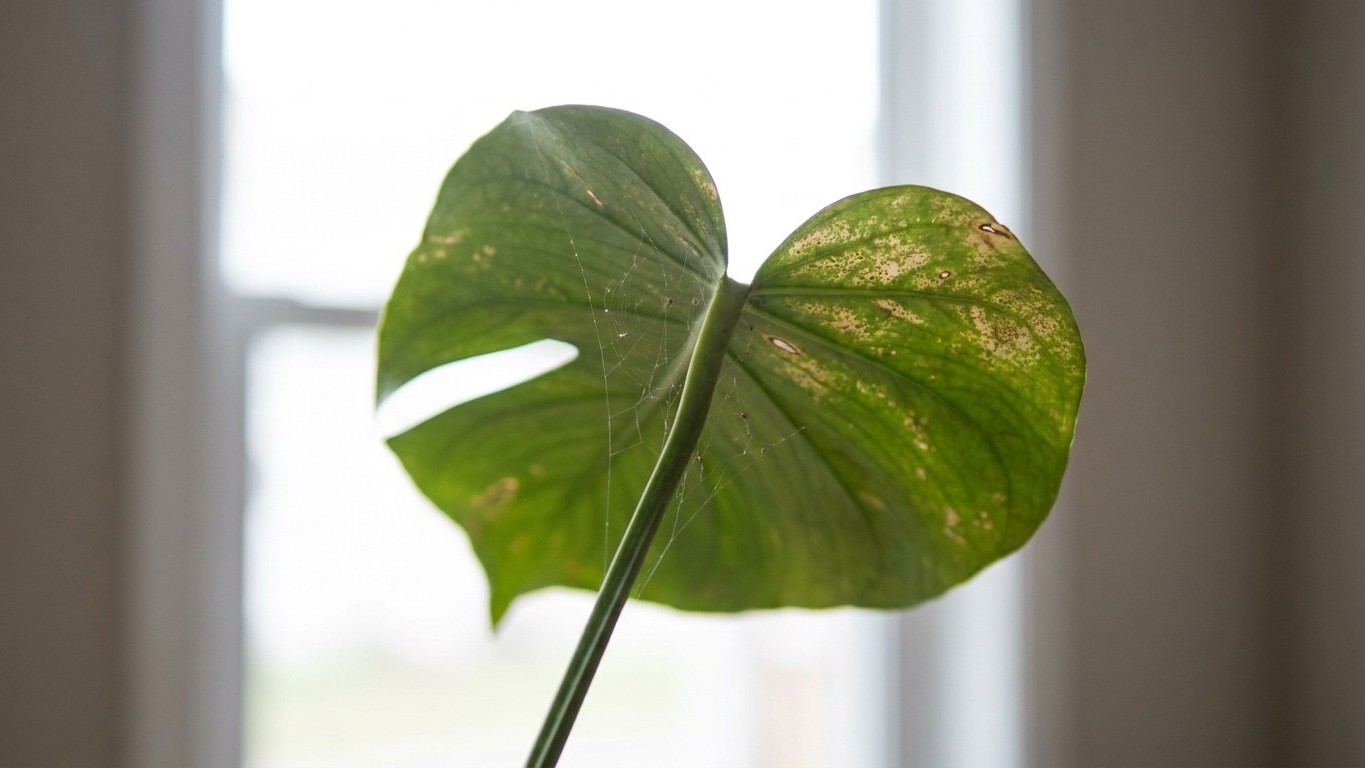
Fine webbing under a monstera leaf during a heatwave means one thing: spider mites, and they thrive precisely because misting made the plant feel humid without actually solving anything. The plant wasn’t drowning in attention. It was being drained by thousands of near-invisible pests while its owner kept spraying water on symptoms that had nothing to do with dehydration.
Spider mites love exactly the conditions a heatwave creates indoors: hot, dry air circulating around a plant near a window. According to the U.S. Environmental Protection Agency, these arachnids reproduce fastest in warm, low-humidity environments, sometimes completing a full generation in under a week when temperatures climb above 80°F. A single misting session raises humidity for maybe twenty minutes. Mites don’t care. They’re back to feeding within the hour.
Key takeaways
- Spider mites reproduce fastest in hot, dry air—the exact indoor conditions heatwaves create
- Misting raises humidity for only 20 minutes while mites keep feeding and multiplying
- The telltale webbing doesn’t appear until populations have been building for 2-3 weeks
Why Misting Made It Worse, Not Better
Here’s the part that trips up a lot of plant owners: misting a monstera during a mite infestation can actually accelerate the damage. Wet leaf surfaces attract fungal issues, sure, but the bigger problem is timing. Misting gives a false sense of care completed. Check the box, walk away, assume the yellowing leaves are just heat stress. Meanwhile the mites keep puncturing cell walls on the underside of every leaf, extracting chlorophyll and fluid one microscopic bite at a time.
A monstera under mite attack shows a specific pattern that’s easy to misread as thirst. Leaves develop a stippled, bronze-ish discoloration that looks like sun scorch. Edges curl. New growth stalls. Every symptom mimics underwatering or heat stress, which is exactly why so many people respond by increasing humidity instead of flipping the leaf over to look for the actual cause.
The webbing itself is the giveaway, but it only shows up once the infestation has already established a foothold. Early stage mite damage looks like tiny pale dots scattered across the leaf, almost like pepper flecks. By the time silk strands are visible connecting leaf to stem, populations have likely been building for two to three weeks. That’s not a coincidence with heatwave timing. It’s the reproduction cycle catching up with the calendar.
What Actually Stops Spider Mites
Water works, just not sprayed as mist. A strong rinse under a sink faucet or shower head physically knocks mites off the plant and washes away eggs clinging to leaf undersides. This needs repeating every four to five days for at least two weeks, since mite eggs hatch on a staggered schedule and a single treatment misses whatever hasn’t hatched yet.
Insecticidal soap or horticultural oil handles what the rinse leaves behind. Both work by disrupting the mites’ outer coating rather than through chemical toxicity, which means direct contact matters more than saturation. Coating the underside of every leaf is non-negotiable here, since that’s where mites feed and lay eggs almost exclusively. Skipping the undersides is the single most common reason treatments fail.
Isolation matters too, and it’s the step people forget. Spider mites migrate to neighboring plants through leaf contact or even air currents in a still room. A monstera sitting eight inches from a pothos on the same shelf can pass along an infestation within days. Moving the affected plant away from others, ideally to a separate room, cuts off that spread while treatment takes effect.
Reading Humidity Correctly for a Monstera
Monstera deliciosa, native to tropical forest understories in southern Mexico and parts of Central America, does appreciate humidity in the 50 to 60 percent range. But there’s a meaningful difference between ambient humidity and surface moisture from misting. Ambient humidity is what a hygrometer measures in the room over hours. Surface moisture from a spray bottle evaporates in minutes and does almost nothing to shift that number.
A humidifier running for several hours a day changes the room’s actual moisture content. A pebble tray under the pot raises humidity in the immediate microclimate around the leaves, gradually, without ever wetting the foliage. Grouping plants together creates a shared humidity pocket through collective transpiration. All three outperform misting for genuine humidity control, and none of them create the wet-leaf conditions that fungal spots and some pests exploit.
Heatwaves complicate this because indoor air conditioning drops humidity even as temperatures climb outside. A room can feel stuffy and warm while registering 25 percent humidity on a hygrometer, dry enough to stress a tropical plant and comfortable enough for spider mites to multiply unchecked. That combination, dry air plus heat, is close to ideal mite breeding weather. Checking actual humidity levels with a cheap hygrometer takes the guesswork out of whether misting was ever addressing a real problem in the first place.
After the Mites Are Gone
Recovery isn’t instant. Leaves already damaged by feeding won’t green back up, since the chlorophyll extracted from those cells is gone for good. New growth emerging after treatment should come in clean, which is the actual marker of success rather than the old leaves looking better. Pruning off the worst-affected leaves once new growth appears redirects the plant’s energy and removes any lingering eggs that survived treatment.
Weekly leaf inspections, flipping a few leaves over during regular watering, catch reinfestation before webbing appears again. It takes maybe thirty seconds. Given how fast mite populations rebuild in warm rooms, that habit is worth more than any amount of misting ever was.