
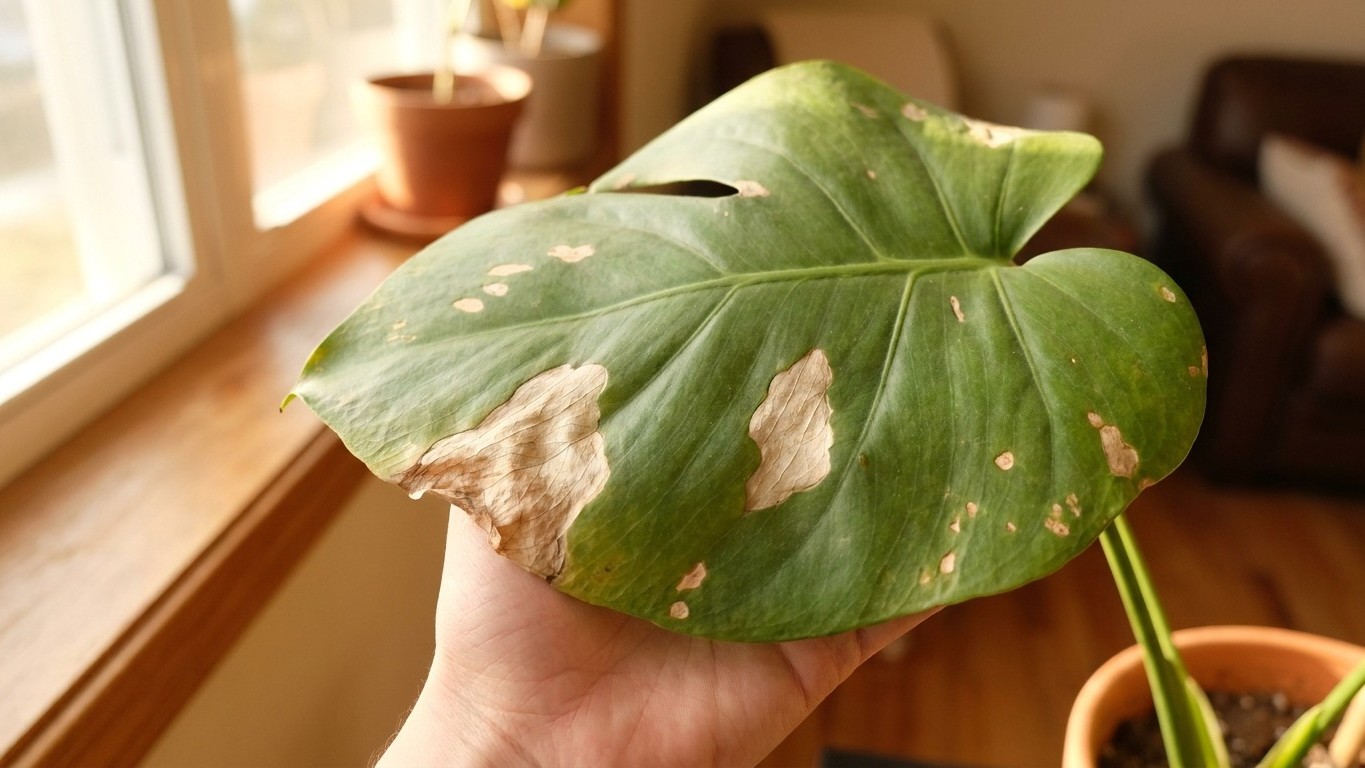
By the time the evening light softened, the damage was already locked in. Leaves that had been glossy and deep green that morning now showed pale, papery patches spreading across the fenestrations, edges curling inward like they were trying to protect themselves. That’s the cruel thing about monstera sunburn: it doesn’t build slowly. Sunburn does all the lasting damage at once, and a leaf can burn in a matter of hours. One afternoon of intense light through glass, amplified by a heatwave, is enough to turn a thriving plant into a triage case.
The instinct to give a monstera “more sun for faster growth” is understandable, but it’s backwards. Placing a monstera directly in a south-facing window during a heatwave, assuming more sun means faster growth, instead often results in serious sunburn. These plants evolved on the floor of Central American rainforests, growing up through the trunks of trees rather than out in open fields. Monstera deliciosa is native to the tropical rainforests of Central America, where it grows under the canopy of tall trees, enjoying filtered light and warm, humid conditions. A south-facing window in July delivers nothing like that dappled, filtered glow. It delivers a magnifying glass.
Key takeaways
- Monstera sunburn happens faster than you think—sometimes in just one afternoon of intense heat
- Those crispy, brown patches will never turn green again, no matter what you do
- Your plant can fully recover if you act fast: move it, prune the damage, and adjust watering
What actually happens inside a scorched leaf
Sunburn isn’t cosmetic, it’s cellular. Initial signs include a yellowing or bleaching of the leaf tissue, where the vibrant green color fades, progressing to light brown or crispy, papery spots as the damage becomes more severe. The mechanism is almost identical to what happens to human skin: plants absorb light energy, and when they receive more than they can use for photosynthesis, they have to dissipate the excess as heat. As MIT chemist Gabriela Schlau-Cohen has explained, “A primary strategy that plants use to protect themselves from this kind of photodamage is to dissipate the extra light as heat.” Normally the plant sheds that heat through transpiration, water evaporating off the leaf surface. But during a heatwave, soil dries out fast and roots can’t keep pace with the demand. Without enough water moving through the tissue, the cooling system fails and the cells cook.
Once that happens, the visual signature is unmistakable. Patches on the leaves turn tan, light brown, or whitish, the affected areas feel papery or crispy to the touch, and in severe cases, the entire leaf may yellow and dry out very quickly, leaving true burn marks where intense sunlight has damaged the leaf tissue. Damage tends to concentrate wherever the leaf faced the glass directly. Damage is usually worse on leaves that face the window, while leaves in shade look better. That’s a useful diagnostic detail: if only the sun-facing side of the plant looks wrecked while the back leaves are fine, sunburn (not overwatering or pests) is almost certainly the cause.
Temperature compounds the problem independently of light. Monstera plants thrive best within a temperature range of 65°F to 85°F, and temperatures consistently above 85°F increase the risk of heat stress, with heat tolerance generally capping around 90°F. A south-facing window during a summer heatwave can easily push the air right against the glass well past that ceiling, even if the room thermostat reads comfortable a few feet away.
Why the leaf that’s already brown won’t come back
Here’s the part nobody wants to hear: those crispy patches are permanent. Scorched spots will not heal, so the goal is to prevent new damage rather than reverse it. The damage is done, and burned leaves won’t regrow. This isn’t a failure of care after the fact; it’s simply how plant tissue works once cells have died from dehydration and heat. Trying to nurse a scorched leaf back to green is a lost cause, and no amount of misting or Fertilizer changes that.
What you can control is what happens next, and there the news is genuinely good. Sunburn is rarely a death sentence for monstera unless the plant is left out there long enough that the roots perish. The plant’s growth engine, the stem and root system, usually survives the ordeal completely intact.
The recovery routine that actually works
Start by getting the plant out of that light entirely, not just dimming it slightly. The primary step in treating a sunburned monstera is to immediately relocate it to a location with bright, indirect light to prevent further damage. A spot several feet back from any west- or south-facing glass, or behind a sheer curtain, works well. Placing them several feet away from a south or west-facing window, or behind a sheer curtain, can diffuse intense sunlight effectively.
Next comes the pruning, and this is where a lot of plant owners hesitate too long out of sentimentality. Severely burned leaves, particularly those with large crispy or brown sections, can be trimmed or removed using clean, sharp shears at the base near the main stem, which helps the plant redirect its energy towards new, healthy growth rather than attempting to repair irreparable tissue. If only part of a leaf is affected and most of it is still green, there’s an argument for leaving it, since the healthy portions can still perform photosynthesis while new growth catches up.
Watering needs careful recalibration too, because a sunburned plant is almost always dehydrated as well. A sunburnt plant is usually dehydrated from being in the sun for too long, so it helps to water more frequently than usual until the leaves start to recover. Resist the urge to overcorrect, though. Overwatering can exacerbate the problem, leading to root rot, while underwatering can dry out the plant even more. Check soil moisture with a finger an inch down rather than watering on a fixed schedule.
Recovery timelines vary, but they’re rarely dramatic. One grower who moved a badly scorched plant into softer light and raised humidity around it saw it produce two fresh, bright-green leaves within about two months, a slow, unglamorous comeback, but a real one.
The lesson for the next heatwave isn’t to banish your monstera to a dim corner. It’s acclimation. If you want to move a monstera to a brighter spot, start with just one hour a day, preferably morning light, and increase that time gradually over one to two weeks, giving the leaf cells time to adjust and significantly reducing the risk of sunburn. Skip that step during a heatwave, and the plant pays for it in a single afternoon, with a bill that arrives, unmistakably, by evening.
Sources : handygardening.com | planethouseplant.com