
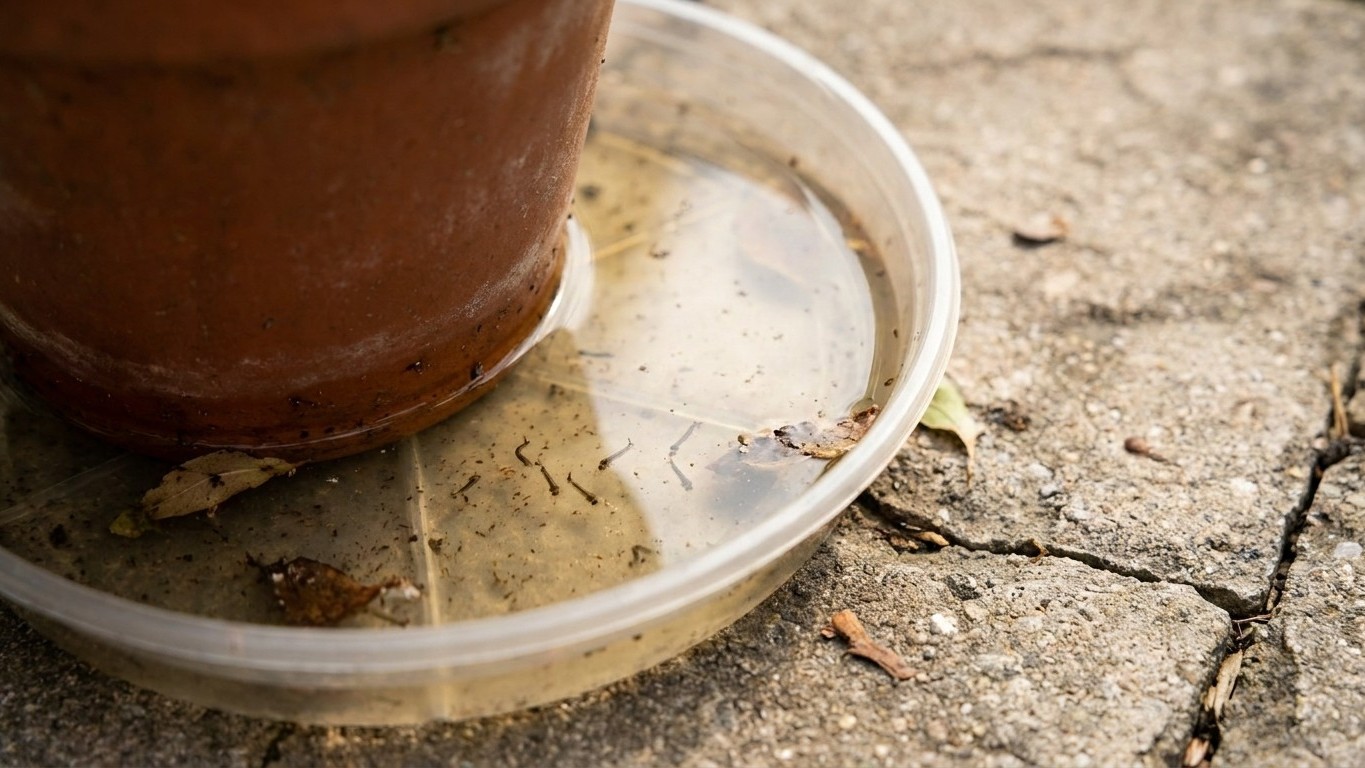
Tiny dark commas twisting just below the surface. That’s what greeted a closer look into those saucers under the patio pots, water that had sat undisturbed for less than a week. Not dirt, not algae debris. Larvae. A full colony of mosquito wrigglers, thriving in what amounted to a rounded plastic nursery, refilled every time the watering can made its rounds.
The instinct to protect a patio floor from water rings and soil stains makes sense. Saucers catch runoff, keep the concrete clean, spare the wood deck from rot. But every one of those trays becomes, almost immediately, a self-replenishing breeding station. The female mosquito will lay her eggs at backyard sources including ornamental ponds, non-functioning fountains, birdbaths and in the saucers below potted plants. No pond required. No swamp nearby. Just a few tablespoons of standing water and a patient female looking for a place to lay.
Key takeaways
- What you thought was harmless runoff is actually a thriving mosquito hatchery refilling itself every time you water
- Mosquito eggs glued to plastic can survive 8 months dry and hatch into biting adults in as little as 4 days
- Disease-carrying Aedes mosquitoes prefer human-made water sources like plant saucers over natural ponds
How little water it actually takes
The numbers here are almost insulting in how small they are. Mosquitoes can breed in very small amounts of water, think a bottle cap or the saucer under a plant, in just a few days. That’s not an exaggeration for effect. According to the CDC, which tracks Aedes aegypti and Aedes albopictus, the two species responsible for most of the biting misery (and disease risk) in American backyards, adult female mosquitoes lay eggs on the inner walls of containers with water, above the waterline, and eggs stick to container walls like glue.
That detail matters more than it seems. Dumping the saucer doesn’t necessarily solve the problem, because the eggs aren’t floating, they’re glued to the plastic. Eggs can survive drying out for up to 8 months, and can even survive a winter in the southern United States. Refill that saucer during the next watering session, and the whole cycle restarts, batch after batch, all summer.
From egg to biting adult in about a week
Here’s the part that should change how anyone waters their patio garden. A mosquito egg takes 7 to 10 days to develop into an adult mosquito, according to the CDC’s breakdown of the Aedes life cycle. That’s shorter than most people wait between grocery runs. Aaron Ashbrook, an entomologist with the LSU AgCenter, put it plainly when describing how fast a random puddle turns into a problem: “Within three to five days, they can start to produce mosquitoes in the area, and of course, these could potentially be biting you and a threat to yourself as a disease vector.”
The EPA’s own timeline backs this up, with some flexibility built in depending on temperature. The life cycle typically takes up two weeks, but depending on conditions, it can range from 4 days to as long as a month. On a hot patio in July, with water sitting in full sun, expect the faster end of that range. The wrigglers seen under a stack of terracotta pots after a week of daily watering weren’t a fluke. They were right on schedule.
Why this isn’t just an itchy-bite problem
It’s tempting to file mosquito larvae under “gross but harmless.” That’s not quite accurate, especially with Aedes species, which have adapted specifically to human environments. Aedes mosquitoes tend to live around people and breed in standing water around the home more than most other species. They don’t need a marsh. A patio, a balcony, a row of saucers under hydrangeas works just as well, and often better, since it’s shielded from wind and predators that might otherwise eat the larvae in a natural pond.
The disease angle isn’t theoretical either. Aedes mosquitoes are the primary vectors for viruses like dengue, Zika, and chikungunya in the U.S., while Culex species (the ones more likely breeding in a shaded saucer) can carry West Nile virus. Nobody wants to think about arboviruses while watering geraniums. But the saucer under the pot is exactly the kind of overlooked, small-volume water source that public health departments spend entire campaigns warning people about.
Breaking the cycle without giving up the saucers
The fix isn’t complicated, but it does require consistency, which is the part most people skip. Three habits actually interrupt the breeding cycle instead of just delaying it:
- Empty saucers every three to four days, not just when they look full. Mosquito eggs need at least 24 hours in water to hatch, so frequent changes interrupt the cycle.
- Scrub, don’t just dump. Since eggs cling to the plastic rim, a quick wipe with a brush or an old sponge removes what a simple pour won’t.
- Drill a few small drainage holes in the saucer itself, or switch to saucers with a built-in gravel layer or wick system that keeps roots hydrated without letting water pool freely.
For anyone dealing with dozens of pots, a more industrial approach works too: mosquito dunks, small biological tablets containing Bacillus thuringiensis israelensis, kill larvae without harming pets, birds, or the plants themselves. Biological larvicides containing Bacillus thuringiensis israelensis (Bti) kill mosquito larvae without harming fish, pets, or wildlife. A single dunk broken into quarters can treat several saucers for weeks at a time, which beats scrubbing every single day during peak summer.
One more thing worth knowing: the eggs found clinging to a saucer this year didn’t necessarily hatch this year. Aedes eggs are built to wait out dry spells, sometimes for months, riding out winter in a shed pot stack before that first refill in spring wakes the whole batch up at once. The patio pots aren’t just breeding mosquitoes in July. They’re potentially banking eggs for next season, too.
Sources : terminix.com | slocounty.ca.gov