
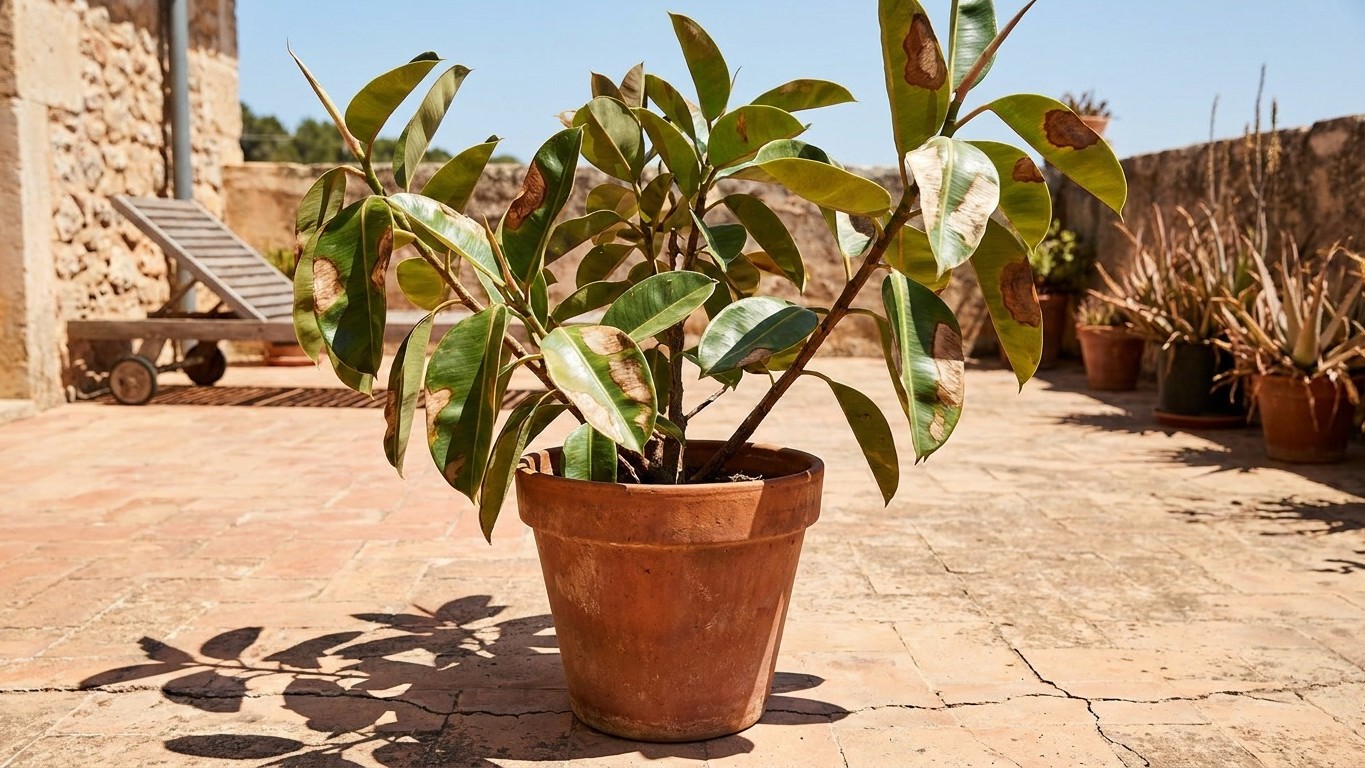
Brown patches spreading across glossy green leaves within a single afternoon. That’s the brutal reality of what happens when a ficus goes from a shaded living room to a sun-drenched terrace in July without any transition. The plant doesn’t get days to adjust. It gets hours, and the damage those hours cause is permanent.
The mechanism is simpler than most people expect. Indoor light, even next to a bright window, is a fraction of what falls on an open terrace at midday in summer. One horticultural expert put it bluntly on a plant forum: the outdoor sun is anywhere from 10 to 100 times more intense than what a plant experiences indoors. A ficus that has spent months, maybe years, calibrating its leaf tissue to filtered, indirect brightness suddenly gets hit with full-strength UV and heat. The cells in the leaf can’t process that jump. They cook.
Key takeaways
- One hour of unacclimated outdoor sun is enough to permanently scorch indoor plant leaves
- The intensity gap between indoor and outdoor light is far more dramatic than most plant owners realize
- There’s a simple multi-week hardening process that prevents damage entirely—but most people skip it
What those hours actually did to the leaves
Sunburn on a ficus doesn’t look like a slow yellowing. It shows up fast and it shows up ugly. The leaves often turn brown and crispy around the edges or tips, due to the intense sunlight scorching the leaf tissue. On some plants the damage takes a different form entirely: pale, almost bleached patches where direct rays hit the surface dead-on, as if the color had been washed out. One plant retailer describes exactly that pattern, noting that bleached foliage can indicate sunburn, as well as brown striping on the leaves where they were exposed to direct sun rays.
Here’s the part that stings the most for anyone hoping to fix it with a little extra water: it’s too late the moment those cells die. A rubber tree owner asking about damaged leaves on a gardening forum got a blunt answer confirming that looks like sunburn and it is permanent. Scorched tissue doesn’t green back up. The plant has to abandon those leaves and grow new ones adapted to the new conditions, which takes weeks, sometimes months.
Speed is the other surprising factor. This isn’t damage that creeps up over a week of neglect. Multiple plant retailers and extension services describe leaf scorch as something that can happen almost instantly once a houseplant meets direct outdoor sun. One retailer’s care guide states it plainly: a mere hour of direct outdoor light is enough to scorch the leaves of an indoor plant that’s been moved outside but isn’t acclimated to its new surroundings yet, and recovery can take months. A ficus dragged onto a terrace at noon doesn’t stand a chance without prior conditioning.
Indoor comfort versus outdoor reality
The gap between a living room and a terrace is bigger than most plant owners assume, and it isn’t only about light. A university extension office breaks down exactly why the jump is so jarring: our homes typically have low light, low humidity, and relatively moderate temperatures with small fluctuations, while outdoor growing conditions are typically high light, high humidity, high temperature and have large temperature fluctuations between day and night. A ficus indoors has never had to deal with wind either, or with the radiant heat bouncing off terracotta tiles and concrete railings, both of which intensify moisture loss through the leaves right as the plant is least equipped to handle it.
Root systems complicate things further. A plant grown for years in low, even indoor light develops thinner leaf cuticles, the waxy outer layer that normally shields tissue from UV. Move that plant into full sun and the cuticle simply isn’t built for the job yet. That’s why even naturally sun-loving houseplants aren’t immune. A gardening retailer notes that even sun-loving plants can burn if not acclimated properly before moved from indoors to the intense sunlight outdoors. A ficus, which tolerates bright indirect light indoors but rarely direct midday sun even outdoors in its native range, is particularly exposed to this kind of shock.
The right way to move a plant outside next summer
Every reputable plant care source agrees on one point: never go from indoors straight to full sun. The recommended approach is closer to a slow introduction than a relocation. A gardening extension office recommends starting in a shaded spot and moving the plant outdoors in a shaded site such as a covered porch, letting the plant adjust to the new temperature, humidity, and brighter light conditions for a week or two before moving it to its final location for the summer.
From there, the increase in light needs to be gradual and measured in hours, not days. One plant nursery’s guide suggests a stepped approach: it’s best to move plants outside by hardening them off first, putting them in a partial shade location with only a few hours of morning or afternoon sun for the first few days, then gradually increasing the amount of direct sunlight they receive by moving the plants into full sun for a limited time, about 4-5 hours. Morning sun is gentler than afternoon sun, since temperatures and UV intensity build through the day, so an east-facing spot for the first week beats a south or west exposure every time.
What to do with the damaged leaves now
Once scorch has set in, the priority shifts from prevention to damage control. Move the ficus back to bright, indirect light immediately, whether that means indoors or into deep shade on the same terrace. Resist the urge to prune aggressively right away. Even a badly burned leaf may still carry out some photosynthesis while the plant recovers, so a fig-growing guide advises to not remove any leaves and let the tree decide, since leaves hit hard by sunburn can often still provide some amount of photosynthesis to the tree, which is critical for a speedy recovery. Watering also needs adjusting, since scorched foliage loses moisture faster than healthy tissue.
The upside, if there is one, is that a ficus rarely dies from this kind of shock alone. It sheds the ruined leaves over the following weeks and pushes out fresh growth suited to its new light level, provided the next move outside is staged in hours and days rather than attempted in a single afternoon.
Sources : garden.org | houzz.com