
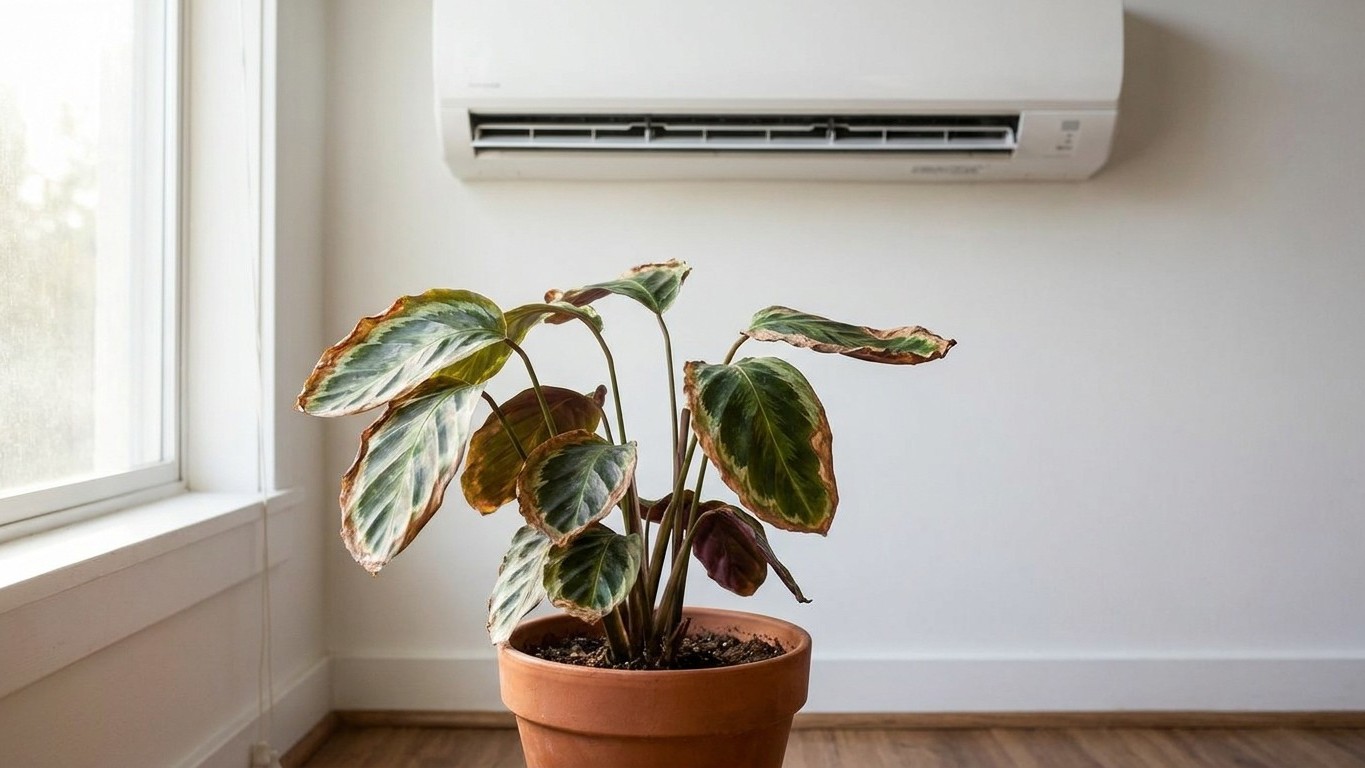
Direct airflow from an air conditioner is one of the fastest ways to turn a healthy calathea into a crispy, brown-edged mess, and four days is honestly enough time to see the damage set in. The plant didn’t get “cool.” It got stressed, dehydrated at the leaf margins, and shocked by a level of dryness it was never built to handle.
Here’s what actually happened in that spot near the split unit. Cold draughts from windows, doors, or air conditioning cause stress that appears as brown tips and edges. But the cold isn’t even the main villain. A/c units often contribute to drier air conditions in the home, so supplemental humidity is necessary. A calathea sitting directly in that stream of air is basically getting blasted with a dehumidifier every time the compressor kicks on.
Key takeaways
- What happens when a tropical rainforest plant meets a dehumidifying machine running 24/7
- Why four days was enough time for every leaf edge to turn brown—and the exact humidity threshold where damage becomes inevitable
- The surprising reason misting won’t save your calathea, and what actually works
Why the AC Was the Worst Possible Spot
Calatheas come from a very specific set of conditions, and moving one under a split system violates almost all of them at once. Calatheas belong to the tropical rainforests of South America, where the air stays thick and moist nearly every day of the year. Down there, humidity rarely drops below 60%, and mist from rain and canopy shade keeps the leaves soft, flexible, and glossy. An air conditioner does the exact opposite of a rainforest canopy: it strips moisture out of the air to cool it, and it does so in a concentrated, directional blast rather than a gentle ambient shift.
The numbers make it clear why four days was plenty of time. Below 50% humidity, consistent crispy edges are almost inevitable. Most homes running air conditioning hard in summer sit well under that threshold, sometimes in the 30s. In indoor environments with air conditioning, brown tips can appear within 2–3 weeks when humidity drops below 40%, a pattern seen consistently across different climate zones. Direct airflow accelerates that timeline dramatically, because the plant isn’t just sitting in dry air, it’s having that dry air actively pushed across its leaf surface, pulling moisture out through the tips and margins faster than the roots can resupply it.
Temperature swings compound the problem. Calathea plants thrive in warm and humid conditions. They prefer temperatures between 65°F to 80°F. Avoid placing them in areas with cold drafts or temperature fluctuations. A split unit doesn’t just cool a room evenly, it creates a localized cold zone right beneath the vent, meaning the plant experiences something closer to a sudden climate shift than a gradual seasonal change. I’ve seen this exact scenario play out with readers who assumed “cooler is better” for a stressed-looking plant, only to watch it decline faster once it was moved into the airflow.
What Brown Edges Are Actually Telling You
Not every brown-tipped calathea is an AC casualty, and it’s worth ruling out the usual suspects before blaming the vent entirely. The most common reason your Calathea’s leaves are turning brown on the edges could be due to your tap water, which contains salts, chlorine, minerals and fluoride, all of which can build up in the soil. If the browning showed up strictly on the side of the plant facing the AC, though, and appeared within days rather than weeks, airflow and humidity loss are almost certainly the trigger, not mineral buildup.
Watering habits matter here too, and they can mask what’s really going on. Those dreaded Calathea crispy leaves and edges, more times than not, are due to inconsistent watering and/or improper watering, not humidity, though high humidity will help. A plant that was watered on a normal schedule but suddenly sitting in a dry air current will show damage that looks identical to underwatering, because functionally, that’s what’s happening. The roots have plenty of moisture; the leaves just can’t hold onto theirs.
One detail people often get wrong: misting doesn’t fix this. Misting the plant will not be enough to keep the humidity up, unfortunately. Spraying water on the leaves once or twice a day does nothing against a machine that’s actively removing moisture from the entire room, and can even invite fungal issues on top of the existing stress. The fix has to change the actual air the plant is living in, not just wet its surface temporarily.
Getting the Plant Back on Track
The first move is obvious but non-negotiable: get the calathea completely out of the airflow path, not just a few inches to the side. Split units throw air in a defined arc, and “nearby” often still means “in the blast zone.” Keep it away from heating vents, air conditioning, and cold drafts by windows, which cause humidity and temperature fluctuations that stress the plant. A spot with bright, indirect light and stable ambient temperature, ideally in a bathroom or kitchen where humidity naturally runs higher, works far better.
From there, rebuild the humidity deliberately rather than hoping for the best. The temperature should be between 65-80°F, and the humidity should be around 50-60%. To maintain the right humidity levels, you can use a humidifier or place a tray of water near your Calathea plant. Grouping it with other plants helps too, since grouping calatheas together helps, as plants naturally release moisture through their leaves, and a cluster of plants creates a small humid zone that benefits all of them. A hygrometer, cheap and easy to find at any hardware store, takes the guesswork out of the equation entirely.
As for the brown edges already there, they’re not coming back. Trim them off with clean scissors, cutting close to the damage but not into healthy green tissue, and treat the incident as a lesson rather than a lost cause. Once the underlying cause is corrected, new growth typically emerges clean within 4–8 weeks, which means the next round of leaves this plant produces should show none of the scarring from its brief, unfortunate stint under the air conditioner.
Sources : edsplantshop.com | agrifarming.in