
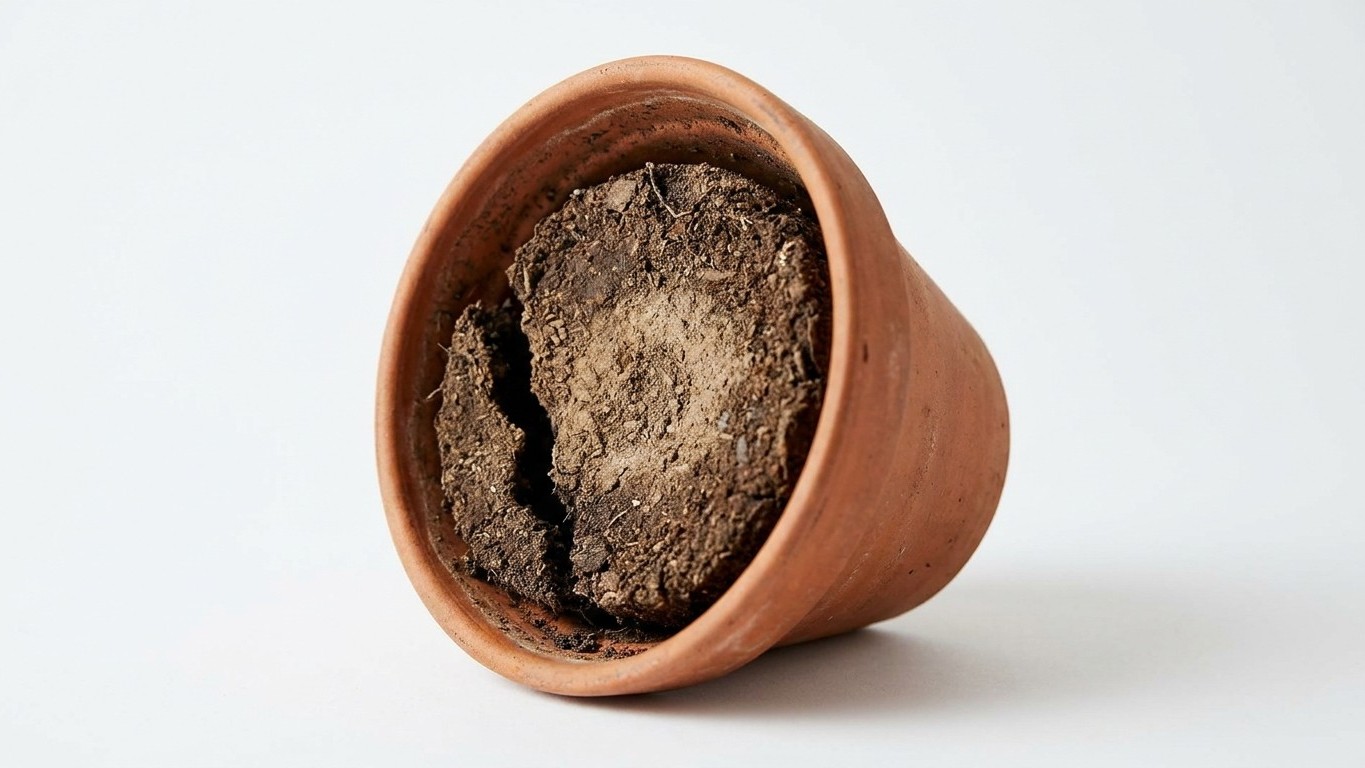
Two summers of watering that seemed to vanish into thin air, and the answer was hiding in plain sight the whole time: a dry, root-choked gap running between the compost and the pot wall, invisible until the moment the whole rootball slid out into a bucket. What looked like a healthy watering routine had actually been pouring straight past the roots and out the drainage holes for months.
Key takeaways
- Peat compost shrinks away from pot walls, creating an invisible channel where water runs straight through without wetting the roots
- Once peat dries past a critical threshold, fatty acids form a waxy coating that repels water—the same chemistry that once made it absorbent now betrays it
- Bottom watering (and a drop of dish soap) can reverse the damage by forcing water back into the compacted, hydrophobic core
The Gap That Was Never Supposed to Be There
That ring of shrinkage around the edge of a pot is one of the most common, and most misunderstood, problems in container gardening. As the organic matter shrinks, a visible gap forms between the soil root ball and the container wall. The compost isn’t just looking a bit tired. It has physically pulled away from its container, leaving a channel that runs from the surface straight down to the drainage holes.
The mechanism behind it comes down to peat’s chemistry. The very structure that allows peat to hold 20 times its weight in water is what makes it so difficult to re-wet, because long-chain fatty acids in the organic matter become concentrated as the soil dries. Once the moisture level drops below a certain threshold, these acids form a paraffin-like coating over the soil particles. Essentially, the material that made peat so prized for retaining moisture is the same one that betrays it once it crosses a critical dryness threshold.
Once that threshold is passed, ordinary watering stops working entirely. Gardeners may see water draining out the bottom of a pot and assume that means that the soil is saturated. But the water might be running between the side of the pot and the hydrophobic root ball instead, barely wetting the outer surface and leaving the center of the root ball dead dry. You’ve done Everything right on the surface. Underneath, the plant has been running on fumes.
Why That Bucket Moment Revealed the Truth
Dropping the whole rootball into a bucket does something a watering can never will: it shows you the full anatomy of the problem from the outside. Lift a pot that’s been silently starved of water and you’ll typically find a compacted, shrunken core surrounded by that telltale gap, dry as chalk despite regular watering. The soil literally shrinks as it dries, pulling away from the pot walls and creating a gap all the way around, and when you water your plant in this state, you’re basically pouring water into a highway system that leads straight to the drainage holes.
Older compost makes the situation worse over time, which explains why a second summer often looks grimmer than the first. Composts that have been in use for more than a year or two also compact and lose structure, making them slower to re-wet even when not severely dried. Two summers of this cycle, dry out, water superficially, dry out again, is enough to leave a pot’s compost permanently altered in structure, even if it never looked obviously dead on top.
The good news: this isn’t a disease, and it isn’t a sign the plant is dying of something exotic. The soil isn’t damaged or diseased. It’s just forgotten how to drink. That reframing matters, because the fix is mechanical, not medicinal.
Getting Water Back Into the Root Zone
Top watering a hydrophobic pot is close to useless once the gap has formed, so the fix has to work from below. The most effective method for re-wetting hydrophobic compost is bottom watering. That means setting the pot in a basin or sink with a few inches of standing water and leaving it there rather than pouring from above and hoping.
Place the pot in a bowl or tray of water and leave it for twenty to thirty minutes. The compost absorbs moisture from the bottom up by capillary action, bypassing the hydrophobic surface layer. You will see the compost darken progressively from the bottom. That darkening is the visual proof the fix is working, watch for it creeping upward through the pot rather than assuming instant success.
For compost that’s crossed deep into bone-dry, waxy territory, plain water sometimes needs a nudge. Dish soap acts as a surfactant that breaks the surface tension of water, allowing it to bypass the waxy coating on dried peat fibers, so the water can “wet” the surface of the soil particles rather than beading up and running off. Use a mild, biodegradable soap and dilute it heavily, usually just a few drops per gallon, to avoid damaging sensitive root systems. A single drop in a full watering can is genuinely enough. This isn’t a scrubbing job, just a chemical assist to get water past that waxy barrier.
Not every growing medium behaves this way, and that’s worth knowing before you swap products in a panic. Composts with a high proportion of bark, perlite, or other free-draining components are less prone to this because those materials do not become hydrophobic in the same way, though they can still dry out unevenly. If a pot has been through two summers of this cycle and the compost still looks compacted and pulls away even after a thorough soak, repotting into fresh mix, ideally with some bark or perlite worked in, is the more sensible long-term move than fighting the same battle a third year running.
One detail that surprises a lot of container gardeners: peat’s water-repelling streak isn’t a manufacturing flaw at all, it’s baked into the raw material itself. Peat moss is naturally water-repellent in its raw, dry state, so manufacturers often add chemical wetting agents to make it usable, but over time, as the soil dries out completely, these agents wash away or break down, and the peat reverts to its natural, waxy state. Which means that first bag of compost was never really “fixed,” just temporarily coated. Two dry summers later, the peat simply went back to being what it always was underneath.
Sources : medium.com | ucanr.edu