
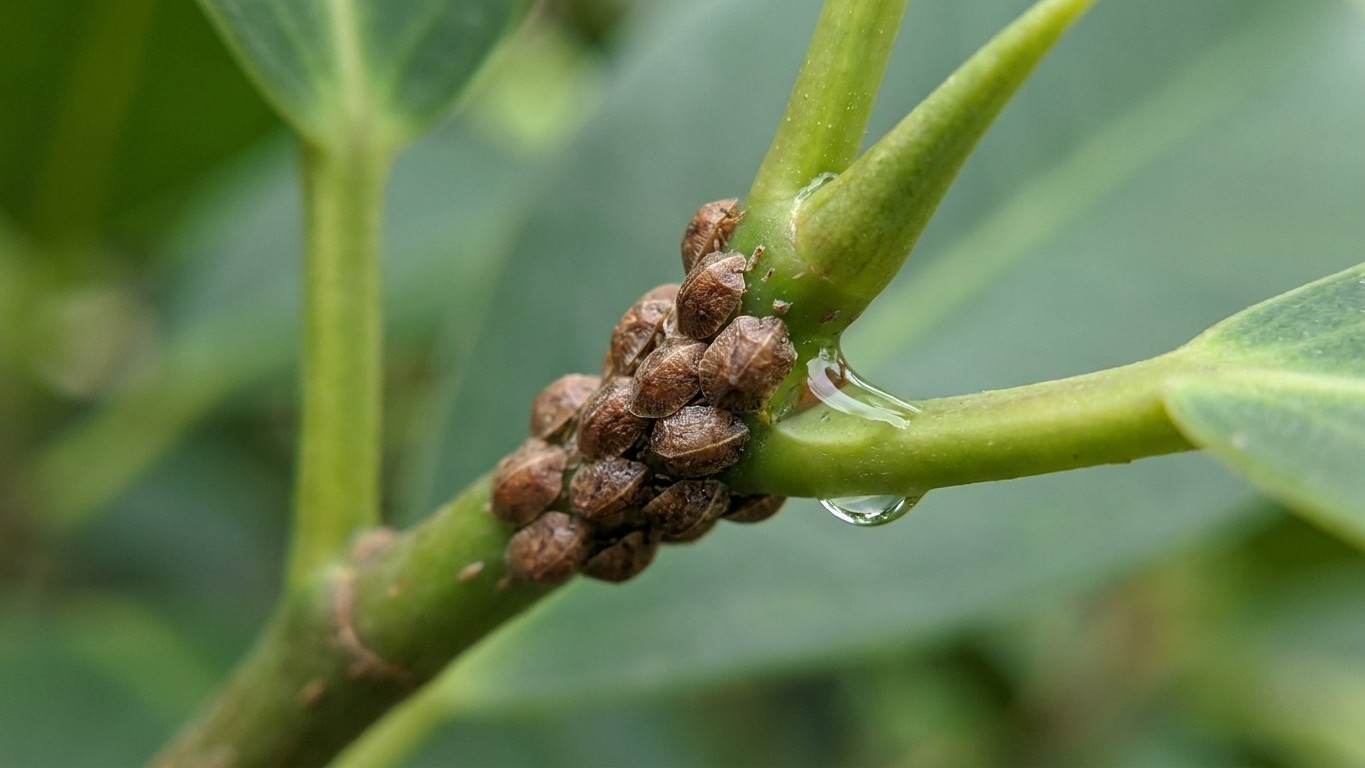
That sticky black residue wasn’t dirt. It was sooty mold, a fungus growing on sugary insect droppings, and its real source was hiding in plain sight at the base of every leaf, in the little pockets where stem meets petiole. Wiping the leaves each week only cleaned the surface. It never touched the colony quietly feeding just out of sight.
Key takeaways
- A sticky black film appears on ficus leaves, but it’s not what you think it is
- The real culprit is hiding where you’d never think to look—in the tiny pockets where leaves meet stems
- Your cleaning routine has been treating the symptom, not the cause, which is why the problem keeps returning
What was actually living in those leaf joints
Look closely at a ficus branch junction with a magnifying glass and you might spot small, oval, brownish bumps that look almost like part of the bark. Brown soft scale is the scale species most commonly found on indoor ficus, and adults look like tiny brown, flat shields fused to stems and the undersides of leaves, easy to dismiss as part of the bark until you notice the sticky honeydew they excrete coating nearby leaves. These insects don’t crawl away and hide. They plant themselves at a feeding site, usually a joint or the underside of a leaf where humidity stays higher and predators rarely check, and stay there for their entire adult life.
The insects themselves aren’t the mess you see. While feeding, soft scale insects excrete a sweet, sticky substance called honeydew, a mixture of undigested sugar and water passed through the insect’s digestive system and deposited onto leaves and stems. That sugary film then becomes the perfect growing medium for airborne fungal spores. Several similar-looking fungus species comprise the group referred to as sooty mold, and they get their name from the black, soot-like coating of fungal growth that appears atop honeydew deposits. the black film is a two-step process: bug first, fungus second. Miss the bug, and the fungus just keeps coming back.
Why weekly wiping never actually fixed anything
Here’s the frustrating part. These fungi are not plant parasites and do not directly cause plant disease, but indirectly, they can stress or stunt plants by blocking light from the leaves, interfering with photosynthesis, resulting in slowed growth or premature leaf shed. So a weekly wipe-down might have kept the plant looking presentable and protected some photosynthesis, but it did nothing about the insects tucked into the leaf joints, quietly reproducing. Sticky residue without treating the pests will recur as long as the insects are feeding.
Scale insects are frustratingly easy to overlook precisely because they don’t move once settled. They present as immobile or slow-moving bodies or coverings roughly 1/25 to 1/4 inch long that lack an obvious head or appendages and don’t resemble most other insects. That’s exactly why leaf joints are the giveaway spot to check, not the flat leaf surface everyone reaches for with a cloth. If a plant has sticky leaves, check it carefully for these pests, particularly on the undersides of leaves and in stem junctions where sap-suckers congregate. A weekly cleaning ritual, however well-intentioned, was essentially mopping the floor under a leaking pipe instead of fixing the pipe.
Breaking the cycle instead of managing the symptom
Treating scale starts with physical removal, and it’s more satisfying than it sounds. Many indoor gardeners report success simply scrubbing colonies off with a soft brush or cotton swab dipped in diluted rubbing alcohol, focusing specifically on those leaf joints and the undersides of older leaves where colonies concentrate. Rinsing leaves with a strong spray of water helps remove honeydew and loose mold, and washing leaves with a mild soap-and-water solution removes existing mold from houseplants. That’s cleanup, though, not treatment. The insects causing the problem need direct attention.
Horticultural oil and neem oil remain the go-to organic options because they smother scale on contact, but timing Matters More Than most people realize. Insecticidal soap or horticultural oil target the scale insects directly, and treatments should be applied in the early morning or evening when the sun isn’t intense to prevent damage to the plant’s leaves. For persistent infestations, systemic products offer a different approach entirely. Systemic insecticides are sprayed onto the plant or applied to its roots, the plant absorbs the insecticide into its tissue and it gets into the plant’s circulatory system and into the sap, and when the scale feed on the sap, they ingest the toxic insecticide and are killed. That mechanism explains why systemics often outperform contact sprays against scale hiding deep in joints and crevices that a cotton swab can’t fully reach.
Patience matters here, maybe more than with any other houseplant pest. The sooty mold won’t quickly disappear even once the scale has been controlled, but as the food supply is exhausted the mold will eventually weather off, and oil sprays help speed the process. Expect several weeks of visible grime even after the insects are gone. It’s also worth improving the growing conditions that let scale settle in the first place. Poor air circulation and high humidity levels create an ideal environment for scale insects to thrive, since stagnant air leads to the accumulation of moisture around the plant’s leaves and stems, creating a humid microclimate that scale insects love. A small fan running nearby, or simply more breathing room between plants on a crowded windowsill, makes that microclimate far less hospitable.
One detail surprises most people once they finally understand what’s been happening: the new leaves that grow in after the infestation clears come out completely clean. New growth produced after the infestation is cleared will be clean. Which means the fastest way to judge whether treatment actually worked isn’t checking the old, scarred leaves. It’s watching what the plant produces next.
Sources : bloomingexpert.com | howorchidsrebloom.com