
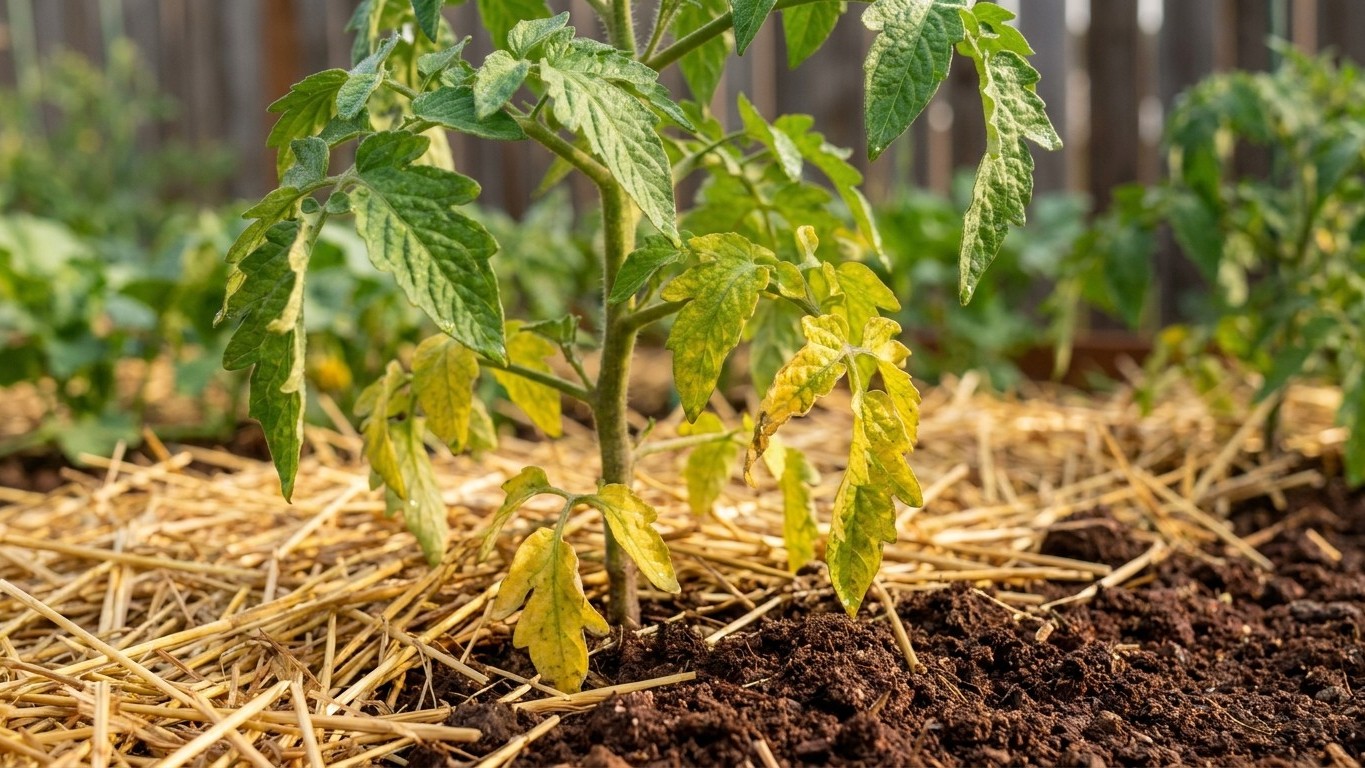
Fresh wheat straw has a carbon-to-nitrogen ratio somewhere around 75:1, sometimes higher depending on how it was cut and stored. Soil microbes need roughly 24 parts carbon to 1 part nitrogen to feed themselves comfortably. When you dump a thick layer of straw that’s nowhere close to that ratio, the bacteria and fungi tasked with breaking it down start scavenging nitrogen from wherever they can find it. That includes the soil right under your tomato plants.
Three weeks. That’s roughly the window it takes for a fresh straw layer to kick decomposition into high gear, and it lines up almost exactly with when gardeners start noticing the bottom leaves turning a pale, sickly yellow. It’s not a coincidence. It’s chemistry playing out in real time under a layer of stalks you thought were just there to keep moisture in.
Key takeaways
- Fresh straw has a carbon-to-nitrogen ratio so high it triggers a microbial feeding frenzy that starves your tomatoes
- Yellow lower leaves appear in a predictable three-week window—and there’s a scientific reason it happens exactly then
- The fix isn’t removing the mulch; it’s a simple nitrogen budget that lets straw do its job without sabotaging your harvest
Why Microbes Outcompete Your Plants for Nitrogen
The process has a name: nitrogen immobilization. Straw has a C:N ratio of roughly 75:1, and adding this directly onto the surface of soil causes nitrogen drawdown at that mulch-soil interface. Microorganisms decomposing the straw are essentially eating a carbon-rich meal that’s short on protein, so they pull nitrogen from the surrounding soil to balance their diet. That nitrogen becomes temporarily locked inside microbial bodies instead of being available for root uptake.
Tomatoes are particularly vocal about this shortage. Nitrogen is mobile within a plant, so when supply runs low, the plant cannibalizes older leaves first, moving whatever nitrogen it can salvage up toward new growth. That’s why the yellowing shows up on the bottom leaves before anywhere else. It’s a survival strategy, not random damage.
Research on straw mulch backs this up directly. Straw can immobilize nitrogen in the soil, preventing tomato plants from getting the nitrogen they need, which can increase the incidence of early blight and reduce tomato yield. Nitrogen can be applied to overcome the effect of nitrogen immobilization by the straw. That last point matters: this isn’t a reason to abandon straw mulch, it’s a reason to compensate for it.
Field trials on other straw-mulched crops show the same pattern at a microbial level. The carbon-to-nitrogen ratio of organic inputs like straw regulates microbial activity, and wheat straw could minimize soil nitrogen leaching and runoff potential while boosting nitrogen immobilization, with fixation primarily caused by fungi when the straw decomposes. The effect is strongest right where straw touches soil, which happens to be exactly where a tomato’s shallow feeder roots are working.
The Fix Is Simpler Than the Diagnosis
You don’t need to rip out the mulch. The straw is still doing its job on moisture retention and disease suppression, it just needs a nitrogen budget to work with. A quick top-dress of blood meal, composted manure, or a balanced granular fertilizer scratched into the soil surface before or right after mulching gives the decomposing microbes something to chew on that isn’t stolen from your tomato roots.
One gardener on a well-known gardening forum described handling the same tradeoff by planting with a bit of bloodmeal worked in first. I plant all my plants with a bit of bloodmeal, so that will help counter any nitrogen loss that may happen in a decomposition process. Composted manure works the same way, and it has the bonus of already being partially broken down, so it releases nitrogen faster than raw straw ever demands it.
Timing also Matters More Than most people realize. Laying straw down at planting time, before the tomato has built any real root mass, is riskier than adding it once plants are established and fruiting has started. By that stage, roots have already spread wide enough to pull nitrogen from soil zones the straw hasn’t reached yet.
An alternative some growers use: layer compost or aged manure directly on the soil first, then put the straw on top as a second layer. A layer of straw mulch could be placed on top of a nitrogen-rich compost, so the lower ratio of the compost provides nitrogen for decomposition and prevents tie-up of soil nitrogen, leaving more plant-available. It’s a small sequencing change, but it essentially feeds the decomposers before they get hungry enough to raid your plant’s supply.
What the Yellowing Actually Tells You (and What It Doesn’t)
Not every case of lower-leaf yellowing traces back to straw. Overwatering, magnesium deficiency, and simple old-leaf senescence as a tomato plant redirects energy toward fruit all produce similar symptoms. The straw-related version tends to show up in a fairly even band across the whole plant’s lower leaves within two to four weeks of a fresh, thick application, rather than as isolated spots or a single stem.
If you catch it early, a foliar feed with a nitrogen-rich fertilizer gives faster relief than soil amendments, since it bypasses the microbial competition entirely and gets absorbed straight through the leaf surface. It’s a stopgap, not a permanent fix, but it buys time while the slower soil-based nitrogen boost takes effect.
Straw’s C:N ratio does drop as it breaks down further into the season, meaning the nitrogen drawdown is temporary rather than a permanent tax on your soil. By the time a tomato plant is deep into fruit production, most gardeners find the same straw that yellowed their lower leaves in June is quietly composting into a nutrient source by August, which is a fairly satisfying twist for a mulch that started out looking like the problem.
Sources : doi.org | ncbi.nlm.nih.gov