
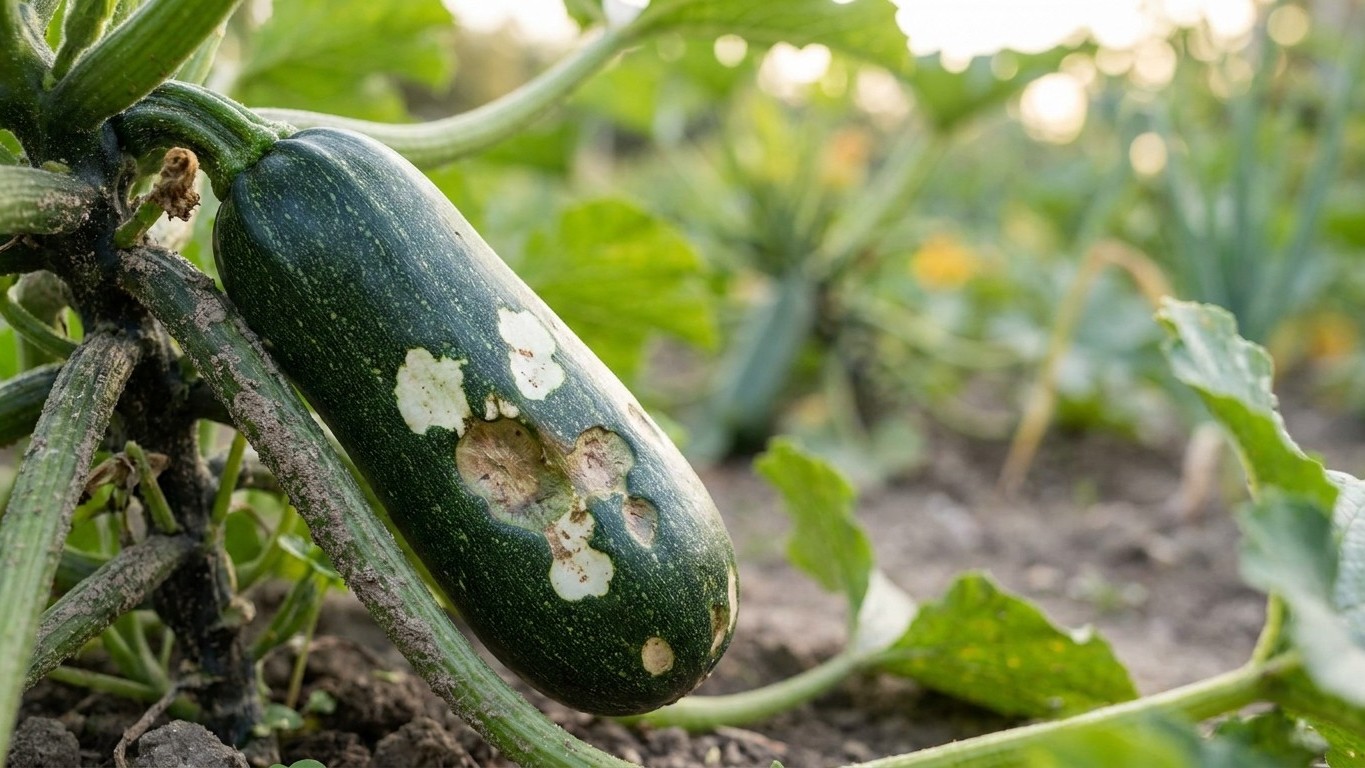
Two weeks. That’s how long it took for my zucchini plant to show me exactly What Happens When You strip away its natural sunshade. In early August, convinced that trimming the oversized leaves would let more light reach the developing fruit and speed up growth, I cut. What I found afterward wasn’t faster-growing zucchini. It was bleached, sunken patches on every squash that had been sitting in direct light, skin gone soft and slightly wrinkled, like a bruise spreading under a too-thin peel.
What I’d triggered has a name: sunscald. Sunscald generally occurs when any plant part developing in lower light is suddenly exposed to higher light levels. Had that plant part always been exposed to full sun, chances are it would not have developed sunscald. My zucchini fruit had been growing quietly under a canopy of broad leaves, protected from direct radiation the way skin under a shirt sleeve stays pale all summer. Removing that cover didn’t toughen the fruit up. It just left it defenseless.
Key takeaways
- A well-meaning pruning decision triggered immediate, irreversible damage to developing fruit
- The science behind plant sunscald mimics human sunburn in surprising ways
- Commercial growers guard against this exact mistake—and here’s how home gardeners can too
The skin comparison that finally made sense
The explanation that stuck with me came from a horticulture extension note, and it’s disarmingly simple. The condition for plants is similar to what our skin experiences. If our skin is gradually exposed to increasing sun light, it adjusts. However, if it is suddenly exposed to bright sun for even a relatively short period, it will burn. That’s precisely what happened in my garden. Fruit that had never known direct sun got thrown into full exposure overnight, with none of the gradual conditioning that might have let it cope.
Extension pathologists actually distinguish between two related problems. There’s the classic sunscald that shows up after prolonged heat, and there’s what some call photooxidative sunscald, which strikes fast and hard. Photooxidative sunscald occurs when shaded fruit suddenly gets exposed to sunlight. This damage can occur at much lower temperatures and is typically a result of intense sudden light exposure. Since my leaf-cutting was a deliberate, sudden move rather than a gradual thinning, I’d essentially manufactured the exact conditions that cause the fast-onset version. No heat wave required. Just scissors and bad timing.
The visual damage matched the textbook description almost point for point. Photooxidative sunscald damage results in large areas of fruit that appear bleached and are completely white in color. These bleached areas will often appear sunken, and outer tissue may be soft. It may wrinkle and develop secondary decay. Within days, a couple of my affected zucchini started showing faint gray fuzz at the edges of the bleached patches, a clear sign that decay organisms had moved in on the weakened tissue.
Why zucchini and its cousins are particularly exposed
Summer squash isn’t the plant you’d expect to worry about here. Tomatoes and peppers get most of the attention when gardeners talk sunscald. But while tomatoes and peppers are most vulnerable to sun scald, zucchini, cucumbers, eggplants, squash, and pumpkins can also be at risk. And ironically, one of the biggest culprits isn’t weather at all, it’s us. Extension researchers specifically flag harvest habits in this crop family. Another step in reducing sunscald is training workers on proper harvesting techniques. This is especially true in crops like summer squash, zucchini and peppers. The highest sunscald incidence for these crops often occurs after harvest. If workers are not careful when they harvest summer squash and zucchini, they can cut leaves when they cut fruit from the plant, exposing remaining fruit. the damage I caused on purpose is the same mistake commercial growers guard against constantly, just done more carelessly with a pair of kitchen shears instead of a harvest knife.
Weather can do the same thing without any human involvement. One extension writer described watching it happen in her own patch after a rough stretch of wind. The intense winds and some careless harvesting in the first week of August shifted and damaged the foliage that was previously covering my zucchini flowers and fruit, and the developing fruit that were newly exposed to the sun all suffered damage and are now rotting. Storms, careless staking, even an aggressive round of pruning for airflow can all set off the same chain reaction I started with my own hands.
What actually protects the fruit
The fix isn’t more intervention. It’s less. Extension guidance across multiple states converges on the same basic principle: leave the leaves alone unless they’re diseased or truly blocking harvest access. Be careful when pruning, staking and tying. Removing foliage that is covering fruits can expose them to intense light they aren’t used to. That canopy isn’t just cosmetic. It’s doing active work, both feeding the plant through photosynthesis and casting the shade that keeps developing fruit at a survivable temperature.
A few habits make the difference between a productive zucchini patch and a scarred one. Keep the plant well watered, especially through hot, windy stretches, since adequate water to your plants is critical, especially on extremely hot, windy days, and maintaining plant vigor also increases foliage that shades fruit, reducing light exposure and temperature of the fruit itself. When you do harvest, cut only the stem of the fruit you’re taking, never the surrounding leaves. And if disease like powdery mildew starts thinning the canopy from the inside, treat it early rather than letting it strip protection away on its own schedule.
Once the bleaching appears, there’s no undoing it. Extension sources are blunt about that. Once damage occurs, it cannot be reversed. The softened, sunken skin on my affected zucchini never firmed back up; within a few more days the spots turned mushy and I pulled the worst ones off the vine entirely. But the plant itself recovered fine once I stopped touching it. New leaves filled back in within about two weeks, and the squash that grew after that, still shaded properly this time, came out with skin as smooth and green as anything I’d grown before the whole misguided experiment.
Sources : gardeningknowhow.com | northerngardener.org