
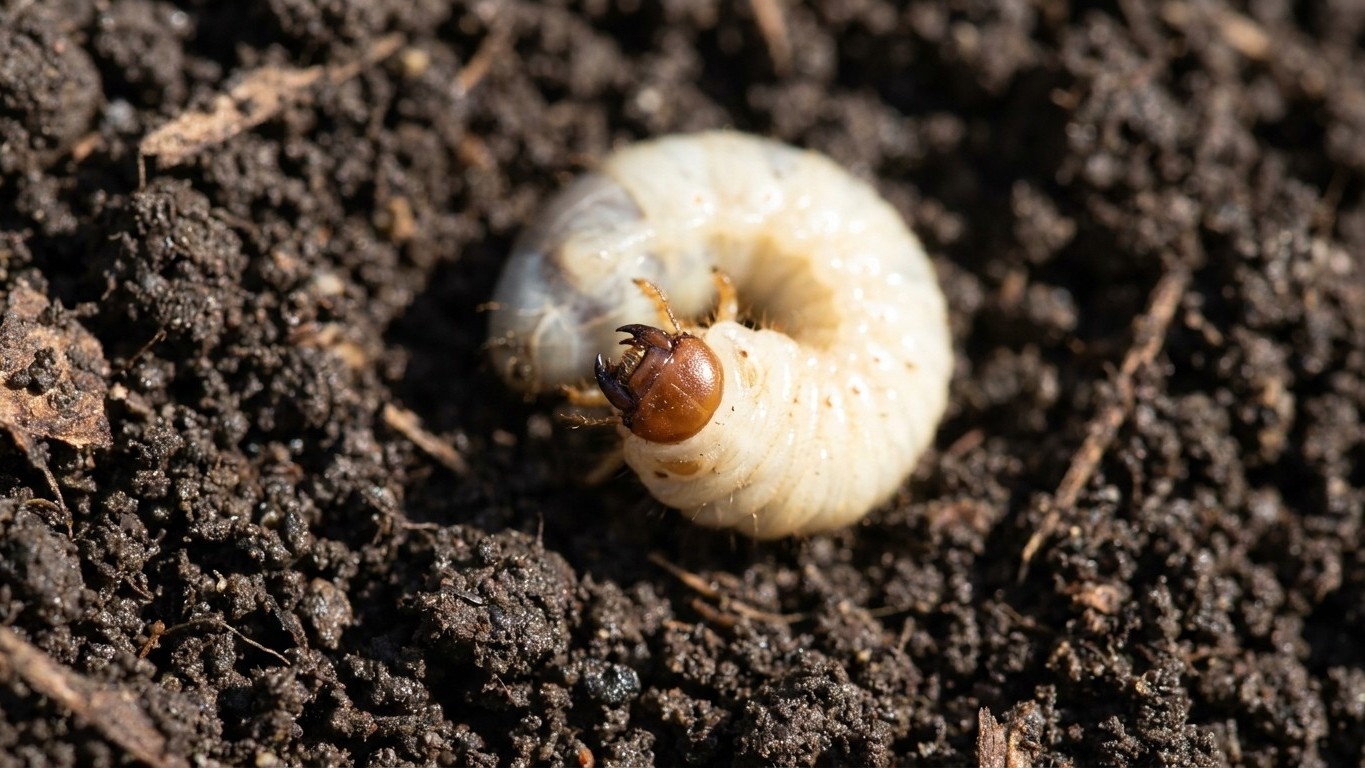
Every summer, gardeners turning their compost pile unearth the same unsettling sight: fat, pale grubs curled into tight C-shapes, squirming when the pitchfork disturbs their nest. The instinct is to squash them on sight. That instinct is often wrong, and the fix takes about three seconds: flip the grub over and look at its head.
Not every white grub in a compost heap is a threat to your garden. Some are the exact opposite: quiet allies that spend their entire larval life breaking down rotting leaves and kitchen scraps into the crumbly, nutrient-rich compost you’ll spread on your beds next spring. The trouble is that the harmless ones look almost identical to the ones that will chew through your lawn’s root system by October. Telling them apart isn’t guesswork. It comes down to a handful of physical details, starting right at the head capsule.
Key takeaways
- A hidden detail on the grub’s head determines whether it’s your compost’s best friend or your lawn’s worst enemy
- The movement test—a simple 30-second observation—almost always reveals the truth about which grubs to keep
- One wrong decision in August could mean thousands of root-eating pests hatching in your beds by October
Why compost bins fill up with grubs in August
Late summer is peak season for this discovery, and there’s a biological reason for it. Grubs can be found at many times during the growing season, however the important window for making accurate assessments of most grub populations spans August through October, depending on conditions. Adult beetles, whether chafers, June bugs, or rhinoceros beetles, lay their eggs through late spring and early summer. By August those eggs have hatched, and the larvae are actively feeding and growing, which means they’re at their largest, most visible, and most alarming-looking stage.
A compost heap is an especially attractive nursery. It’s warm from decomposition, loose enough to burrow through, and packed with the one thing certain species need most: dead organic matter. The larvae of the rhinoceros beetle, which are more commonly found in compost piles, feed exclusively on dead organic matter and thus help to convert garden waste. That’s not a coincidence. Females of several beneficial beetle species actively seek out compost heaps to lay eggs precisely because the larvae have zero interest in living roots.
The head detail that separates friend from foe
Here’s where it gets specific. Pest species that damage lawns and garden beds, like the common cockchafer (also called the May bug or Maybug), tend to have a disproportionately large, hardened head equipped with visibly strong mandibles. The larvae have a whitish curved body, large head, with strong mandibles and long, hairy, well developed yellow legs. Those oversized jaws exist for a reason: this grub spends years underground gnawing through living root systems, and it needs the hardware to do it.
Compare that to the beneficial decomposers. The flower chafer grub is white with a greyish shade, its front part a bit slimmer than its rear part, stretching three pairs of small legs at chest height. The head on these grubs looks almost too small for the body, and the legs are noticeably stubby rather than long and grasping. That mismatch, a small head with short legs versus a large head with long legs, is the fastest visual cue you have in the field, no magnifying glass required.
Size matters too, but in a different way than you’d expect. A grub that seems abnormally short-legged and thick-bodied for its length is more likely harmless. The larvae of the flower chafer and rhinoceros beetles are beneficial organisms, and the rhinoceros beetle is the largest representative of the scarab beetle family, growing between 2.5 and 4 cm in size. Bigger, in this specific case, doesn’t mean more dangerous. It often means you’ve found one of the good ones.
A second test: watch how it moves
If the head isn’t conclusive enough on its own, set the grub on a flat, hard surface for a few seconds. This single behavioral tell is more reliable than appearance alone. Based on the way the grubs move, they can also be distinguished from the useful grubs of the flower chafer and rhinoceros beetles, which stretch out and crawl away on their backs. One longtime compost-watcher in the UK put it plainly after years of observing these larvae up close: they “unroll, turn on their backs and start a back stroke,” a motion sometimes nicknamed the “crawly back.”
Pest grubs don’t do this. They stay belly-down and drag themselves forward using their legs, a slower, more labored crawl. As one longtime observer of both types noted, the destructive diggers are “bigger-headed and longer-legged, grubs to be found while digging, and never in the compost,” and they move away as if dragging weight behind them, a very different motion from the backstroke. If you’re still unsure after checking the head, thirty seconds of watching the grub crawl will usually settle it.
What to actually do once you’ve identified them
If the grub has the small-head, short-leg profile and flips onto its back to crawl, leave it alone. It’s earning its keep, aerating your pile and speeding up decomposition. Grubs break down organic matter in compost, making it easier for microorganisms to continue the process of decomposition and release of nutrients, and grub activity makes the process of composting much faster since they make the mechanical breakdown easier. Squashing these is worse than pointless. It’s actively working against the compost you’re trying to build.
If instead you’re looking at a large-headed grub with long, developed legs, the calculation changes, but only slightly. In the compost bin itself, even these grubs usually aren’t a problem. There is no need to control the white grubs in your compost pile because of damage they might do, reports the University of Arizona Cooperative Extension Service. The real risk comes later, when you spread that finished compost onto lawns or garden beds. In your garden, if you spread compost full of grubs into your garden beds, they will hatch and eat the roots of your living vegetables and lawns. The fix isn’t chemical warfare. Sift the finished compost before spreading it, pick out anything with that oversized head and long-legged crawl, and either relocate it far from your beds or, if you keep chickens, hand it over as a protein snack. They’ll consider it a treat, and you’ll have solved the problem without a drop of pesticide.
Sources : horticulture.co.uk | reencle.co