
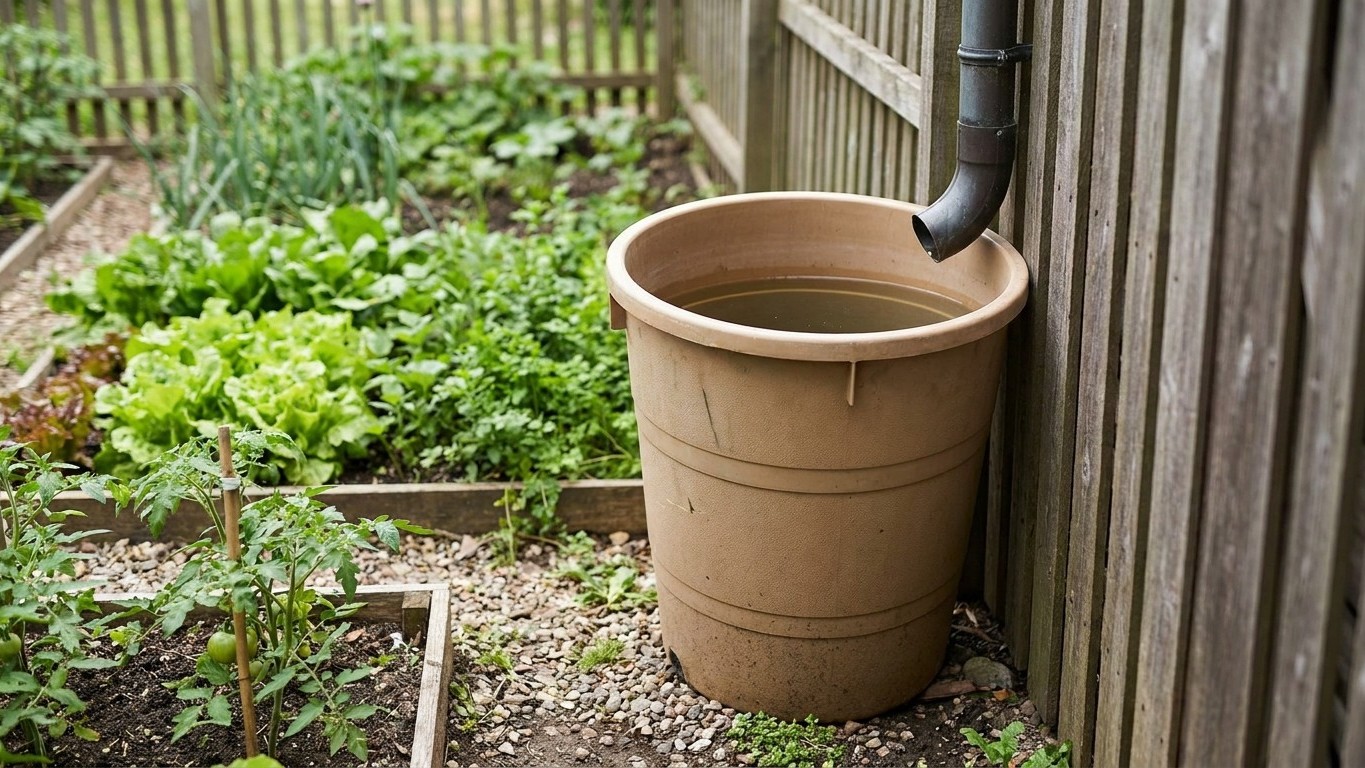
A single 300-liter butt sounds generous until you do the math on what a vegetable bed actually drinks. That barrel holds roughly 79 gallons, and after one good downpour it can go from bone dry to overflowing in the time it takes to make a cup of tea. The surprise isn’t how fast it fills. It’s how fast a thirsty raised bed can drain it right back down to nothing.
Key takeaways
- One good rainstorm fills a 300L barrel—but what happens in the first week of watering?
- The numbers reveal why most gardeners underestimate how thirsty their vegetable beds really are
- Single-barrel systems are a starting point, not a solution—here’s what actually works
Why a Single Storm Fills the Barrel So Quickly
Roofs are far better rainwater collectors than most people give them credit for. Just a half inch of rain falling on a 1,000-square-foot roof will yield 300 gallons of water. Scale that down to an average garage or shed roof feeding a single downpipe, and you’re still talking about a serious volume moving through that gutter in minutes. The standard conversion gardeners use is that 1 inch of rain on 1 square foot gives 0.623 gallons, which is why even a modest roof section can dump 60 or 70 gallons into a butt during a single proper shower.
That’s the part that feels almost magical the first time you watch it happen: a barrel that took weeks to fill from a hose in dribs and drabs suddenly tops out and starts overflowing the diverter before the rain has even stopped. It’s tempting to think you’ve solved your watering problem for the season. You haven’t. You’ve just discovered how much water your roof can catch, not how much your vegetables actually need.
The Math Nobody Mentions Before You Empty It by Saturday
Here’s where the numbers stop being impressive and start being sobering. For vegetables in the summer, the recommendation is applying about 1 inch of water over the surface area of the garden bed per week, equivalent to 0.623 gallons per square foot, so a 32 sq ft bed requires 20 gallons of water per week. That’s just one standard raised bed, sized like a typical 4-by-8 frame. Scale up to something closer to an allotment-style plot, and that adds up to about two-thirds of a gallon per square foot of garden space, meaning a 10×10 garden needs around 66 gallons per week.
Suddenly a 79-gallon barrel that felt like abundance after the rain looks a lot smaller. One week of watering a decent-sized vegetable patch can burn through nearly the entire tank, and that’s assuming mild weather. Push the temperature into the 90s, and demand climbs fast. Water needs increase significantly during hot weather (90 degrees and above), windy conditions, and the fruiting stage for tomatoes, peppers, and squash. Some extension guidance pushes the summer target even higher: most commonly grown vegetables require 1 to 2 inches of water per week and many are sensitive to over-, under-, or irregular irrigation. Double the inches, and you’ve roughly doubled the gallons your barrel needs to supply.
Add in the fact that raised beds are notoriously leaky by design. Their sides drain faster than open ground, so during a heat spell you’re not watering once a week, you’re watering every two or three days, and each pass takes another meaningful bite out of the barrel. A single storm might refill 79 gallons in an afternoon, but if your bed is drinking 20 to 40 gallons every few days through July, the math simply doesn’t balance without either more storage or more rain than most regions reliably deliver.
Getting More Out of the Water You’ve Already Caught
None of this means a rain butt is a waste of money. It means one barrel is a starting point, not a finished system. A few adjustments make a real difference in how far that water stretches:
- Add a second or third barrel linked in series off the same downpipe, since storage tanks made of plastic or concrete can hold hundreds or even thousands of gallons, or you can start smaller with a barrel typically holding 40 to 80 gallons and simply add more of them.
- Mulch heavily around the vegetables, since mulching significantly reduces this need by cutting down evaporation from bare soil.
- Water deeply and less often rather than a light daily sprinkle, since vegetable gardens need 1 to 2 inches of water per week either from rainfall or the garden hose, and it doesn’t need to be watered all at once.
Checking soil moisture before reaching for the hose or the barrel tap also stops you wasting stored water on a bed that doesn’t need it yet. A simple finger test tells you more than a fixed schedule ever will, and it means the gallons you did manage to catch during that one good storm get spent on the days that actually matter, not on a routine that ignores what the soil is already holding.
What This Means Before You Add a Second Butt
The real lesson isn’t that rainwater harvesting fails. It’s that a single 300-liter tank was never sized to carry a full vegetable bed through a dry stretch on its own. Think of it less as a reservoir and more as a top-up buffer that catches free water during wet weeks so you’re pulling less from the tap during dry ones. Pair it with a second barrel, a rain gauge to track what’s actually landing on the bed, and a layer of mulch, and that same downpipe setup starts covering far more of the season than it did on its own. The barrel isn’t the problem. Expecting one of them to do the work of three is.
Sources : wilkes.ces.ncsu.edu | lawnlove.com