
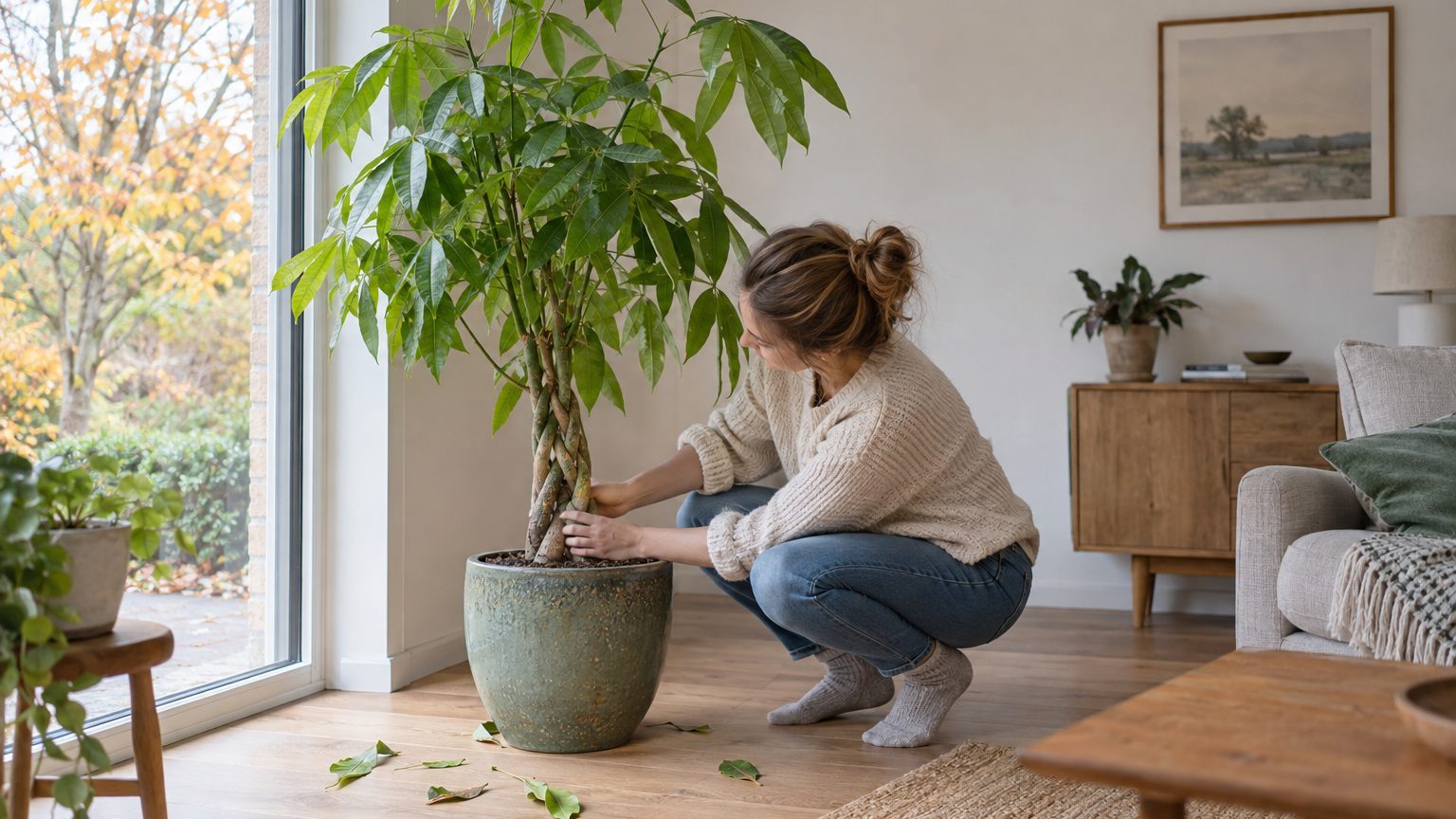
A money tree (Pachira aquatica) that sheds leaves is sending a message, and the pattern of the drop Tells You Which one. Yellow leaves that go soft point to the roots, a bare lower stem with stretched growth points to the window, and green leaves that fall overnight point to a draught or a sudden temperature swing.
Get the diagnosis wrong and the fix can finish the plant off. Watering a cold-stressed tree more, for instance, is the fastest route to rot.
- Yellow, soft leaves usually point to overwatering and root trouble.
- A bare lower stem with stretched growth signals too little light.
- Green leaves dropping overnight, on one side of the plant, point to cold draughts.
Overwatering: the usual suspect
Most dying money trees are drowning. Pachira stores water in its swollen, braided trunk, a trait it developed in the seasonally flooded wetlands of Central and South America, yet indoors in a pot with limited drainage, that storage becomes a liability.
The signs show up in a recognizable order. Leaves turn yellow, often starting in the middle of the canopy, then feel limp rather than crisp before they fall. The soil stays dark and damp a week after watering, and sometimes a sour, swampy smell rises from the pot.
Check the trunk base. Press it gently with a thumb. Firm means healthy; a squishy or darkened patch near the soil line means rot has started.
Slide the plant out of its pot if you suspect the worst. Healthy roots are pale tan to white and smell like earth, while rotted ones are brown or black, mushy, and shed their outer skin when pinched. Cut away everything soft with clean shears, let the root ball dry for a few hours, and repot in a fresh, gritty mix (roughly one part perlite or coarse sand to two parts potting soil works well) in a pot with a drainage hole.
Then wait. Do not water again until the top two inches of soil are dry.
A good rule for ongoing care: water thoroughly, let the excess drain, and let the upper half of the soil dry before the next round. In a bright room that is often every two weeks, and in winter it can stretch to three or four. Decorative cachepots are a quiet culprit here, since water pools in the bottom unseen for weeks.
Low light: slow, steady, and easy to miss
Light problems unfold over months, not days. A money tree in a dim corner will keep a few leaves for a long time, which is exactly why owners overlook the issue until the plant looks like a bare stick with a tuft on top.
Look at the growth. Long gaps between leaves, new shoots leaning hard toward the window, and smaller, paler foliage all mean the plant is stretching for light it can’t find. Older, lower leaves yellow and drop one at a time because the plant is abandoning what it can’t afford to feed.
The soil gives it away. If the leaves are yellowing but the mix dries out quickly and the roots look fine, light is the more likely cause. A plant in poor light also drinks far less, so a watering schedule that worked in July can quietly turn into overwatering by November.
Pachira does best in bright, indirect light, such as a spot a few feet from an east or south-facing window, or right beside a west-facing one with a sheer curtain. Direct afternoon sun, however, scorches the leaves, leaving tan, papery patches rather than a clean yellow fade. Rotate the pot a quarter turn each week so the braided trunk grows evenly instead of leaning.
If your home is simply dark, a full-spectrum LED grow bulb on a timer for 10 to 12 hours a day is a cheap fix. Move the plant gradually, though. Going from a gloomy hallway straight to a sunny sill can cause its own leaf drop.
Cold draughts and sudden changes
This one is the most dramatic. A money tree can look perfect on Monday and be shedding green, apparently healthy leaves by Thursday.
The plant is tropical and its comfort zone sits roughly between 60 and 85°F. Below about 50°F it begins to suffer, and a blast from a drafty window, an exterior door, or an air-conditioning vent can trigger the same reaction at higher temperatures. Heating vents do the reverse damage, drying the air and crisping leaf edges.
The giveaway is the leaf condition. Cold-stressed leaves often drop while still green, or turn dark and blotchy with a water-soaked look, and the damage tends to hit the side of the plant facing the draught. Overwatering rarely produces such a lopsided pattern.
Relocation is also a cause. Plants bought at a garden center, then carried home through a chilly parking lot, frequently drop a handful of leaves within two weeks. That is acclimation shock, not disease, and it usually settles once the plant sits in a stable spot.
Walk the room with the back of your hand and feel for moving air around the pot. Move it at least three feet from vents, radiators, and single-pane glass. In winter, pull it back from the window at night, because the gap between the glass and the room can be 10 degrees colder than the thermostat reading.
Saving the trunk and reading the clues together
Real life rarely hands you one clean cause. A plant in a dim, cool corner that gets watered on a calendar suffers all three at once, and that combination is the classic recipe for trunk rot.
So triage in this order: trunk firmness first, roots second, environment third. A firm trunk means the plant can recover from nearly anything, even if it loses half its leaves. A soft one calls for immediate action, which means unpotting, trimming rot, and, if the damage is partial, cutting back to healthy tissue.
Once the cause is fixed, resist the urge to fuss. Skip fertilizer until you see new growth, since feeding a stressed plant burns damaged roots. Remove fallen leaves from the soil surface so mold doesn’t take hold, and leave the remaining foliage alone unless it is fully yellow.
Patience is the hard part. A recovering money tree often takes four to eight weeks to push out fresh leaves, usually from the top of the braid or from nodes along the trunk. Pachira is forgiving that way, and even a bare trunk with a firm, green-tinged core can leaf out again by spring.
One last detail for the skeptics: the braided trunk is not a single stem but usually three to five young plants woven together. If one strand rots, you can often cut it out and the others carry on, so a partial loss isn’t necessarily a total one.