
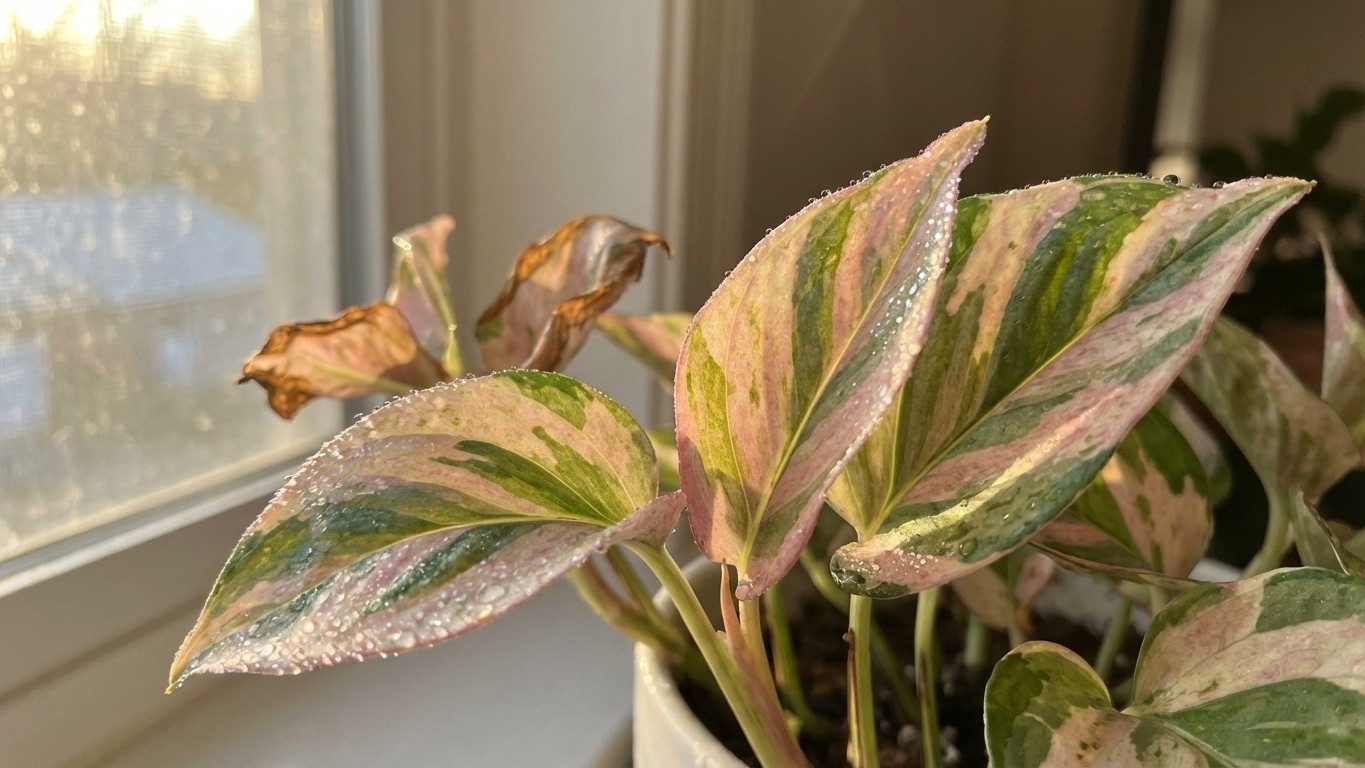
The leaves were turning brown at the edges, the vibrant pink stripes were fading to a sickly yellow, and my prized variegated pothos was clearly on its last legs. Three months of careful watering, perfect placement by the east window, premium potting soil—and still, decline.
I was ready to accept defeat. Then I noticed something odd while photographing what I thought would be its final portrait: tiny water droplets clinging to the leaf surfaces, almost like morning dew. But it was 2 PM on a Tuesday, nowhere near morning.
Those droplets changed everything I thought I knew about my plant’s condition.
Key takeaways
- Those water droplets on your plant’s leaves might mean the opposite of what you think
- Variegated plants have a hidden vulnerability that makes them look worse before they look better
- The brown edges driving you crazy could just be your plant telling you something surprisingly positive
When Plants Cry Happy Tears
What I was witnessing wasn’t plant distress—it was guttation, a process where plants literally weep excess moisture through specialized pores called hydathodes. Think of it as your plant’s way of releasing pressure when it’s actually thriving, not dying.
Healthy, well-hydrated plants often exhibit guttation during periods of high humidity or after thorough watering. The root system is working so efficiently that it’s pushing more water up through the plant than the leaves can transpire. Result? Those mysterious droplets that initially had me panicking.
The irony hit me hard. My variegated beauty wasn’t gasping for life—it was so robust that it needed to release excess water. Those brown edges I’d been obsessing over? Classic signs of inconsistent watering, not terminal illness.
The Variegated Plant Paradox
Variegated plants are living contradictions. Their stunning white, cream, or yellow patches make them Instagram darlings, but those same patches create their greatest vulnerability. Unlike their solid-green cousins, variegated plants have reduced chlorophyll in their light-colored sections.
Less chlorophyll means less photosynthesis. Less photosynthesis means they need more strategic care to maintain their health. The plant world’s equivalent of a high-maintenance friend who’s absolutely worth the effort.
My pothos was actually adapting beautifully to its environment. The slight yellowing I’d interpreted as decline? Natural aging of older leaves as the plant redirected energy to new growth. The brown edges? A gentle reminder that my watering schedule needed fine-tuning, not a death sentence.
Professional growers know this secret: variegated plants often look their worst right before they look their best. New growth emerges with more vivid patterns, older leaves fade gracefully, and the overall plant Becomes more stunning with time.
Reading the Real Warning Signs
Distinguishing between normal plant behavior and genuine distress requires understanding your plant’s language. Guttation droplets are typically clear and appear on leaf margins or tips. If the liquid is cloudy, sticky, or accompanied by a foul smell, that’s when concern is warranted.
Real trouble shows up differently. Leaves dropping rapidly, mushy stems at soil level, or a sudden collapse of multiple branches simultaneously—those are genuine emergency signals. The gradual browning of leaf edges, especially on variegated plants, is usually just environmental adjustment.
Temperature fluctuations, changes in humidity, or even seasonal shifts can trigger protective responses that mimic distress. Your plant might be doing exactly what it should: adapting.
Six weeks after my revelation, the same pothos has produced four new leaves with the most striking variegation I’ve ever seen on a houseplant. The guttation continues sporadically, now a welcome sign that my watering rhythm has finally synced with the plant’s needs.
The Patience Factor
Plant parenthood demands something our instant-gratification culture struggles with: patience. Unlike pets or children, plants communicate in slow motion. Their responses to care changes can take weeks or months to manifest.
That emergency repotting you’re considering? Your plant might just need another month to settle. The fertilizer you added last week won’t show results until next month. Plant time operates on a different scale entirely.
I learned to document changes with photos rather than relying on daily anxiety checks. Monthly comparisons revealed growth patterns invisible to daily observation. The worried plant parent in me was missing the bigger picture.
Professional botanists recommend the three-month rule: give any plant care change a full season to show results before making adjustments. Your dying plant might Actually be preparing for its most spectacular growth phase.
Now when I see those tiny water droplets gathering on leaf edges, I smile instead of panic. They’re not distress signals—they’re tiny celebrations of a plant system working exactly as nature intended. Sometimes the best plant care advice is the hardest to follow: trust the process and resist the urge to intervene too quickly.
What signs from your plants have you been misreading? That brown edge might be telling a completely different story than you think.