
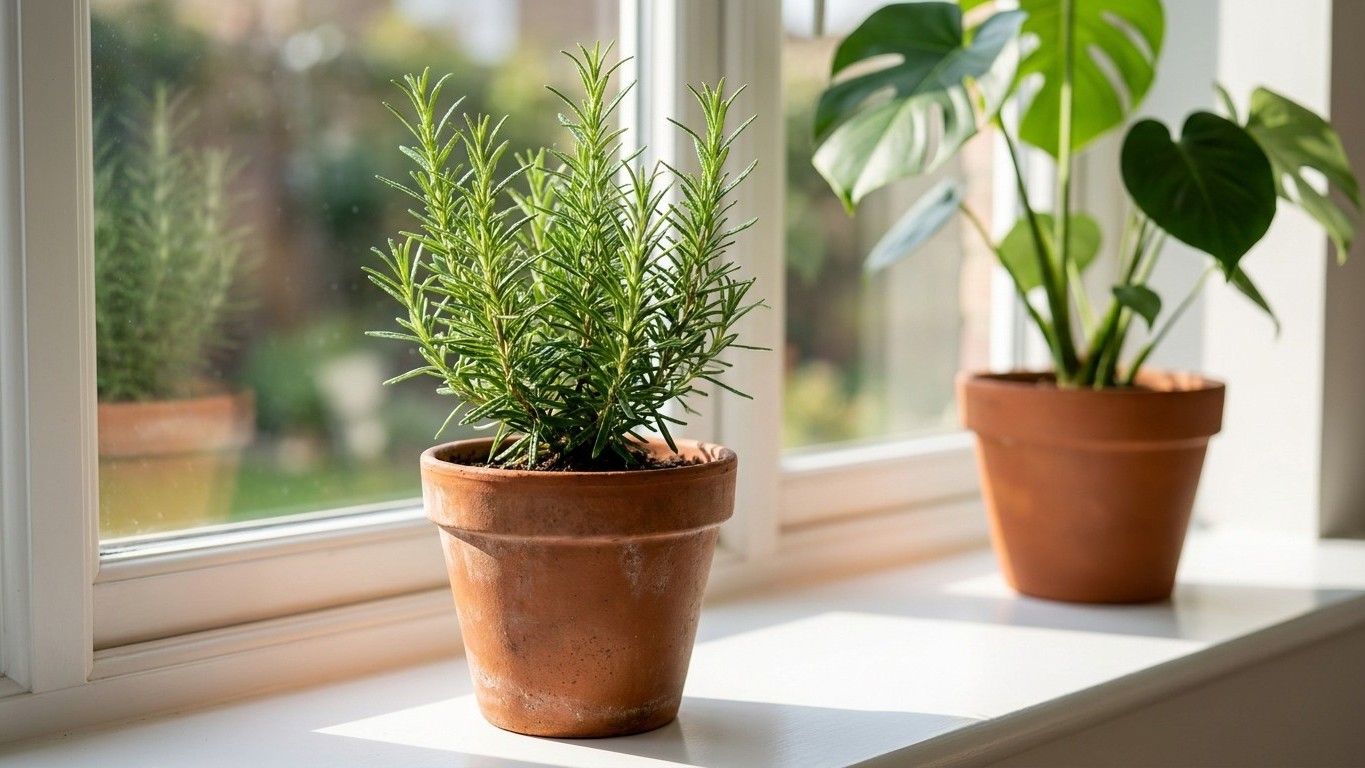
Three tiny black specks hovering over your monstera. Then six. Then twenty. Fungus gnats don’t announce their arrival, they just colonize Your Living Room while you’re distracted, and before long you’re swatting at insects every time you water. The fix that’s making the rounds on plant forums lately: park a potted rosemary next to your houseplants. A week later, the gnats are gone. The story is real, the chemistry backs it up, and the approach is more nuanced than it appears.
Key takeaways
- A single potted rosemary plant can eliminate fungus gnats from your entire plant collection—but here’s what most people get wrong
- The chemistry behind rosemary’s gnat-killing power involves three specific oil compounds working in synergy to jam insects’ ability to navigate
- Rosemary alone only stops new gnats—you need this one additional step to eliminate larvae already living in your soil
What You’re Actually Fighting
Fungus gnats are insects commonly associated with overwatered houseplants. That’s the first thing to understand. They’re not random invaders from outside, they’re a symptom of conditions you’ve already created. Fungus gnats are small flies that infest soil, potting mix, and other sources of organic decomposition. Their larvae primarily feed on fungi and organic matter in soil, but also chew roots and can be a problem in greenhouses, nurseries, potted plants, and interior plantscapes.
The adults are mostly harmless nuisances. The larvae, though, are another matter. Adult fungus gnats don’t damage plants or bite people; their presence is primarily considered a nuisance. Larvae, however, when present in large numbers, can damage roots and stunt plant growth, particularly in seedlings and young plants. Significant root damage and even plant death have been observed in interior plantscapes and in Houseplants when high populations were associated with moist, organically-rich soil. A wilting plant that gets enough water isn’t necessarily thirsty, it may have a root problem you can’t see.
Speed is the other unsettling factor. Adult female fungus gnats live about 7 days and can lay up to 1,000 eggs during their lifespan. Once the eggs are laid, they will hatch in 4–6 days. After hatching, the larvae begin tunneling through the soil in search of food. The larval stage lasts 10–14 days. A full cycle takes 25–34 days to complete. That’s roughly the same time it takes to notice a problem, Google solutions, order something, and wait for delivery. By then, you’re two generations deep.
Why Rosemary Works : The Chemistry Behind the Smell
Rosemary oil acts as an effective fumigant agent against fungi, fungus gnats, weevils, and beetles, and can also repel roaches. That’s not folk remedy territory, it’s backed by research. Rosemary essential oil has insecticidal properties and is the active ingredient in a number of commercial insecticides. The mechanism is surprisingly specific.
Analysis of rosemary essential oil reveals sixteen components, with 1,8-cineole (40.80%) being the major constituent, followed by α-pinene (26.18%) and camphor (19.53%). These aren’t passive aromatics, they work synergistically. The insecticidal activity of rosemary oil appears to be a consequence of the synergistic interaction between 1,8-cineole and camphor, and camphor should be considered a promising synergizing agent. the plant’s scent operates as a multi-compound system, not a single active ingredient.
Gnats rely heavily on their sense of smell to find food, moisture, and breeding sites. Essential oils overwhelm those receptors. Research on fruit flies (close relatives of common gnats) shows that volatile compounds in plant oils activate multiple odor receptors simultaneously, essentially jamming the insect’s ability to navigate. Put a rosemary plant next to your pothos, and you’ve effectively introduced a chemical fog that makes the entire area disorienting and unappealing to gnats.
There’s also a bonus effect worth noting. Like citronella, rosemary plants release their scent when their leaves are crushed or brushed against. To release the fragrance and enhance its gnat-repelling properties, gently crush or rub the leaves. Simply brushing past your rosemary pot while watering your other plants amplifies the effect passively.
Rosemary Alone Won’t Save an Overwatered Plant
Here’s the honest part: rosemary repels adult gnats. It doesn’t touch the larvae already sitting 2 inches deep in your soil. Fungus gnats breed in the moist soil of potted plants, so surface spraying alone won’t solve the problem. The rosemary strategy works as a deterrent layer, it keeps new adults from choosing your pots as breeding sites — but it needs backup.
Altering environmental conditions of houseplants is the single most important step in managing this insect. Keep the soil surface dry to eliminate favorable egg-laying sites for the insect. You can do this by allowing the top inch of the soil to dry out before you water. Bottom-watering lets the plant absorb only what it needs, keeping the soil’s surface dry and discouraging gnats. Set the pot in a tray of water for 15 to 30 minutes, then remove any excess water. That single change, switching from top-watering to bottom-watering, often does more in a week than any spray.
For existing infestations, the most reliable soil treatment is biological. A natural bacterium called Bacillus thuringiensis var. israelensis (BTI), found in mosquito dunks, works against fungus gnat larvae. Add a piece of a dunk to your watering can. BTI is safe for plants and pets and targets only fungus gnat larvae. Combine BTI watering with rosemary repellence and you’re attacking the problem at two life stages simultaneously, larvae underground, adults in the air.
Building a Full Natural Defense
Rosemary isn’t the only herb worth keeping around. Succulents and cacti prefer dry soil and are naturally resistant; snake plants tolerate infrequent watering; ZZ plants thrive on neglect and dry conditions; herbs like rosemary and thyme dislike consistently moist soil. Grouping these naturally drought-tolerant plants together creates a zone that’s inherently hostile to fungus gnats, low moisture, strong aromatics, little organic decay on the surface.
If you want to amplify the rosemary effect without adding another pot, you can use rosemary essential oil to make your own gnat-repelling sprays or diffuse essential oils to keep an area gnat-free. A simple spray bottle works well for targeting specific areas like kitchen counters, window frames, or the soil surface of houseplants. The standard ratio is 20 drops of essential oil per liter of water.
Pet owners need one caution before going all in. Most of the essential oils that repel gnats are toxic to cats. This includes tea tree, eucalyptus, peppermint, citronella, lemongrass, lavender, and citrus oils. Cats lack the liver enzymes needed to break down certain compounds in these oils, and exposure through diffusers, skin contact, or ingestion can cause drooling, breathing difficulty, vomiting, and potentially liver damage. A living rosemary plant in a pot, releasing scent passively, is far lower risk than a diffuser running concentrated essential oil, but it’s worth knowing the distinction.
One last angle most gnat guides overlook: when potting or repotting plants, use sterile potting mix to avoid introducing fungus gnat larvae into your home. New plants can introduce fungus gnats, quarantine and inspect new plants for a few weeks before introducing them to your plant collection. The majority of indoor infestations don’t drift in through an open window. They arrive in a bag of fresh potting mix or ride in on the new plant you couldn’t resist at the garden center. That’s the entry point most people never think to close.
Sources : amazon.com | amazon.com