
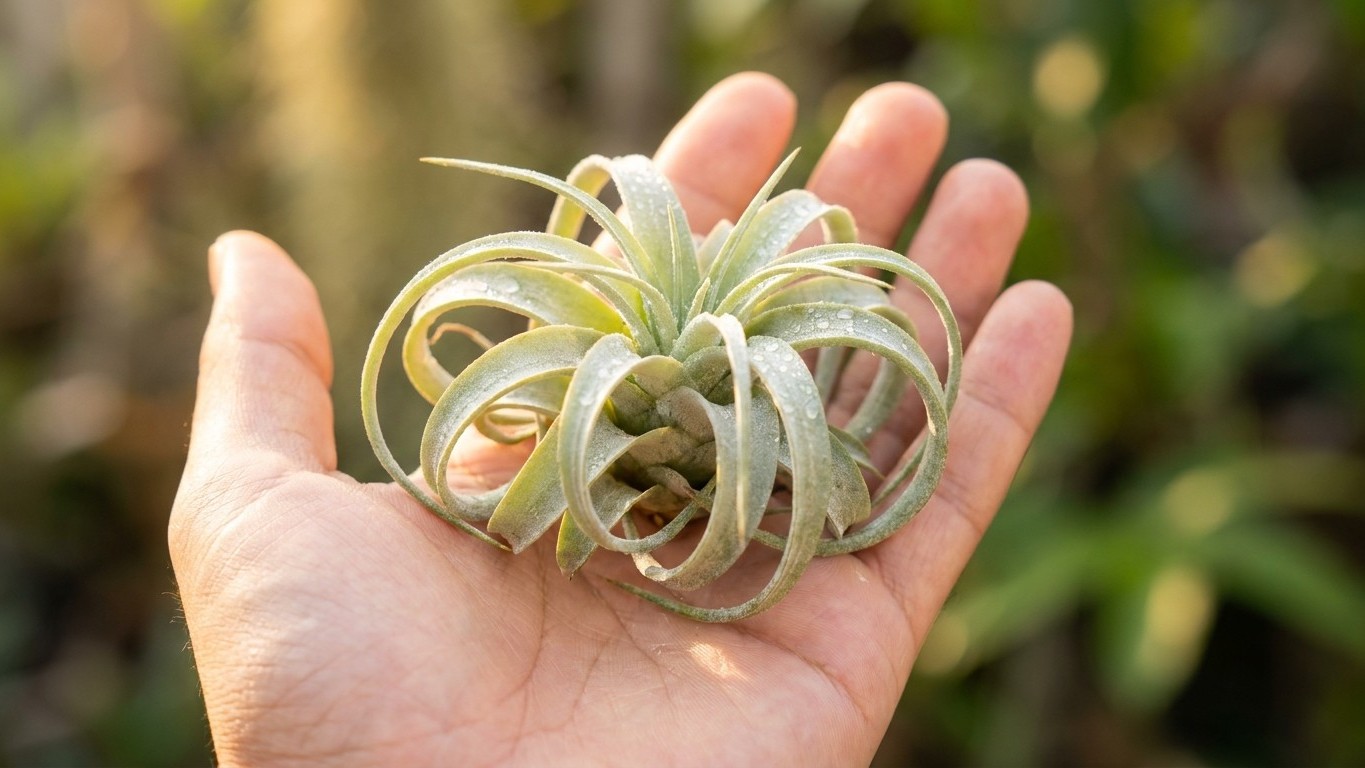
Air plants rot from the center out, and by the time you notice, it’s already over. The damage happens silently, over 24 to 48 hours, while the plant looks completely fine sitting on your windowsill. You pick it up to admire it, give the leaves a gentle squeeze, and the entire core pulls away in your hand. That’s not bad luck. That’s a drainage problem almost everyone creates without realizing it.
Key takeaways
- The standard ‘set upside down to dry’ method traps moisture exactly where rot begins
- A gentle breeze dries air plants in hours, but still air can trigger collapse in 48 hours
- Early rot signs are subtle: translucent leaves at the base and a faint fermented smell
The Real Problem With “Set It Upside Down to Dry”
The standard advice circulates everywhere: soak your tillandsia for 20 to 30 minutes, shake off the excess water, and set it on a towel to dry. Some sources add “place it upside down.” That last part is the trap. Tillandsias collect water in the rosette, the tight center where the leaves converge, and inverting them does help drain it. The problem is that “invert and set down” still traps a pocket of moisture against the base of the innermost leaves, the softest and least protected part of the plant.
The rot that forms there is bacterial, not fungal. It spreads quickly in the absence of airflow, and it doesn’t need much water to get started, just enough residual moisture sitting against tissue that never fully dries. A plant that spends two days in still indoor air, even inverted, can accumulate enough stagnant wetness at the crown to trigger this process. The leaves around the outside dry out and look healthy. The center is quietly dying.
What Actually Works: Airflow, Not Position
The orientation of the plant matters far less than the air moving around it. Tillandsias in their natural habitat, strapped to tree branches in humid subtropical climates across Central and South America — dry out within a few hours of rainfall because wind is constant. Replicating that indoors is the whole game.
After soaking, shake the plant firmly two or three times to dislodge water from the center, then hold it upside down for 30 to 60 seconds over the sink. The goal isn’t a perfectly dry plant, it’s removing the pooled water before it settles. After that, place the plant somewhere with active airflow: near a fan on low, next to an open window, or under a ceiling fan. A gentle breeze dries a tillandsia in two to four hours. Still air on a bathroom shelf can take two days — and that window is exactly where rot gets established.
One thing worth knowing: the watering schedule matters as much as the drying method. Soaking once a week is the common recommendation, but it was calibrated for drier climates and less humid homes. If your apartment runs humid, above 50 to 60 percent relative humidity, you can water less frequently, misting every few days instead of submerging. In a dry desert home in winter with the heat running, weekly soaking is probably not enough. Read the plant’s leaves, not a calendar. Silvery, curling leaves signal thirst. Soft, dark tissue at the base signals too much water with nowhere to go.
How to Tell If Your Air Plant Has Already Started Rotting
The early signs are subtle and easy to dismiss. The base of the innermost leaves takes on a slightly translucent, waterlogged look, almost like wet paper. If you gently press there and the tissue gives more than it should, or if a leaf pulls away with almost no resistance, rot has already started. A faint, off smell (not the clean scent of wet plant material but something slightly sour or fermented) is another reliable indicator.
At that stage, you can sometimes save the plant by pulling away the affected leaves cleanly, letting the remaining healthy tissue dry completely in strong airflow, and switching to a misting-only schedule for several weeks. The success rate isn’t high, maybe 50/50 if you catch it early, but it’s worth attempting on a plant you’ve grown attached to. Once the center collapses entirely, the way it does when you pick it up and the core separates in your hand, the plant is gone. No amount of drying reverses structural collapse of the meristem.
A common misconception is that air plants are Indestructible because they require “no soil.” They’re actually more sensitive than many potted plants in one specific way: they have no root system to buffer mistakes. A potted succulent in dry soil is just thirsty. An air plant with trapped moisture has no mechanism to drain it away from its core tissues. The entire plant is the vulnerable zone.
Small Adjustments That Make a Real Difference
Display matters too, and this is where people create problems without thinking about it. Tillandsias tucked inside glass terrariums, nestled in shells, or set into decorative driftwood holders with tight crevices are essentially being denied the airflow they need. Beautiful? Yes. Practical for the plant? Often not. If you love the terrarium look, leave the lid off permanently and position a small fan nearby. If the plant sits in a shell, make sure it’s resting on its side, not cupped inside the concave surface where water collects.
Wire hangers and suspended displays aren’t just aesthetic choices, they’re actually better for the plant. When an air plant hangs freely, air reaches all sides simultaneously, including the base. Growers who raise tillandsias commercially almost always hang them. The decorative bowl of air plants on the coffee table is the hobby version; the hanging plant in the bathroom window is closer to how the plant actually thrives.
One detail that rarely makes it into beginner guides: the water temperature you use for soaking affects how quickly the plant rehydrates and how long moisture lingers in the tissue. Room-temperature water is absorbed faster than cold water, which means the plant takes on what it needs more efficiently and sheds the excess more readily. Cold tap water slows absorption, which sounds like it might be safer, but it just prolongs the exposure window without improving uptake. Lukewarm, and done.