
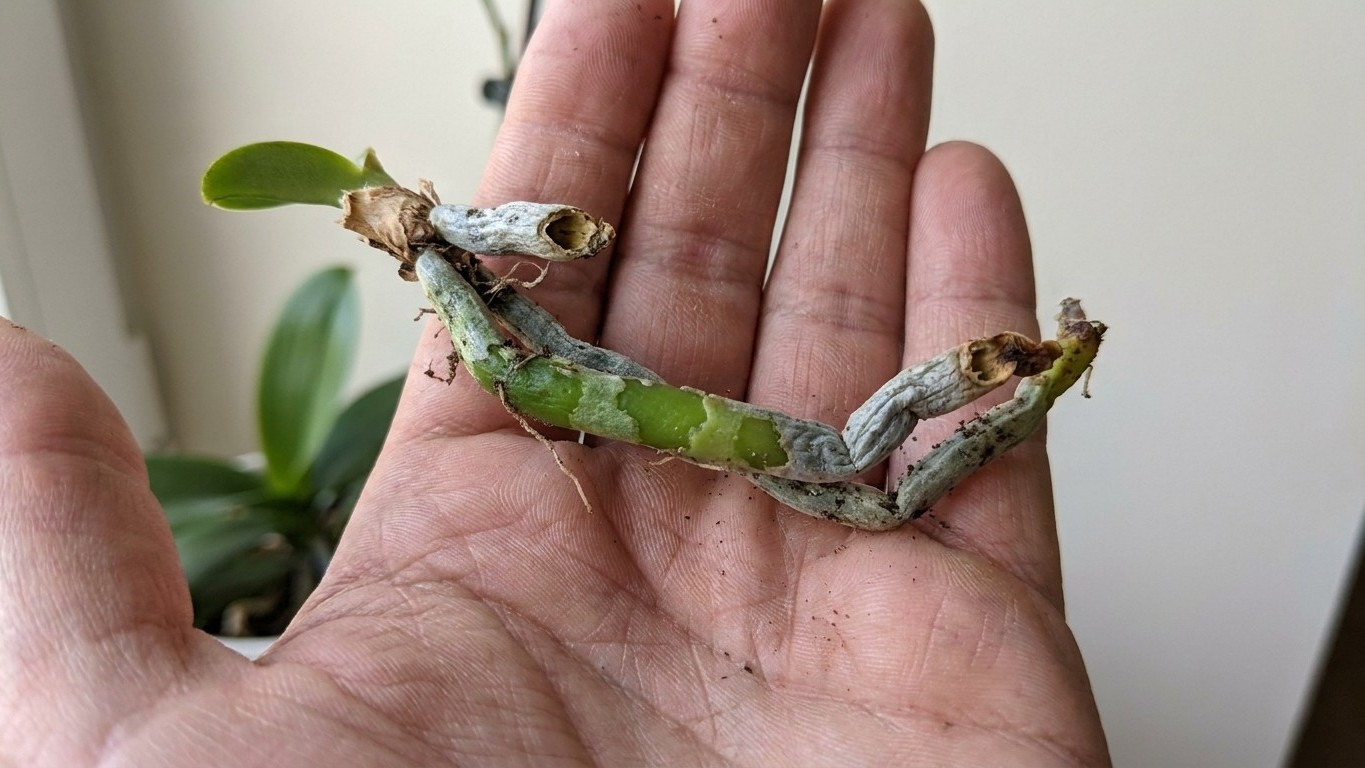
The roots were gray, hollow, and fell apart at the touch. Three of them. Gone in seconds, just from gently prodding the potting mix. The nursery grower standing across from me didn’t look surprised. “Ice cubes,” she said, not even as a question. She’d seen it before, hundreds of times, she told me, in orchids brought in by well-meaning owners who’d been following watering advice they found online.
The ice cube method for orchids became wildly popular somewhere around 2012, pushed hard by a major grocery chain orchid brand whose marketing framed it as a foolproof, “no overwatering” solution. The pitch was simple: one ice cube per week keeps the water slow and controlled. Millions of people bought it. The problem is that Phalaenopsis orchids, by far the most common variety sold in American homes, are native to tropical regions of Southeast Asia, where temperatures rarely drop below 60°F even at night. Exposing their roots to ice is, biologically speaking, a kind of repeated cold shock.
Key takeaways
- A viral orchid care hack has been silently destroying thousands of houseplants — and a professional grower explains exactly why
- Tropical orchid roots can’t handle cold exposure, and the damage accumulates invisibly before roots start crumbling
- The real solution is shockingly simple, and even severely damaged orchids can be saved with one unexpected tool
What cold water actually does to orchid roots
Orchid roots are not like the roots of a tomato plant buried in soil. They are aerial structures adapted to absorb moisture from humid air and intermittent rainfall. In their natural habitat, water passes quickly through the root zone and then evaporates. The roots breathe. They’re covered in a spongy layer called velamen, which acts like a moisture-absorbing wick. That velamen is sensitive to sustained cold.
When ice melts against velamen tissue repeatedly over weeks and months, it causes cellular damage similar to what happens when tropical leaves are left near a cold window in January. The cells contract, the tissue breaks down, and the root loses its ability to absorb water or nutrients efficiently. Visually, healthy velamen appears silvery-white when dry and bright green when freshly watered. Damaged velamen turns gray or brown and stays that way. By the time roots are crumbling, the damage has been accumulating for a while.
A 2017 study published by researchers at the University of Georgia found measurable physiological stress in Phalaenopsis plants watered with ice compared to those watered with room-temperature water. Leaf chlorophyll levels dropped, root viability decreased, and overall plant health declined over a 12-week period. The study was modest in scale, but its conclusions aligned with what professional growers had been observing for years.
The right way to water an orchid (it’s simpler than you think)
Room-temperature water. That’s it. The grower who examined my plant uses what she calls the “sink method”: take the plastic nursery pot to the sink, run lukewarm water through it thoroughly for about 30 seconds, let it drain completely, and return it to its decorative outer pot. No ice, no misting, no measuring. She does this once a week in summer, every ten to twelve days in winter when indoor humidity drops.
The key detail most people miss is the drainage. Orchids sitting in water, even a small amount pooled at the bottom of a decorative ceramic pot — will rot from below. The roots need to go from wet to almost dry between waterings. That cycle mimics what happens in a tropical forest after a rain shower. Wet for a short period, then back to aerated and drying. A pot with drainage holes sitting on a layer of pebbles (with water below the pebble line, not touching the roots) creates humidity without waterlogging.
Rainwater or filtered water works better than tap water in areas with high mineral content. Mineral buildup from hard tap water shows up as white crust on the potting mix and can block nutrient absorption over time. Not a crisis if you use tap water occasionally, but worth switching if your orchid seems stalled in growth despite otherwise good conditions.
Saving an orchid with damaged roots
When I asked the grower whether my orchid was salvageable, she picked it up, tapped it out of the pot, and assessed the root system with the calm of someone who has done this several thousand times. About half the roots were still firm and green. That’s enough, she said. The dead ones needed to come off.
Using sterilized scissors (a quick wipe with rubbing alcohol before cutting), she trimmed every gray, hollow, or mushy root back to healthy tissue. The cuts were clean and fast. Then she dusted the cut ends with ground cinnamon, an old grower’s trick that works as a natural antifungal. Letting the plant air-dry for an hour before repotting gives the wounds time to callous slightly.
Fresh orchid bark mix, not regular potting soil, which holds too much moisture and suffocates the roots — went into a clean pot with drainage holes. The plant went back in, the healthy roots arranged loosely around the new bark. She mentioned that the orchid might drop its leaves within a few weeks as it redirects energy to rebuilding its root system. Normal. Expected. Not a sign of failure.
Two months later, four new roots were visible through the transparent nursery pot, bright green after watering, silvery-white in between. No flowers yet, the plant needed to stabilize before blooming again, but the velamen looked healthy. The difference between a plant dying slowly in icy water and one actively rebuilding itself came down to a change in temperature and a pair of sterilized scissors.
One thing worth knowing: Phalaenopsis orchids typically need a brief period of cooler nights (around 55-60°F for two to four weeks) to trigger a new bloom spike. A spot near a slightly drafty window in October or November, kept away from heating vents, often does the job naturally. So counterintuitively, a little seasonal cool air, not ice in the pot, is exactly what encourages them to flower again.