
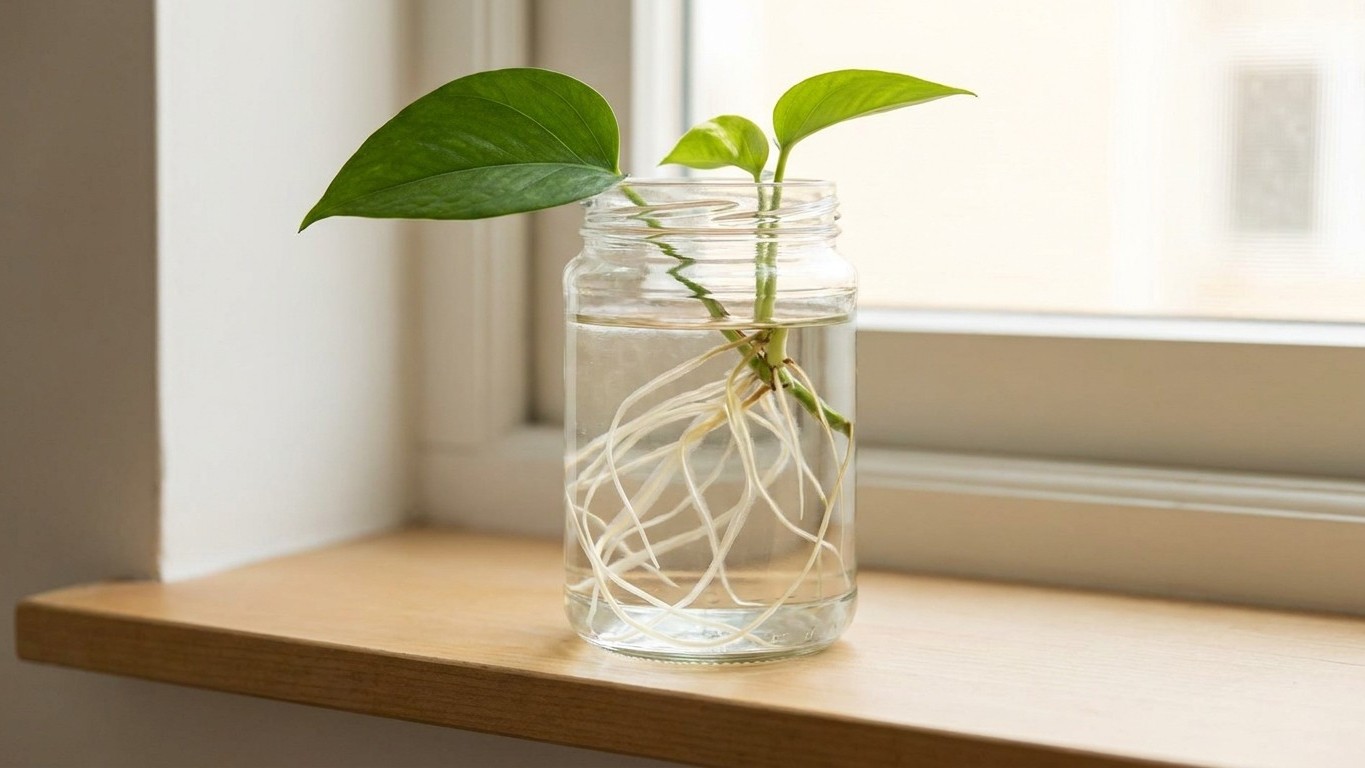
Six weeks in a glass jar, roots trailing like white ribbons through the water. The cutting looked alive, thriving even, and every time you walked past it on the windowsill, it felt like a small victory. Then you finally potted it, waited a month, and… nothing. No new leaf. No visible growth. Just a plant that seemed to have forgotten how to be a plant.
This is one of the most common frustrations in the world of indoor plant propagation, and it has a very specific biological explanation that most beginner guides skip entirely.
Key takeaways
- Water roots and soil roots are structurally different—and your plant must rebuild its entire root system when transitioning between them
- Long, beautiful roots grown in water are actually working against you once soil enters the equation
- That mysterious month of no growth is when critical underground work happens—and it’s exactly what should be happening
Water roots and soil roots are not the same thing
Here’s the part that genuinely surprises most plant owners: roots grown in water are structurally different from roots grown in soil. Water-propagated roots develop in a low-resistance, oxygen-rich liquid environment. They grow long and smooth, optimized to absorb dissolved nutrients directly from the surrounding water. Soil roots, by contrast, are shorter, denser, and covered in fine root hairs designed to navigate around particles and access moisture locked inside a medium. When you transfer a cutting that has spent six weeks developing water roots into a pot of standard potting mix, those roots are essentially starting over. The plant isn’t dying. It’s rebuilding its entire root system for a completely different environment.
Pothos (Epipremnum aureum) is one of the most forgiving Houseplants on the market, which is exactly why it’s so popular for water propagation. But “forgiving” doesn’t mean instant. The month-long pause after potting is the plant redirecting its energy underground, producing new root structures capable of functioning in soil. The visible silence above the soil line is deceptive. Beneath the surface, the plant is doing significant work.
Why leaving cuttings in water too long actually slows things down
There’s a sweet spot for water propagation, and most people overshoot it. Roots that are 1 to 2 inches long transition to soil far more successfully than roots that have grown for six weeks and reached 4, 5, or even 6 inches. Longer water roots are more brittle and more committed to their current growth pattern, which makes the adaptation process harder and longer.
The six-week timeline also raises another issue: nutrient depletion. Plain tap water contains no meaningful nutrition. A cutting sitting in water for that long is surviving on its own stored energy reserves, which diminishes the plant’s capacity to handle transplant stress. Some growers add a single drop of liquid fertilizer to their propagation water to partially address this, though the benefits are modest. The bigger fix is simply transferring earlier.
Research on plant propagation consistently shows that the transition from water to soil is most successful when it happens before roots become established and specialized. A 2021 study on vegetative propagation methods in ornamental plants found that cuttings transferred at the early root emergence stage (roughly 1–2 cm of root development) showed faster adaptation and higher survival rates than those transferred after extended water exposure. The aesthetic appeal of long, flowing roots is real, but it works against you the moment you pick up a trowel.
How to actually pot a water-propagated cutting without the month-long freeze
Transition matters more than timing. If your cutting already has long water roots, the goal is to ease the shift rather than make it abrupt. Start by filling the pot with a lightweight, well-draining mix, something like a standard potting soil cut with 20 to 30 percent perlite. This creates an intermediate environment that retains some moisture (closer to what water roots are used to) while still providing the structure and aeration that soil roots need to develop.
Water the freshly potted cutting more frequently than you normally would for an established pothos, at least for the first two to three weeks. The water roots can still absorb moisture, and keeping the medium consistently damp gives the plant a functional bridge while new soil-adapted roots form. Then gradually reduce watering frequency to encourage the plant to develop those denser root structures. Think of it as weaning, not switching.
Some growers swear by a half-and-half approach: moving the cutting from pure water to a mix of water and moistened perlite or LECA (lightweight expanded clay aggregate) before introducing potting soil. This staged transition reduces shock because the roots don’t have to adapt to a completely foreign medium all at once.
Avoid fertilizing during the first four to six weeks after potting, regardless of how eager you are to see growth. A root system in transition is already under stress, and fertilizer salts in the soil can burn the fragile new roots trying to establish themselves. Patience here pays off measurably.
What “doing nothing” actually looks like underground
That month of visible inactivity after potting isn’t a failure signal. Pothos, like most tropical aroids, prioritizes root establishment before pushing new foliage. The plant is essentially operating on a triage system: stabilize the foundation before spending energy on growth above the soil. This is the same reason newly planted outdoor shrubs often look unchanged for an entire season before suddenly taking off. Horticulturalists call it “establishment lag,” and it’s a feature, not a flaw.
A simple test to check progress: after three or four weeks, give the cutting a very gentle tug. If there’s resistance, roots have anchored into the soil. That resistance is the signal you’ve been waiting for. New leaf growth typically follows within one to two weeks of successful anchoring, sometimes faster in bright indirect light.
One detail worth knowing: pothos cuttings potted in spring or early summer tend to exit the establishment phase faster than those potted in fall or winter, simply because longer daylight hours accelerate metabolism. If your cutting seems frozen for more than six weeks with no resistance on a gentle tug, check soil moisture levels and consider moving it closer to a light source before assuming something went wrong.