
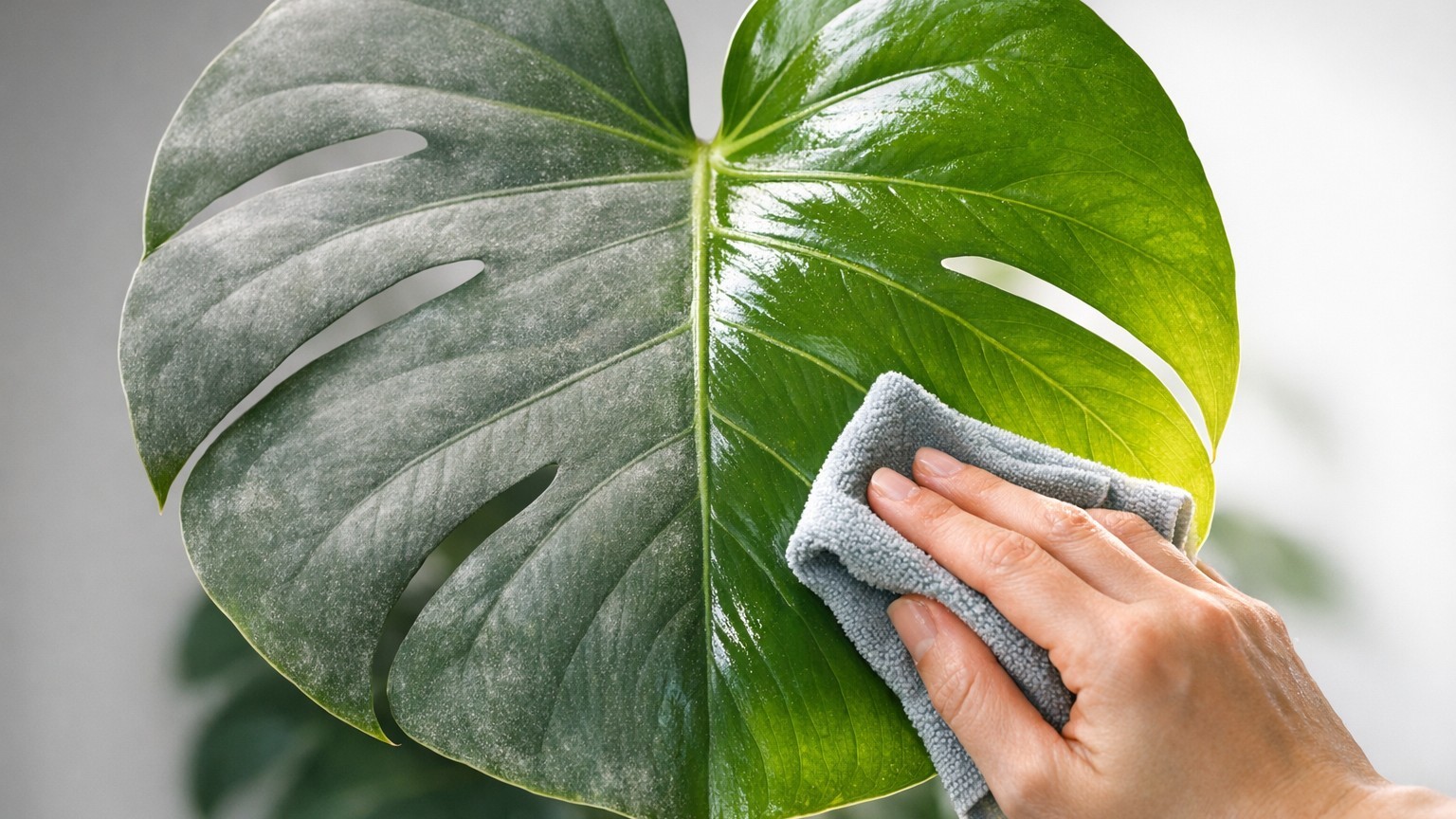
Two years of religiously spraying leaf shine on a monstera, watching it slowly decline, and blaming everything except the obvious culprit. That’s the short version. The longer version involves a scratched leaf, a waxy residue that came off in grey flakes, and a crash course in how tropical plants actually breathe.
Leaf shine products, those aerosol sprays or pump bottles promising glossy, showroom-worthy foliage — are one of the most popular plant care accessories sold at garden centers. They work by depositing a thin film (usually silicone-based or oil-based) across the leaf surface. The result looks incredible for about a week. The problem is what happens underneath that film over the following months, especially if you keep reapplying without ever cleaning the leaves first.
Key takeaways
- Leaf shine products accumulate into a thick film that blocks stomata, the microscopic pores tropical plants use to breathe
- Repeated applications without cleaning in between create a grey, waxy buildup that traps humidity and causes yellowing from the inside out
- One simple cleaning method with soap and water revealed bright green leaves underneath and stopped the plant’s decline
What a monstera leaf actually does all day
A monstera deliciosa leaf isn’t just decorative. It’s a working organ, covered in thousands of microscopic pores called stomata, primarily concentrated on the underside. These stomata open and close to regulate gas exchange: carbon dioxide in, oxygen and water vapor out. They’re also directly involved in a process called transpiration, which is how the plant moves water and nutrients from roots to leaves. Block those pores, even partially, and you’re essentially putting a plastic bag over the plant’s face.
Most leaf shine sprays are designed to be applied sparingly, dried completely, and reapplied infrequently. The instructions often say “use once a month” or “apply to the upper leaf surface only.” In practice, most people, myself included, spray more often and don’t distinguish between top and bottom. After two years of monthly applications with no cleaning in between, I had built up a dense, compacted layer of product that turned grey and tacky to the touch. When I scratched it with a fingernail, it peeled off like a dull, waxy film, revealing the original bright green underneath. The leaf had essentially been suffocating in slow motion.
The yellowing wasn’t about water or light, it was gas exchange
Yellowing monstera leaves get blamed on overwatering about 90% of the time on the internet. The chlorosis pattern on mine didn’t match: it started at the center of the leaf, not the edges, and progressed unevenly across sections rather than following the vein structure typical of nutrient deficiency. That’s a red flag worth knowing. When stomata are blocked, the plant can’t efficiently photosynthesize, which means chlorophyll production drops, and that’s what shows up as yellowing.
A 2019 study from the journal Environmental and Experimental Botany on stomatal clogging in ornamental plants found that even a 30% reduction in stomatal conductance measurably impacts photosynthetic efficiency. Leaf shine products were not the specific subject, but the mechanism translates directly: anything that impedes gas exchange at the leaf surface will eventually show up in the plant’s health metrics, including color.
The buildup also traps humidity against the leaf surface, creating a microclimate where fungal spores can take hold. My monstera developed small brown specks near the petiole junctions during its second year. I initially attributed those to low humidity. Wrong diagnosis, same root cause.
How to actually clean monstera leaves
The fix, once you understand the problem, is almost embarrassingly simple. A soft cloth dampened with plain lukewarm water removes fresh dust and light residue. For accumulated product buildup like mine, a diluted solution of dish soap (a few drops in a cup of water) on a microfiber cloth works well, wiped gently in one direction from the stem outward, then followed by a clean damp cloth to remove any soap residue. Never scrub or wipe in circular motions, which can damage the waxy cuticle the plant produces naturally.
After cleaning every leaf on my monstera, seventeen mature leaves, plus a handful of juveniles, I let it sit in bright indirect light for a week without touching it. New growth that emerged three weeks later was noticeably more vigorous, and the yellowing on two older leaves that I’d been watching stopped progressing. The plant didn’t suddenly transform overnight, but the trajectory changed.
Neem oil deserves a mention here as a frequent culprit alongside commercial shine sprays. It’s recommended constantly as a natural pest deterrent, and at low dilutions it does deter spider mites and fungus gnats. The issue is that neem oil, applied to the upper leaf surface repeatedly, behaves similarly to synthetic shine products: it coats, accumulates, and clogs. Use it as a targeted treatment when pests are present, not as a routine foliar spray on every leaf every week.
What to use instead if you want that glossy look
A clean, healthy monstera leaf has its own natural sheen, the plant produces a waxy cuticle layer that reflects light. That’s what you’re chasing. The fastest way to restore it is consistent leaf cleaning with a damp cloth, roughly every two to three weeks depending on how dusty your home runs. Homes near busy streets, or with forced-air heating systems, accumulate significantly more particulate matter on leaf surfaces than you’d expect.
Some growers swear by a tiny amount of diluted coconut oil on a cloth for a light shine boost, applied very sparingly on the upper surface only. The key difference from commercial sprays is control: you apply a microscopic amount, not a uniform coating. Others simply mist with filtered water and buff dry, which works, costs nothing, and carries zero risk of buildup.
The deeper lesson from my two-year experiment is about product accumulation over time. Any single application of leaf shine is probably harmless. The risk lies in layering applications month after month without ever stripping the slate clean. Houseplant products are rarely tested for chronic long-term use the way, say, agricultural treatments are. The assumption is that leaves get replaced seasonally. Monstera leaves, which can live for years on the same plant, don’t benefit from that assumption.