
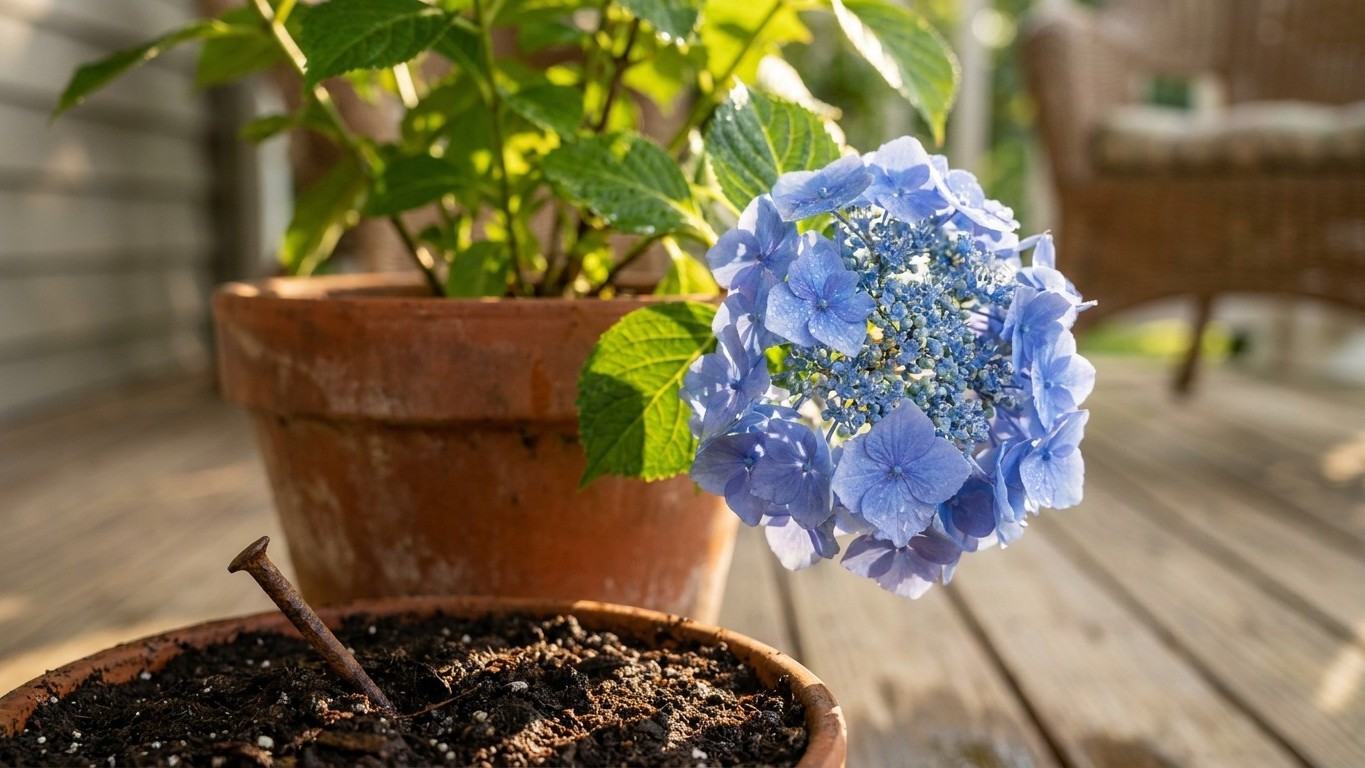
Every spring, millions of American gardeners buy blue hydrangeas from the nursery, plant them with care, and watch them slowly blush pink over the following season. Frustrating, sure. But the real story behind it is one of the most counterintuitive lessons in backyard science, and a rusty nail dropped into a pot by someone’s grandmother cuts right to the heart of it.
Key takeaways
- A grandmother’s rusty nail trick has persisted for generations, but the real mechanism is far more complex than anyone realizes
- Aluminum absorption, not soil acidity alone, is what determines whether hydrangeas bloom blue or pink
- Container-grown hydrangeas naturally drift toward pink, and tap water might be the sneaky culprit
The Color Was Never Really About the Flower
Here’s the first thing to know: the blue you’re buying isn’t locked into the plant’s DNA the way a rose’s red is. Color can only be changed on specific species of hydrangea, mainly those related to H. macrophylla or H. serrata, and the common assumption is that flower color is related to soil pH, but as horticultural expert Michael Dirr explains, the color is actually determined by the amount of aluminum a plant can access in the soil, which itself is governed by pH and phosphorus levels. Soil pH, is just the gatekeeper. Aluminum is the thing actually pulling the strings.
Hydrangeas absorb aluminum from the soil, but only when the pH is low enough, or acidic. That aluminum mixes with natural pigments inside the flower, turning it blue. When the pH is higher and the aluminum can’t be absorbed, the flowers turn pink instead. Think of it like a locked cabinet: the acidity of the soil is the key, and aluminum is what’s inside. No key, no aluminum, no blue.
In acidic soil with a pH of 5.2 to 5.5, the hydrangea is blue. In neutral or alkaline soil with a pH of 6.0 to 7.5, the flowers turn pink. If the pH lands right in between, at around 6, you might end up with purple, a mix of both. So when your store-bought blue plant gradually pinks out, the potting mix has simply drifted alkaline, or the tap water You’ve Been Using has raised the pH over time. The plant isn’t broken. It’s responding to chemistry.
Why the Rusty Nail Trick Is Both Right and Wrong
Your grandmother’s rusty nail trick is one of the most persistent pieces of gardening folklore in America. Homespun recipes abound for changing pink hydrangea blooms to blue: pouring vinegar or lemon juice on the soil, mulching with coffee grounds, citrus fruit rinds, or pine needles, or burying rusty nails, old tin cans, or copper pennies next to the bush. The instinct behind all of these is the same, make the soil more acidic.
But here’s where it gets complicated. The “rust” that accumulates on old nails is iron oxide, an insoluble form of iron that will not make any difference in soil pH. Iron oxide (the reddish-brown rust on a rusty nail) is almost completely insoluble in water. So the nail itself isn’t doing the chemical work you’d hope. People assume that the nails will add iron to the soil, thus lowering the pH and turning the flowers blue — but lowering the soil pH is only part of the story. Aluminum is also required to produce blue flowers.
That said, dismissing grandmother entirely would be unfair. The rusty nail legend isn’t built on nothing. Iron really is what these plants sometimes need, and the intuition to reach for a source of iron to counter an iron deficiency is directionally correct, hence why gardeners of old turned to nails. In a world before specialized bottled nutrients, a handful of rusty nails probably felt like a logical supplement to bury near the roots. The diagnosis was reasonable. The delivery was just off. The problem is in the delivery: rust is the wrong form, released too slowly, in a way that soil pH will largely neutralize before roots ever see it.
There is also one scenario where something like the nail trick might nudge things in the right direction. Adding iron oxide (in the form of rusty nails) can acidify the soil, which in turn enables the absorption of aluminum and iron, turning the blooms blue. The operative word is “can”, the effect, when it exists at all, is slow and unpredictable. A potted plant with a single nail dropped in may sit unchanged for a full growing season.
The Pot Problem: Why Container Hydrangeas Are a Whole Different Game
Buying a blue hydrangea and putting it in a container is actually one of the harder ways to keep it blue, which is ironic, since pots seem like they’d offer more control. If hydrangeas are grown in pots, it’s best to use potting soil rather than garden or topsoil, since standard mixes should not contain aluminum. In a pot, it will be much easier to control the requirements for growing pink hydrangeas. Notice the direction there: pots naturally favor pink, not blue.
For anyone serious about maintaining blue in a container, it’s worth having your water tested, the pH of the water used for irrigation should not be higher than 5.6. Most municipal tap water sits well above that. Every watering can full of slightly alkaline water is quietly nudging those blooms toward pink, week by week. A simple pH meter from any garden center, used on both your soil and your water supply, reveals more than any nail ever could.
One less obvious culprit: planting or placing hydrangeas very near a sidewalk or concrete foundation makes it hard for the plant to get blue blooms, because lime leaches out of cement, raising the soil pH. A pot sitting on a concrete porch? Same problem, compounding slowly.
What Actually Works to Keep Hydrangeas Blue
The most reliable method, used by both commercial growers and serious home gardeners, is aluminum sulfate. Dissolving one tablespoon of aluminum sulfate in one gallon of water and drenching the soil around the plant in March, April, and May is a proven approach, just avoid getting the solution on the leaves. This simultaneously lowers pH and delivers the aluminum the plant needs to produce blue pigment.
For those who prefer a more organic route, adding organic matter like coffee grounds, fruit and vegetable peels, or grass clippings to the soil can lower pH over time. These work more slowly but won’t risk root burn. Color shifts may take a couple of years to reach their full effect, and soil amendments act on developing buds, not flowers that have already formed and bloomed. Patience, is non-negotiable.
One nuance worth knowing: it is actually easier to change a hydrangea from pink to blue than the reverse, because it is easier to add aluminum to soil than to remove it. And not every hydrangea will respond at all. White hydrangeas cannot be changed to pink or blue by the grower, their color is fixed by genetics alone. The color-changing magic is specific to bigleaf varieties (H. macrophylla) and closely related cultivars, the same ones sold everywhere in deep indigo blue every spring, and the same ones turning stubbornly pink on porches across the country by July.
There’s a small irony in the fact that not all hydrangeas are equal in their ability to incorporate aluminum ions into the plant, meaning two plants sitting in identical soil, fed the same amendments, can behave differently. The chemistry is real. The outcome isn’t always guaranteed. Which may be why grandmother’s nail, dropped with such confidence into the pot, is remembered more fondly than the results it actually produced.
Sources : gardeningknowhow.com | thegardeningcook.com