
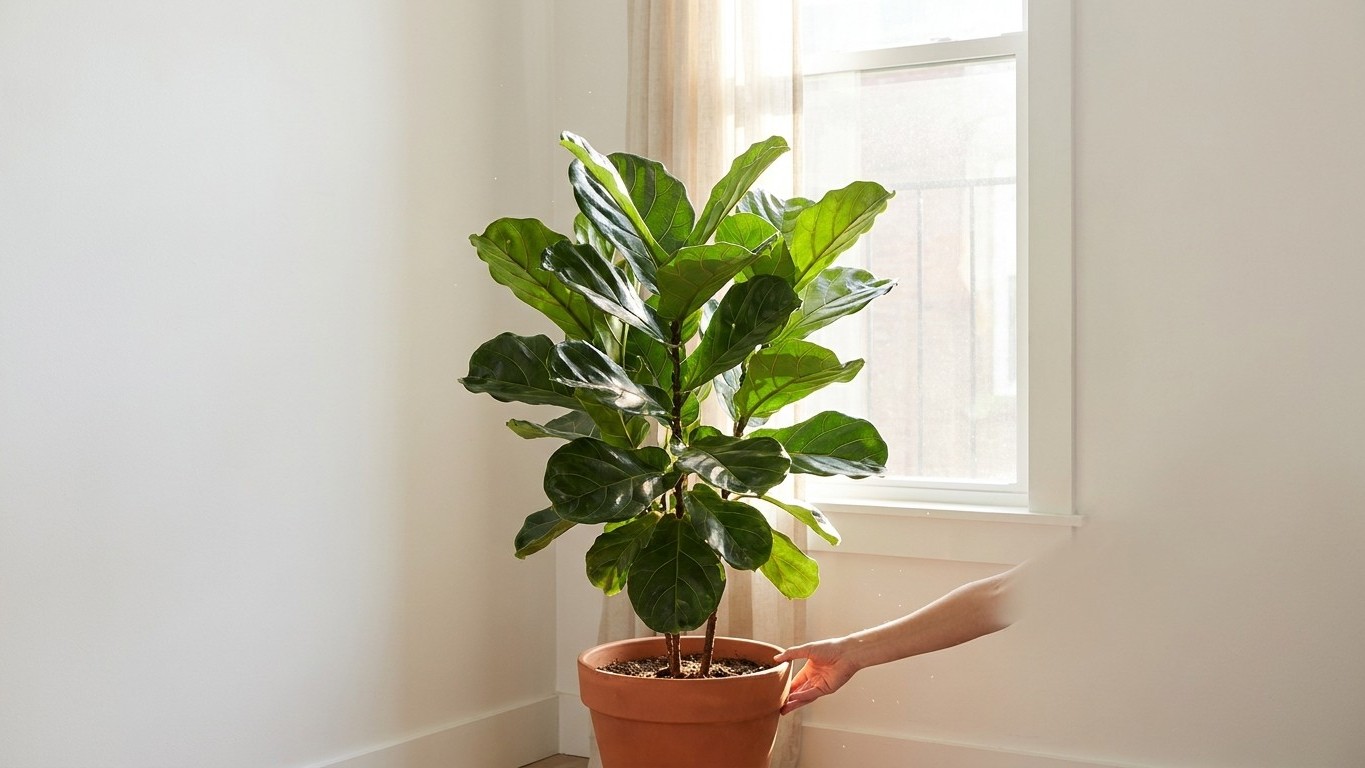
Three moves in six weeks. That’s what it took for my fiddle leaf fig to go from a glossy, upright showpiece to a plant that looked like it had been through a small hurricane. Every time I dragged the pot to a new room chasing better light, a fresh batch of leaves turned yellow and dropped within days. It wasn’t the light I was getting wrong. It was the moving itself.
These plants are incredibly sensitive to environmental changes. When you move a fiddle leaf fig, it experiences shifts in light levels, temperature, humidity, and air circulation all at once. I thought I was solving a lighting problem. I was actually stacking four different stressors on top of each other every single time I picked up that pot.
Key takeaways
- What looks like a lighting problem might actually be a plant screaming for stability
- There’s a critical difference between rotating a pot and moving it across the house
- The answer was simpler than expected, but only after three painful moves revealed the pattern
Why a Simple Room Change Reads as an Emergency
A fiddle leaf fig doesn’t experience your living room the way you do. It reads temperature, humidity, and light as one continuous signal, and disrupting all of them simultaneously triggers a survival response. The fiddle leaf fig responds to this stress by dropping leaves, often starting with the older, lower leaves first, as a way of conserving energy while it adjusts to the new conditions. That’s exactly what happened to mine. The bottom leaves went first, then the ones just above them, working upward like a slow-motion countdown.
What surprised me most was learning this isn’t really about the destination. Leaf drop is the most common and most alarming problem in indoor ficus care, and the important distinction is between leaf drop caused by a correctable care problem and leaf drop caused by relocation or transition stress, which resolves on its own once the plant stabilizes. My plant wasn’t dying. It was doing exactly what a stressed ficus is supposed to do: shed weight until conditions feel predictable again.
There’s a threshold, though, and I blew past it. As long as the plant isn’t losing more than one or two leaves per week and you see new growth emerging from the top, it should recover fine. I was losing far more than that, because I never gave it a chance to stabilize before uprooting it again for the next “better” spot.
Rotating in Place Is Not the Same as Moving Rooms
Here’s where I’d been confusing two completely different actions. Turning a pot on its own axis is maintenance. Carrying it down the hall is trauma. This is not rotating the pot occasionally for even growth. I mean significant location changes like moving from one room to another, bringing it home from the nursery, or even just shifting it several feet to a different spot. The plant doesn’t distinguish between “a few feet” and “across the house.” Any relocation resets its internal expectations.
Rotation, by contrast, is something you’re supposed to do regularly, and for a specific reason that has nothing to do with stress. Regularly rotate your plant to ensure even growth on all sides, as it will tend to grow towards the light source. Skip this step and the trunk leans, the canopy grows lopsided, and you end up with a tree that looks like it’s trying to escape through the window. Rotating your tree once a month keeps it standing straight and tall, since fiddle leaf figs in particular like to reach towards the light, so skipping rotation means you’ll notice them bending over time.
So the fix was never “find the perfect room.” It was picking one good spot and turning the pot a quarter turn every week or two instead of hauling the whole tree somewhere new. Rotating it a quarter turn every week or two lets it grow evenly toward the light instead of leaning to one side. That single habit does the job three room changes never accomplished.
Finding the Spot Worth Committing To
Once I stopped moving the plant and started actually evaluating my windows, the answer was obvious in hindsight. A location away from air vents and drafts where the tree will receive plenty of bright ambient light works best, with directly in front of, or close by, a southern or western facing window being ideal, and eastern exposure also working as long as the plant is directly in the window and the space feels very bright. I’d been putting mine in a north-facing corner because it looked nice there, not because the plant could actually use that light.
North light was the mistake all along. A fiddle leaf fig is not recommended for windows with northern exposure, since it will not thrive in low-light locations. No amount of relocating within a dim room was ever going to fix that. The plant needed one bright window, not a tour of every mediocre one in the house.
If your fig genuinely does need a location change, don’t treat it like moving furniture. If you absolutely must move your fiddle leaf fig, try to match the conditions of its previous location as closely as possible. Same light intensity, similar humidity, no sudden draft exposure. And once it’s settled, leave it there. Don’t move your fiddle leaf fig unless you really need to. Once you have found a location that keeps it happy, keep it in the same place to avoid stress to the plant.
My fig has now sat in the same south-facing corner for four months, gaining two new leaves at the top and losing exactly zero from the bottom. The rotation happens every Sunday when I water it, a quarter turn, nothing more. What I’d mistaken for a lighting problem was really an impatience problem, and the plant had been telling me that with every leaf it dropped. Next time a houseplant looks unhappy, the instinct to relocate it immediately might be worth resisting for a week or two first.
Sources : edsplantshop.com | aol.com