
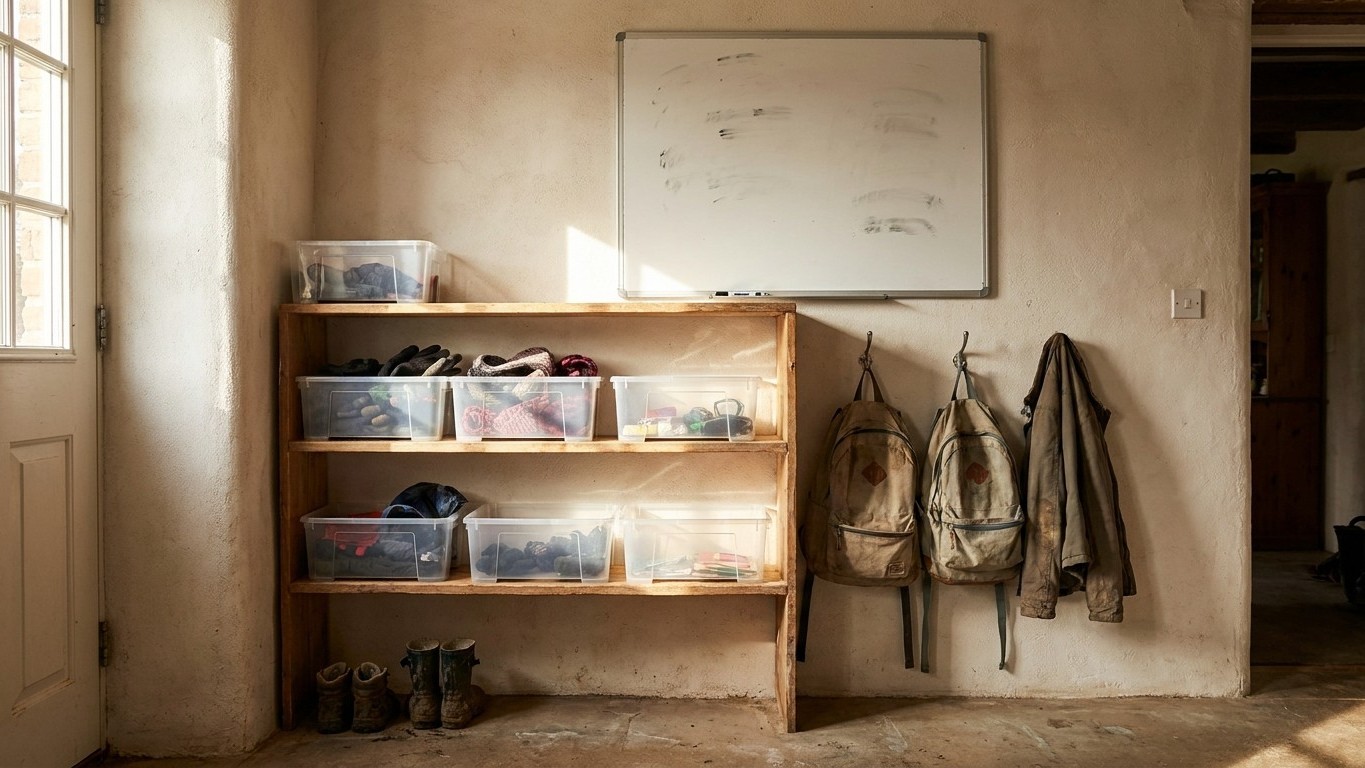
Seventeen minutes. That’s the average time parents spend each morning hunting for permission slips, missing shoes, or a calculator that vanished sometime around spring break, according to organizational surveys cited by family productivity researchers. Multiply that across a 180-day school year and you get roughly 51 hours of pure, avoidable chaos. A command center fixes this, not with a Pinterest-perfect wall display, but with a functional system built where your family actually drops its stuff.
Key takeaways
- Most command centers fail because they’re installed in the wrong location—discover the one spot your family actually uses
- Weekly schedules at kid height beat monthly calendars, but here’s the unexpected second system that works even better
- One 15-dollar supply hack eliminates the nightly pencil scramble and cuts homework arguments dramatically
Pick the Right Spot (It’s Probably Not the Kitchen Wall)
Most command centers fail before they start because they get installed somewhere nobody actually stops. The mudroom, the wall by the garage door, or the entry closet works better than that empty stretch above the kitchen counter, because those are the exact spots where kids drop bags, keys hit a bowl, and shoes come off. If your family enters through a side door nine times out of ten, that’s where the system goes. Not the front hallway. Not the “nice” family room wall.
Command centers need three zones to actually function: an incoming zone (backpacks, lunch boxes, coats), a paperwork zone (forms, calendars, permission slips), and a supplies zone (the stuff kids forget until 7:42 a.m.). Skip one and the whole system collapses within two weeks, because family clutter always finds the path of least resistance. A single hook by the door without a paper tray just becomes a place where jackets pile up and permission slips get crushed underneath.
Schedules That Kids Actually Look At
A shared family calendar only works if it’s visible at kid height and updated weekly, not monthly. Dry-erase boards mounted around 40 inches from the floor let even elementary-age children check their own schedule, which builds independence faster than any chore chart. Color-coding by child, rather than by activity type, cuts confusion dramatically, since a seven-year-old can scan for “my color” far faster than parsing text.
Weekly planning beats monthly at every turn for households with multiple kids in different activities. Monthly calendars look organized in photos, but by day twelve they’re already outdated and everyone’s mentally tuned them out. A simple weekly strip, refreshed every Sunday night, keeps information current and forces a five-minute family check-in that catches conflicts before they become Tuesday-morning crises. The CDC’s guidance on child development and routines notes that predictable schedules reduce anxiety in school-age children, and a visible calendar is the simplest way to deliver that predictability without nagging.
Digital calendars shared across family phones work well for teenagers juggling sports practices and part-time jobs, but younger kids need the physical version. Running both isn’t redundant, it’s developmentally appropriate. A ten-year-old doesn’t check a shared Google Calendar unprompted. She does glance at a whiteboard on her way to grab a snack.
Homework Stations That Survive Actual Use
The pristine homework desk with color-coordinated supplies rarely gets used the way it’s photographed. Kids do homework at kitchen tables, on couches, sprawled on bedroom floors, because that’s where they feel comfortable working, and fighting that instinct wastes energy better spent elsewhere. Instead of building a dedicated station, build a portable one: a caddy or bin holding pencils, erasers, a sharpener, index cards, and a calculator that travels wherever the kid actually sits down to work.
Supply duplication solves more homework friction than any organizational hack. Buying two sets of basic supplies, one for the backpack and one for home, eliminates the nightly scramble when a pencil case gets left at school. This costs maybe fifteen dollars extra per kid at the start of the year. It saves dozens of arguments and at least a few tears.
Designated “launch pads” near the exit door matter more than the homework station itself. This is where finished homework, signed forms, and packed lunches live the night before, ready to grab on the way out. Teachers report that late or missing assignments drop noticeably in classrooms where families use even an informal version of this system, largely because the friction of “did I remember it” gets removed the night before rather than gambled on during a rushed morning.
Supplies: Sort Once, Restock Weekly
Back-to-school shopping trips generate a predictable problem: too much stuff, nowhere logical to put it. Clear bins labeled by category, paper products, writing tools, art supplies, project materials, work far better than one giant “school stuff” tote that becomes an archaeological dig by October. Stackable bins on a closet shelf or under a console table keep supplies accessible without consuming a full room.
A standing Sunday-night ritual of five minutes, checking backpacks, restocking the homework caddy, confirming Monday’s schedule, does more for smooth mornings than any elaborate setup ever could. This is the piece most families skip, and it’s the piece that actually matters. The system isn’t the bins and the whiteboard. The system is the five minutes you spend using them.
Labeling bins with words and pictures helps non-readers and early readers navigate the setup independently, which is the entire point. A command center that requires parental supervision every time isn’t actually saving anyone time, it’s just relocating the chaos to a nicer-looking shelf. Kids as young as four can learn to match a picture of scissors to a bin labeled “art supplies,” and that small independence compounds over a school year into genuinely less parental labor.
One underappreciated detail: rotating out expired school papers and artwork every quarter keeps bins from becoming permanent storage for last September’s worksheets. A command center that only accumulates, never purges, turns into clutter with better branding within a single semester. Set a recurring date, maybe the first Sunday of each new month, to clear out what’s no longer active. That single habit, more than any bin or label, determines whether the system survives past Halloween.