
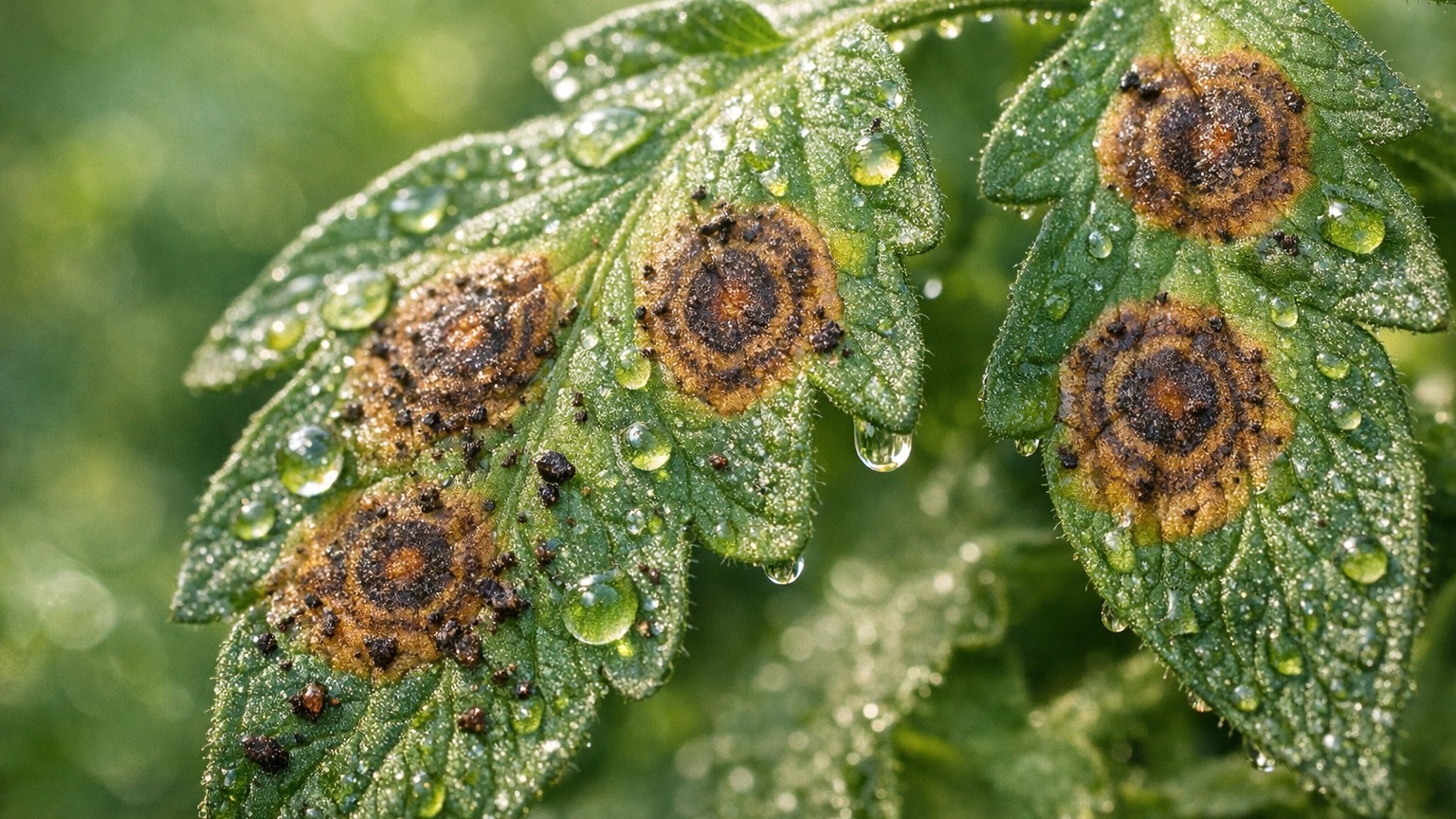
For years, the routine felt right: grab the hose, arc the water overhead, soak the plants, move on. The tomatoes looked green and growing. What wasn’t visible, not until a closer look at the lowest leaves one July morning — was a constellation of brown, bullseye-ringed spots quietly spreading upward from the soil. That was blight. And the watering can was the delivery system.
Key takeaways
- Your watering method might be the reason blight spreads faster than you think
- Fungal spores live in soil waiting for splash contact—and overhead watering delivers them directly to your plants
- A single infected leaf can trigger whole-plant collapse in just 5 days under the right conditions
The Mechanics of Blight You Never Think About
Blight spreads by fungal spores that are carried by insects, wind, water, and animals from infected plants, and then deposited on soil. The disease requires moisture to progress, so when dew or rain, or a garden hose, comes in contact with fungal spores in the soil, they reproduce. That last part is what most home gardeners miss entirely. The spores aren’t floating through the air looking for a leaf to land on. They’re already in your soil, waiting. And every time you water from above, you turn your garden bed into a splash zone.
When water hits the ground, it splashes soil and spores onto the lower leaves of plants, where the disease shows its earliest symptoms. Watch it happen in slow motion with any sprinkler on a bare patch of dirt: tiny droplets of soil-laced water fan outward in every direction. At six inches of height, the bottom leaves of a tomato plant are right in that splash radius. That’s not bad luck. That’s physics working against you.
Early blight and late blight behave differently once established, but share this same ignition point. Early blight is caused by the fungal pathogens Alternaria tomatophila and Alternaria solani. Despite the name, it usually appears in midsummer on mature plants, the “early” refers to the fact that it hits older tissue first. The hallmark is the target-board pattern: concentric brown rings inside a larger brown spot, giving each lesion a ridged, circular appearance about a quarter to half an inch wide. Late blight, on the other hand, is a different beast entirely: it can collapse a plant entirely within days under cool, wet conditions.
What Overhead Watering Actually Does to Your Leaves
In order for infection to occur, prolonged surface wetness of several hours is required; this is why blight is so serious in wet summers. Evening watering is particularly dangerous. Wet leaves heading into a cool night create exactly the sustained moisture window the pathogens need. The production of pathogen spores is promoted by moist conditions, 90 to 100% relative humidity, with moderate temperatures between 60 and 80°F. That’s a standard summer night across most of the United States.
Early blight thrives in warm, humid conditions, specifically 75 to 84 degrees Fahrenheit with extended leaf wetness. The word “extended” is doing the heavy lifting there. A quick splash that dries within the hour is unlikely to trigger an infection cycle. Leaves that stay damp from an evening watering session until mid-morning the next day are a different story. And if you’ve been running a sprinkler overhead to cover the whole bed at once? The combination of damp foliage and soil splash from overhead sprinklers can worsen a fungal problem significantly.
There’s also the matter of speed. After just 4 to 5 days of sufficient moisture and moderate temperatures, a new phase of sporulation can occur at the site of the initial infection. New sporangia are then carried by wind and splashed water to new plant tissue, creating fresh infections. Five days. That’s how quickly a single infected lower leaf can become a whole-plant problem, and then a neighbor’s problem, since late blight spreads through airborne spores that can travel miles on the wind.
The Fix Is Simple, But You Have to Actually Do It
Changing the angle of the water changes everything. Avoid wetting tomato foliage when watering. Apply water directly to the ground around plants with a soaker hose, slow-running hose, or watering can. If a sprinkler must be used, water in the morning so the foliage dries quickly. Morning watering is the right call for another reason: watering in the early morning lets any extra moisture evaporate before night falls, controlling the humidity conditions blight needs.
Mulch is the other half of the fix, and it works precisely because of the splash problem. Mulching reduces soil splash from rain or irrigation. It provides a physical barrier to fungal movement from the soil to the lower leaves. Two to three inches of straw or wood chips around each plant creates that buffer. The right conditions for blight are cool temperatures, wet conditions, and colonizing spores. Take any one of these out of the equation, and you can do a lot to halt or limit blight. Mulch takes out the “wet conditions” variable at the soil surface. Good watering technique takes out the “wet foliage” variable above it.
Spacing matters too, and most home gardeners plant too tightly. Blight loves stagnant, humid air. By giving plants proper space, you allow breezes to flow through, drying the leaves quickly after rain or morning dew. This drastically reduces the time spores have to germinate. The more airflow through the canopy, the faster the leaves dry, and the shorter that critical window of leaf wetness becomes.
When to Prune, When to Act
Lesions first develop on lower leaves as small, brownish-black spots which can expand to about a quarter to half an inch in diameter, with characteristic concentric rings in the darkened area. The area surrounding the lesions may become yellow, and as the disease progresses, the entire leaf may turn yellow. In later stages, lesions may appear in the upper leaves, and defoliation may occur in the lower part of the plant, leaving the fruit susceptible to sunscald. Catching it at the first-spot stage, before the yellow halos appear, is when removal actually helps. Cut the affected leaves, dispose of them in the trash, never compost them, and do it with clean tools. Snippers, cultivators, shovels, trowels, and any tool used on your tomatoes, potatoes, eggplants, and peppers should be disinfected before moving to another area of the garden.
For gardeners who’ve had repeat blight problems in the same bed for multiple seasons, the spore reservoir in the soil is likely already dense. The fungus can survive between seasons on crop debris in the soil. Crop rotation, moving tomatoes to a different spot every three to four years — breaks that cycle. Plant tomatoes where no tomatoes, potatoes, peppers, or eggplants have been for the past three to four years. For anyone with a small urban garden where rotating within the same raised bed isn’t realistic, refreshing the top few inches of soil each spring with clean compost reduces the density of lingering spores at the leaf-splash zone.
One last wrinkle worth knowing: most beloved heirloom varieties like ‘Brandywine’ or ‘Cherokee Purple’ are highly susceptible to blight. The trade-off for that extraordinary flavor is a plant with almost no natural resistance. If you grow heirlooms, you’re essentially gardening with the disease prevention fully on your shoulders, every watering decision, every pruning choice, every inch of mulch counts twice as much.
Sources : harvesttotable.com | growtomato.com