
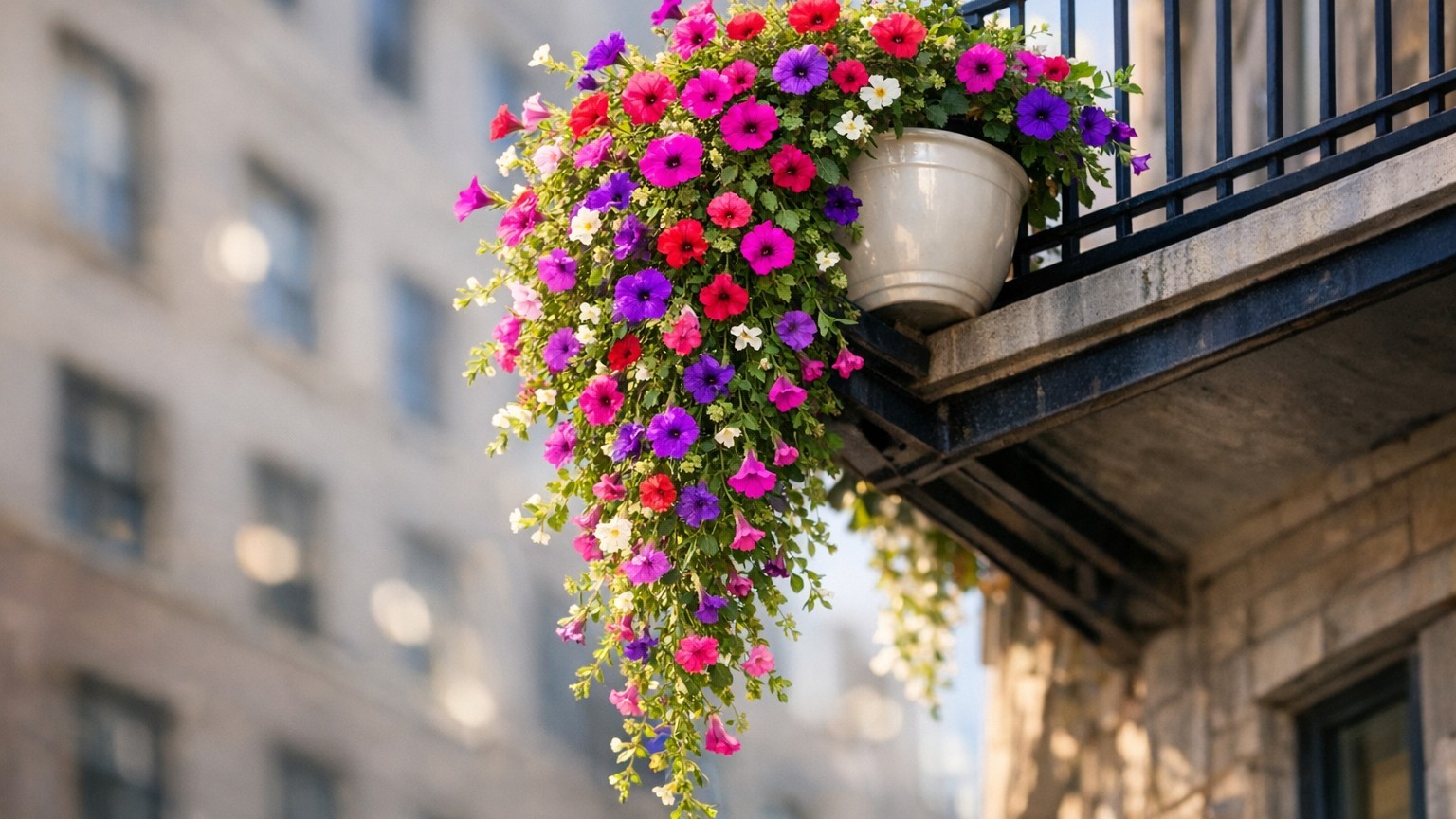
The geranium had a good run. For decades, rows of red-flowering pelargoniums lined apartment balconies across American cities, recognizable, sturdy, and cheap. But something has shifted. That very ease eventually worked against them. The same reds and pinks repeated from one building to the next, creating a frozen, uniform look. And heat waves have exposed a weakness many didn’t anticipate: geraniums can be thirstier than their reputation suggests. Urban gardeners have quietly moved on, and two plants in particular are now taking over the railing — the petunia (specifically the Surfinia type) for sun-drenched balconies, and the impatiens for shadier spots. Each solves a different problem the geranium never quite cracked.
Key takeaways
- The flower that dominated balconies for decades has a hidden weakness that brutal summers exposed
- One replacement creates cascades so dramatic they transform entire buildings from the street
- Another barely needs water once established—the game-changer for forgetful gardeners
The Geranium’s Real Weakness : It’s Not What You Think
In a pot exposed to full southern sun, a geranium can demand several waterings per week in August. The problem isn’t only heat, beyond 86°F (30°C), the soil inside the pot heats up from the morning, and much of the water poured in during the day evaporates before reaching the roots. The result: a constant cycle of stress, yellowing leaves, and a sad-looking balcony at exactly the moment summer should peak.
A geranium loves light, and it requires sustained watering to stay beautiful. On a north-facing balcony or one sandwiched between two buildings, it blooms less, exhausts itself quickly, and loses its charm. That’s the honest verdict. Geraniums thrive in specific, generous conditions that urban apartments rarely offer consistently. Add weekend trips, water restrictions, and increasingly brutal summers to the equation, and the case for switching becomes obvious.
The Surfinia Petunia: King of the Sunny Balcony
Leading the replacement charge, the petunia has taken a prized spot. This trumpet-shaped, intensely colorful flower forms full floral clouds in a short time. Trailing varieties, sold under names like Surfinia, transform window boxes into cascades that spill down railings. The visual effect is dramatic, especially from the street.
Spectacular in its trailing habit and continuous bloom, this hybrid petunia revolutionized the world of summer hanging baskets and window boxes. Developed in the 1990s in Japan, the Surfinia is a variety of Petunia x hybrida selected for its vigor, its ability to flower relentlessly, and its tolerance for outdoor conditions. Well maintained, it can bloom continuously from May through October, or even until the first frost. That’s six months of color, without replanting.
The watering question deserves honesty, though. In summer, watering is frequent, sometimes daily in a heat wave, especially in a pot or hanging basket. If you leave for a few days in summer, plan a watering system or ask someone to check in, because a Surfinia can suffer very quickly from drought in a small pot. This is not the plant for the truly forgetful gardener. Being sterile, Surfinias produce fewer seeds and offer prolonged flowering — which is the biological reason they bloom so freely. That sterility, a product of Japanese horticultural engineering, is actually the secret behind their nonstop show.
Lantana: The Flower That Simply Doesn’t Quit
For gardeners who genuinely cannot water every day, or who want something that laughs at heat waves, lantana is the real answer. In the lead among heat-tolerant options, lantana forms multicolored clusters from May to October and thrives in full sun. Native to tropical America and South Africa, it was designed by nature for exactly the conditions that punish geraniums.
Lantana blooms continuously from planting until frost, or nearly year-round in regions where it grows as a perennial shrub. Colors include pink, orange, red, yellow, lavender, and white, occurring in single, bicolor, or multicolor patterns. A single pot can display three colors at once as the clusters evolve, a feature no other common balcony plant offers. Once established, lantana is drought tolerant. After an initial establishment period, it needs watering only once a week. That’s a radical difference from the daily summer ritual that petunias and geraniums demand.
Lantana also does well in pots when you’re short on garden space. Use a container at least 12 to 14 inches in diameter with drainage holes. One practical note: lantana can be toxic to pets if ingested. Keep it out of reach from curious cats and dogs. The flowers attract pollinators such as butterflies, bees, and hummingbirds, a genuine bonus on any urban balcony that feels cut off from nature.
Impatiens: The Shade Specialist Everyone Underestimates
Impatiens thrives in places other plants avoid: a shaded corner, filtered light, a balcony that stays cool in the morning. Where the geranium exhausts itself, it keeps flowering. For north-facing apartments and balconies hemmed in by neighboring buildings, the situation for millions of city dwellers, impatiens is not a compromise. It’s the right tool for the job.
The real surprise is its adaptability. Impatiens tolerates filtered light, slightly cool temperatures, and even occasional missed waterings. It doesn’t love prolonged drought, but it bounces back quickly once the soil becomes moist again. Its foliage stays dense and tidy, even in a somewhat windy spot. It also occasionally attracts bees and butterflies. On a city balcony, that small movement immediately brings more life.
Care is minimal but specific. To keep impatiens beautiful for a long time, remove faded flowers regularly. This quick gesture genuinely helps the plant produce new buds. A monthly application of a liquid fertilizer low in nitrogen can also extend the flowering period. Too much nitrogen, the mistake many beginners make, feeds leaves at the expense of flowers. Another reassuring detail: impatiens are non-toxic to dogs and cats, which matters more than it sounds when you’re choosing a plant for a shared household.
The bottom line on all three geranium replacements is this: the choice depends entirely on your specific balcony, not on trends. Lantana’s exceptionally long blooming season, heat and drought tolerance, and adaptable growth habits make it ideal for pots, window boxes, and hanging baskets, even with minimal watering. Surfinias win on pure visual spectacle, provided you can water consistently. And impatiens covers the shaded spots that neither lantana nor petunias can handle well. What’s changed isn’t gardening — it’s the honest acknowledgment that one default flower was never going to work for every balcony in every city in every climate.
Sources : gardeningtheme.com | epicgardening.com