
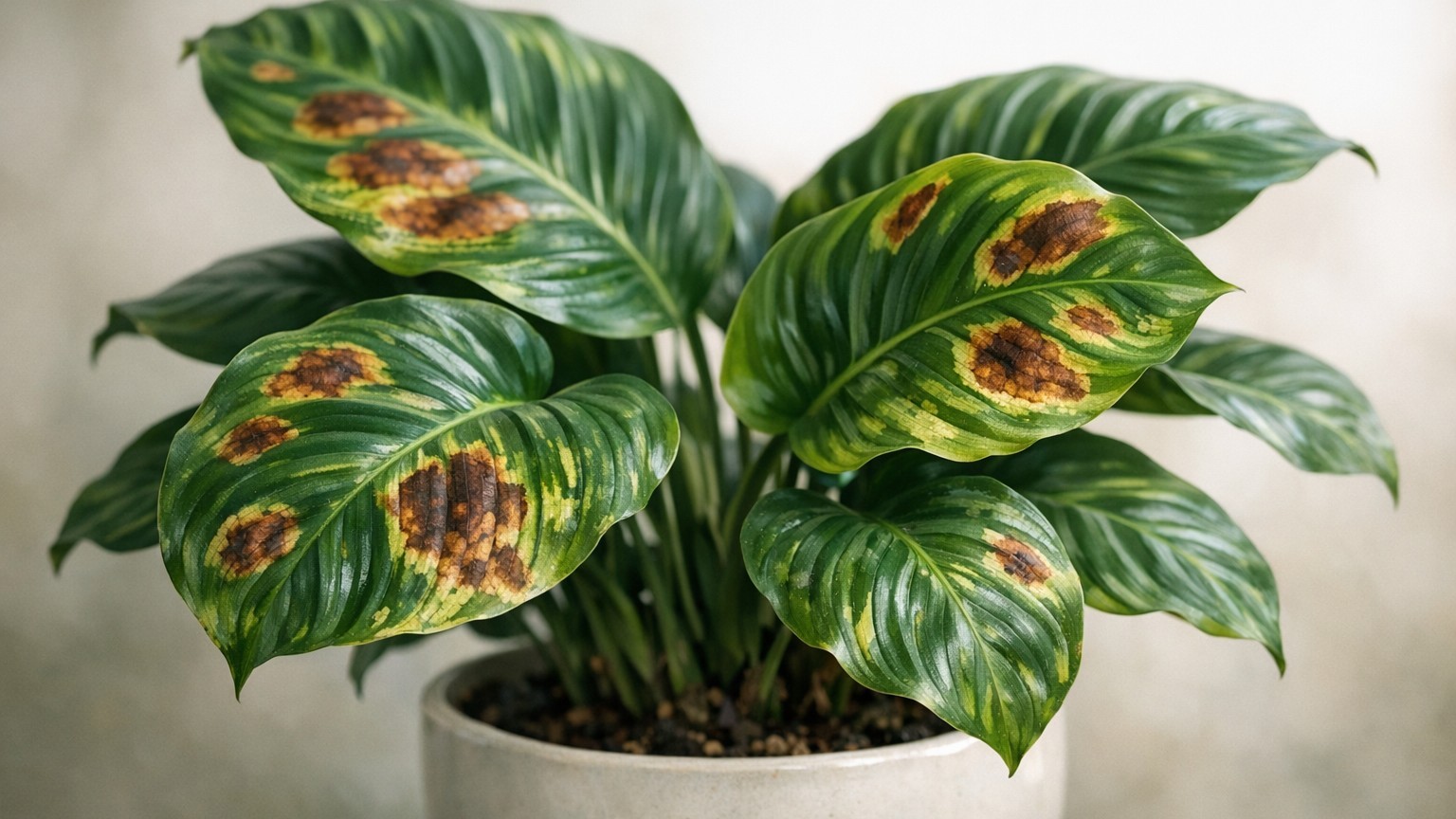
Brown spots on Calathea leaves are one of the most common complaints among houseplant owners, and misting is almost always the culprit, even when it feels like the most caring thing you can do. The logic seems sound: tropical plants come from humid rainforests, so spraying water on their leaves should replicate that environment. The reality is considerably more complicated, and a daily misting routine can quietly damage the very plant you’re trying to protect.
Key takeaways
- Why the most caring thing you’re doing for your Calathea might actually be harming it
- The sneaky way mineral deposits and fungi thrive on wet leaves—and how brown spots reveal the damage weeks later
- The counterintuitive humidity secret that tropical plant experts have known for decades
Why Misting Feels Right But Often Isn’t
Calatheas are native to the tropical forests of South America, where humidity regularly exceeds 80%. That’s not a gentle mist from a spray bottle twice a day, that’s a constant, ambient moisture surrounding the entire plant, roots included. A spray bottle delivers a fundamentally different experience: brief surface wetness followed by evaporation, which can actually leave mineral deposits on the leaves if your tap water is hard. Over weeks, those deposits accumulate and disrupt the leaf tissue.
The brown spots that appear from misting usually show up at the edges or tips first, which is easy to confuse with underwatering. But the mechanism is different. When water sits on Calathea leaves and doesn’t evaporate quickly enough, it creates the perfect conditions for fungal issues — Helminthosporium leaf spot being one of the most common offenders. The spots spread outward from a dark center, and no amount of extra misting will fix damage that misting caused in the first place.
There’s also the timing problem. Misting in the morning sounds responsible, the plant has all day to dry off. But in a home with moderate air circulation, water on broad Calathea leaves can linger for hours, especially in rooms without direct airflow. The leaves of Calatheas are particularly susceptible because they’re wide, textured, and held horizontally — a natural water-collecting surface.
What Calatheas Actually Need Instead
The goal is ambient humidity, not wet leaves. Those are two completely different things, and mixing them up is where most Calathea frustration begins. A humidifier placed nearby raises the moisture level of the surrounding air without ever touching the plant’s foliage. This is how tropical forests work, the air itself is saturated, not the individual leaves.
Pebble trays are another practical option. Fill a shallow tray with pebbles, add water below the surface level of the pebbles, and set the pot on top. As the water evaporates, it creates a microclimate of higher humidity directly around the plant. It won’t replace a humidifier in a very dry home, but it’s a passive system that requires almost no effort and carries zero risk of leaf damage.
Grouping plants together also raises local humidity through transpiration, plants constantly release water vapor through their leaves, and a cluster of several plants creates a noticeably more humid environment than a single specimen sitting alone on a shelf. A Calathea next to a pothos and a peace lily will generally fare better than the same Calathea isolated in a dry corner.
The other half of the equation is soil moisture management. Calatheas want consistently moist soil, not soggy, not bone dry between waterings. The roots staying evenly moist matters far more than anything happening at the leaf surface. A common mistake is overcompensating for dry air by watering more frequently at the roots, which risks root rot, while simultaneously misting the leaves, which risks fungal spots. Both habits compound the problem rather than solving either one.
Reading the Damage Your Plant Is Trying to Show You
Brown spots don’t all mean the same thing on a Calathea, and diagnosing them correctly changes how you respond. Crispy brown edges with no dark center typically point to low humidity or inconsistent watering. Soft, dark spots with a slightly mushy texture suggest fungal or bacterial activity, often misting-related. Yellow halos around brown spots can indicate a bacterial infection, sometimes introduced when water sits on the leaf surface long enough to harbor pathogens from the air.
Calathea leaves also brown from fluoride and chlorine in tap water, the plant is sensitive enough that these minerals, harmless to most houseplants, cause visible tip burn over time. Switching to filtered water or leaving tap water out overnight to off-gas the chlorine makes a real difference. If you’ve been misting with straight tap water daily, you’ve been delivering two potential irritants at once: excess surface moisture and chemical residue.
Once brown spots appear, they won’t reverse. The tissue is damaged. The practical response is to trim the affected areas with clean scissors to prevent fungal spread, then adjust the environment rather than the leaf care. Moving the plant to a bathroom with natural light, where shower steam provides genuine ambient humidity, has rescued more than a few struggling Calatheas without any additional intervention.
The Counterintuitive Truth About Plant Humidity
Most houseplant advice defaults to “mist regularly” as a catch-all for tropical species, and the recommendation persists because it sounds logical. But plant physiology doesn’t reward surface-level solutions. A 2019 review of horticultural practices noted that foliar wetting in low-airflow environments consistently increased disease incidence in broadleaf tropical plants, findings that align with what experienced growers have observed anecdotally for decades.
Calatheas have a reputation for being difficult, but much of that reputation is built on this single misunderstanding. Given stable humidity around 50-60%, consistent soil moisture, filtered water, and indirect light, they’re actually forgiving plants. The difficulty is largely self-inflicted, through the well-meaning daily ritual of a spray bottle that delivers stress disguised as care. A hygrometer costs less than $15 and gives you actual data on your home’s humidity levels, which is a more honest starting point than guessing and misting.