
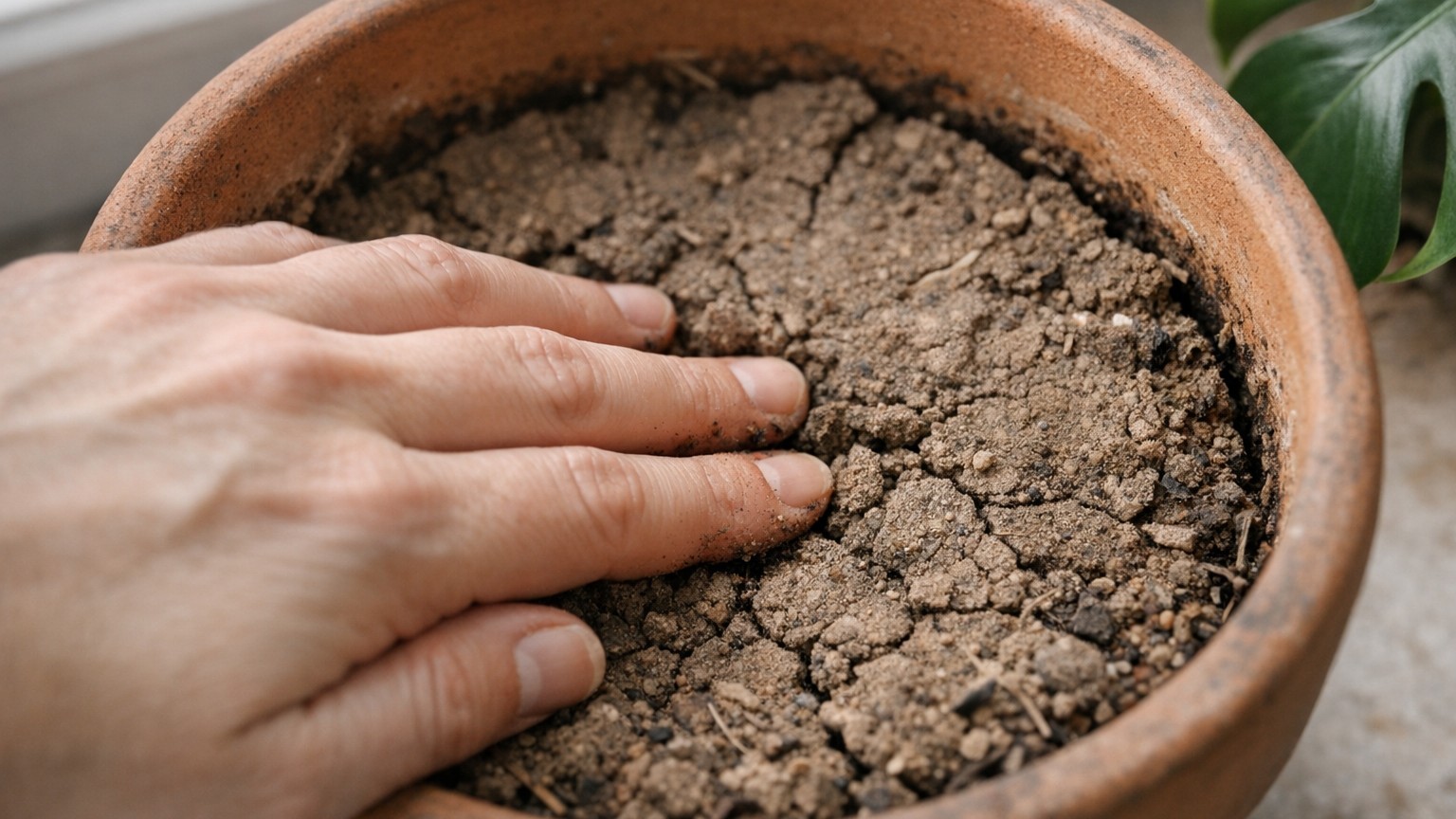
A Monstera that simply refuses to grow is one of the more maddening experiences in plant keeping. You water on schedule. You fertilize every two weeks. You rotate the pot toward the window. And yet the plant just sits there, frozen in place, occasionally mocking you with a single unfurling leaf that takes three months to complete the job. That was my situation, until the day I pressed my fingers against the soil and felt something I should have noticed much earlier.
Key takeaways
- Hydrophobic soil can repel water entirely, leaving your Monstera in a hidden drought no matter how often you water
- Fertilizer becomes toxic to root-bound plants and can’t be absorbed without proper soil moisture—solving water comes first
- Your Monstera might be screaming for help underground while its leaves look perfectly healthy on the surface
The clue was in the roots, not the leaves
The soil felt bone dry. Not just surface-dry, but genuinely parched several inches down, despite the fact that I had watered two days prior. That contradiction is the tell. When water runs straight through the pot and out the drainage holes without saturating the root zone, the plant receives almost nothing, even though you’ve technically watered it. The term for this is “hydrophobic soil,” and it’s far more common than most houseplant guides acknowledge.
Potting mix that has dried out completely, especially mixes with a high peat content, repels water rather than absorbing it. The liquid finds the path of least resistance, usually a gap between the dried soil and the edge of the pot, and drains away before the roots can drink. Your Monstera is essentially sitting in a drought while you congratulate yourself for consistent watering. Months of this will stall growth completely, because a plant under water stress redirects all its energy toward survival, not new leaves.
The fix is simpler than you’d expect: bottom watering. Set the pot in a basin of water for 30 to 45 minutes and let the soil wick moisture upward from the drainage holes. Do this once or twice, and the substrate rehydrates properly. After that, top watering works normally again, at least until the soil dries out and compacts once more.
Why fertilizer doesn’t solve what water can’t fix
Adding fertilizer to a Monstera with hydrophobic soil is like pouring protein shakes into a car’s gas tank. The plant cannot uptake nutrients without adequate moisture in the root zone. Fertilizer salts that aren’t absorbed accumulate in the soil, and over time they create a toxic environment that burns roots, compounding the problem. This is called fertilizer salt buildup, and it’s a silent grower-killer that rarely gets discussed alongside the more photogenic issues like yellowing leaves.
There’s a broader lesson here about the order of operations in plant care. Water is the medium through which Everything else travels, nutrients, hormones, cellular signals. Solve the water issue first, always. A Monstera in perfectly fertilized, nutrient-rich soil that is consistently dry will still refuse to grow. The biology doesn’t negotiate.
One additional factor worth examining: the frequency of fertilizing during low-light months. Monsteras in a Chicago apartment in January are receiving maybe four to five hours of indirect light. Growth slows dramatically, and the plant’s nutritional demands drop accordingly. Continuing to fertilize at summer rates during winter is one of the most consistent ways hobbyist growers damage their plants without realizing it, the roots simply cannot process what they’re being given.
Root-bound stress and the pot size trap
After I fixed the watering issue, the Monstera still didn’t resume growing at the pace I expected. That sent me to the next logical step: unpotting to inspect the roots. What I found was a dense, circling mass of roots that had completely filled the container, with several thick roots spiraling around the drainage holes. The plant had been root-bound for at least a season.
A root-bound Monstera is not always a bad thing, the species actually tolerates and sometimes prefers a slightly snug pot. But there’s a threshold. Once the roots have no remaining space to expand, the plant signals itself to stop investing in top growth. The root-to-shoot ratio becomes the limiting factor. Repotting into a container that’s roughly two inches wider in diameter gave the plant room to push again. Within six weeks, two new leaves had emerged from the central stem.
The repotting also gave me a chance to refresh the soil entirely. I switched from a standard peat-heavy potting mix to a chunkier blend: a base of regular potting mix combined with perlite and a portion of orchid bark. This type of mix drains quickly, stays aerated, and, critically, does not go hydrophobic when it dries out. The bark and perlite create enough air pockets to keep the structure loose even after weeks without water. It’s the single change that has made the most lasting difference to how the plant behaves.
The tactile habit most plant owners skip
Checking a plant visually tells you very little about what’s happening at root level. Leaves can look glossy and green while the root zone is in crisis : Monsteras are particularly good at maintaining the appearance of health while quietly suffering underground. The habit of physically touching the soil, pressing down an inch or two, and noting the actual moisture level is information that no amount of visual inspection can replace.
Some growers use a moisture meter, which works well enough, though they require occasional calibration and can give false readings in very chunky soil. The finger test, unglamorous as it sounds, remains one of the more reliable diagnostic tools available. Two seconds of contact with the soil every few days would have told me everything I needed to know months before I finally paid attention.
Interestingly, researchers studying root behavior in container-grown tropical plants have found that soil structure degrades meaningfully within 12 to 18 months of repotting, even with careful watering habits. The organic components break down, compaction increases, and aeration drops. For long-term Monstera growers, this suggests that a full soil refresh every year and a half is less optional maintenance and more basic plant biology.