
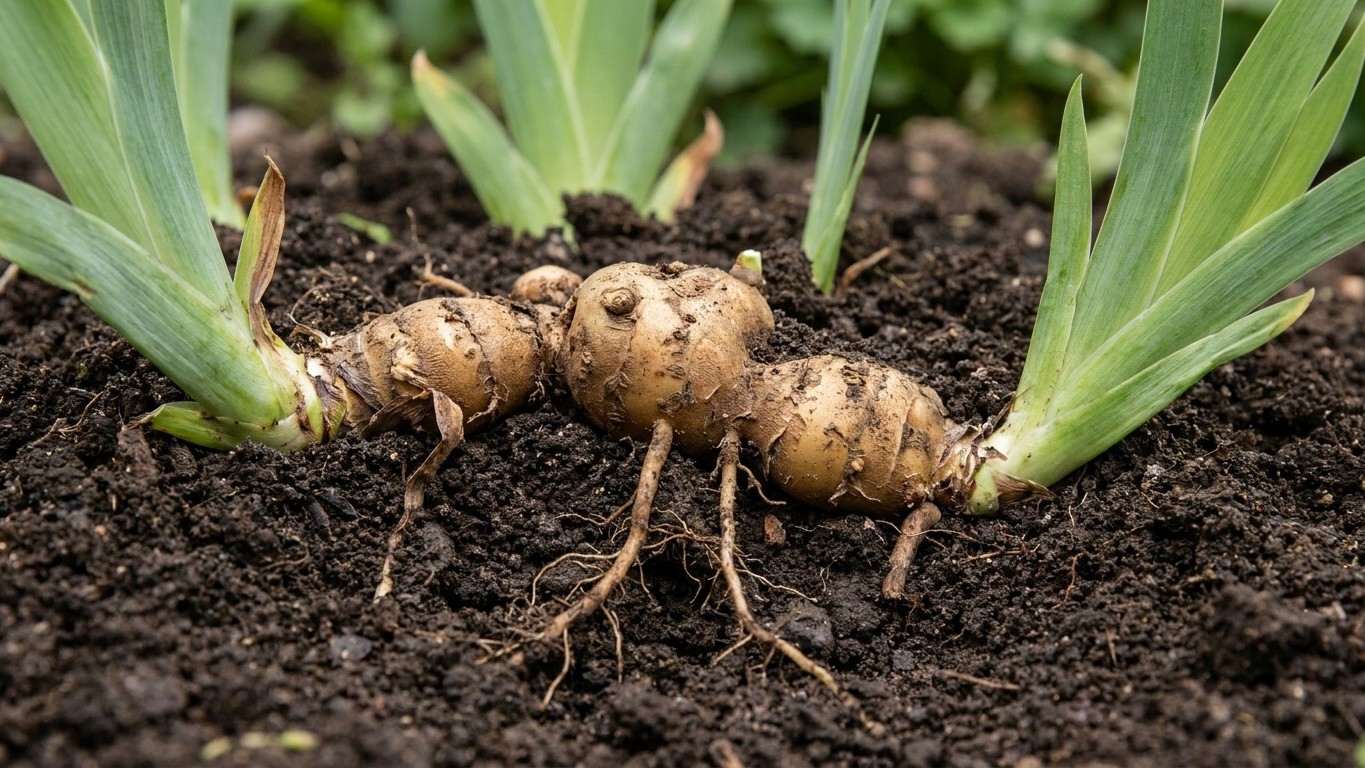
A rhizome tucked too far under the soil doesn’t rot right away. It doesn’t wilt, doesn’t yellow, doesn’t send any obvious distress signal. It just sits there through fall and winter, quietly building leaves that look perfectly healthy come spring. Then June arrives, the neighbors’ iris beds explode into ruffled purples and golds, and yours produce nothing but a fan of green blades. That silence is the tell. Bearded iris rhizomes need to breathe at the soil surface, not hide beneath it, and burying them “for protection” is one of the most common ways gardeners accidentally sabotage next year’s blooms.
Key takeaways
- A rhizome buried ‘for protection’ shows no symptoms until June—then mysteriously refuses to flower
- The plant needs direct sunlight and temperature fluctuations to trigger its blooming alarm clock
- Moving a too-deep rhizome to the surface in late summer can rescue an entire season of lost flowers
Why a rhizome buried for safety backfires
The instinct makes sense. A rhizome dividing in August looks exposed, almost defenseless, sitting there in the heat with cut ends still healing. Piling on a generous layer of soil feels like tucking it in before winter. But bearded iris don’t behave like tulip or daffodil bulbs, which genuinely want depth and darkness. Unlike bulbs, which thrive deep underground, bearded iris rhizomes need a bit of sun and air to dry them out. If they’re covered with soil or crowded by other plants, they’ll rot. The rhizome is essentially a modified stem sitting horizontally in the ground, and it’s built to bake in direct light, not to disappear.
That baking isn’t decorative. For the plant to produce flowers, the top of the rhizome must sit at or slightly above the soil surface, where it can receive direct sunlight. It needs to “bake” in the summer sun to set buds for the following year. Cover it up, and the plant doesn’t just skip a cosmetic step. When the rhizome is buried too deeply under soil or mulch, the plant shifts its energy into survival and leaf growth instead of blooming, and it also becomes much more prone to rot. The foliage you’re admiring in May is essentially the plant’s way of saying “I’m alive,” while the flower buds it never got the signal to form stay dormant underground.
There’s a second mechanism at play, one most gardeners never hear about. Bearded irises rely on temperature fluctuations around the rhizome to initiate blooming cycles. When buried too deep, the soil insulates it, dulling these signals. Think of it as a seasonal alarm clock. The rhizome needs to feel the swing between a scorching August afternoon and a cool September night to know it’s time to prepare for next year’s show. Bury it under three or four inches of soil, and that alarm clock stops ringing.
What the correct planting depth actually looks like
The University of Wisconsin’s extension service puts it plainly: Bearded irises grow from thick rhizomes that should be at or just below the soil surface. Not two inches down. Not “mostly covered for safety.” At or just below, with the top visibly peeking out of the ground like a partially surfaced potato.
Illinois Extension describes the planting technique in concrete terms: dig a hole about four inches deep with a small mound in the middle of the hole. Place the rhizome on top of the mound and let the roots fall down the sides of the mound. The roots go down, the rhizome itself stays up, and only a thin skin of soil should ever touch its back. After spreading the roots out, cover them with soil, so the rhizome is just slightly exposed. Do not plant the rhizome too deep because this can lead to issues with root rot.
Climate does introduce one exception worth knowing. Iris should be planted so the tops of the rhizomes are exposed and the roots are spread out facing downward in the soil. In very light soils or in extremely hot climates, covering the rhizome with 1 inch of soil may be desirable. That’s the ceiling, though, a single inch in sandy soil or blistering southern heat, not the four or five inches a well-meaning gardener might pile on out of caution. If you’re gardening in a typical clay-loam mix anywhere in the Midwest or Northeast, skip the extra cover entirely.
Rescuing a buried clump without waiting another year
The good news is that a too-deep rhizome usually isn’t dead, just dormant in the wrong sense of the word. Checking the depth takes less effort than most gardeners expect. If you think your irises are planted too deep, start by checking the depth. Gently brush away the soil around the base of the leaves until you can see the top of the thick, potato-like rhizome. If you have to dig more than about an inch to find it, it is too deep.
Fixing it means lifting the whole clump rather than just scraping soil off the top, since a rhizome that’s spent months underground has often rooted itself deeper than the surface soil alone. Start by gently lifting the entire plant with a garden fork, which is less likely than a shovel to slice through the fleshy rhizome, then loosen the soil in the planting area and form a small mound in the center of the hole. Set the rhizome directly on top of this mound, allowing the true roots to drape naturally down the sides into the deeper soil.
Timing matters almost as much as depth. For best results, plant iris rhizomes in July, August or September. This is also the best time (plants are normally dormant during the heat of July and August) to divide and replant iris that have become overcrowded, usually after three to five years. Fix the depth problem now, in late summer, and there’s a real chance of seeing blooms next June rather than losing an entire second season to trial and error. And once it’s replanted correctly, resist the urge to mulch heavily around it come fall. Do not mulch over the rhizomes, mulch traps moisture against the crown and invites rot. Keep mulch and competing plants pulled back a few inches from the rhizome itself. The same protective instinct that buried it the first time is exactly what will bury it again if you’re not careful.
Sources : easytogrowbulbs.com | extension.illinois.edu