
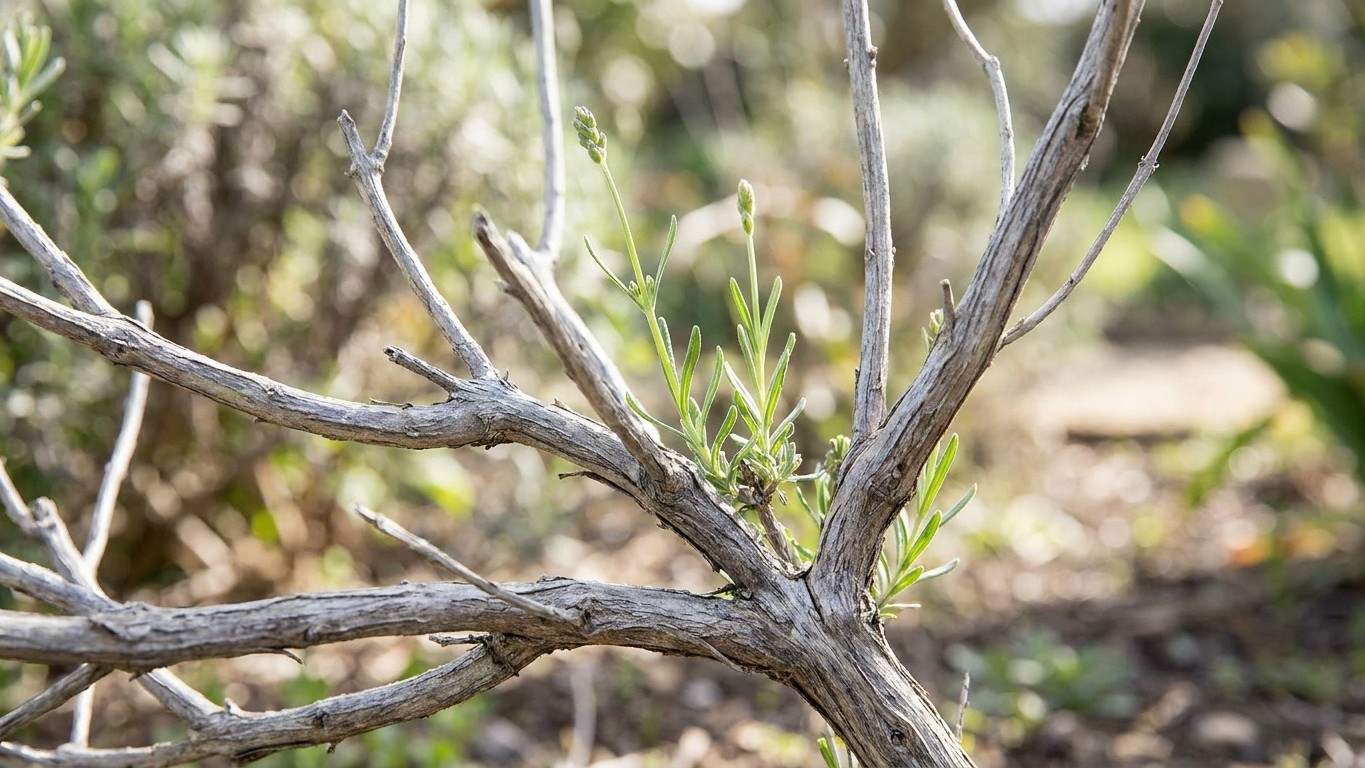
Two green stems. That was the entire spring harvest on a lavender bush that had filled half a border for three summers straight. The rest of the plant looked like driftwood: gray, brittle, completely bare. The mistake had been made the previous August, in the name of tidiness, with a pair of hedge shears and zero research. The cut had gone too deep, straight through the woody base, and lavender does not forgive that kind of haircut.
Key takeaways
- A perfectly timed August prune can still kill lavender if the shears go too deep
- That gray, woody base hiding under your hedge shears has no dormant buds left to activate
- One simple rule separates lavender resurrection from permanent damage
Why a “tidy” cut can be a death sentence
Lavender looks like a shrub, but botanically it behaves more like a perennial with a woody skeleton. Every spring it produces soft green growth, and every year that growth gradually turns to bark-like wood at the base. Lavenders are semi-shrubs, meaning that they produce green growth every spring, like all perennials, but older stems become woody as the plant grows older. The problem is that this woody base has essentially no dormant buds left to activate.
You must never cut into the bare, woody part of the stem. That hard, brown wood at the base of the plant has no dormant buds waiting to sprout. Unlike roses or other shrubs that can regrow from old wood, lavender cannot regenerate from bare stems. If you cut too far down into the woody base, the branch simply will not recover. That single fact explains the two lonely stems in May. Cutting the plant “hard back to keep the border tidy” almost certainly meant cutting well past the green tissue and into the part of the stem that had already turned to wood, a section incapable of pushing out anything new.
The frustrating part is that late August isn’t the wrong season, it’s actually the recommended one. The best time to prune is after they have flowered, i.e. late summer or early fall but they can also be pruned in late winter or early spring. Timing wasn’t the issue here. Depth was.
The one-third rule that actually works
Professional growers repeat the same guideline so often it’s practically a mantra: never remove more than a third of the plant, and always stop above the line where green tissue ends and gray wood begins. Cut back the shrub to about 1/3 of its original height but do not cut down to the woody area as old wood will not generate new green growth. Leaving 3 or 4 buds above the woody part of a stem is a good rule. That margin of green stem, the part that still has visible leaf nodes, is where next year’s growth actually comes from.
Garden Design’s pruning guide frames the technique the same way: always make your pruning cuts above new leaf growth rather than cutting into the woody sections of the plant, since lavender will not form new growth on old wood. The exception is dead or damaged stems, which should be removed right down to the base. In practice, that means eyeballing every stem before the shears go anywhere near it, not just running a hedge trimmer across the top of the mound in one confident sweep.
Timing matters at the other end of the calendar too. Pruning shouldn’t happen right before the cold sets in. Don’t prune lavender in late fall, or any later than at least 6 weeks before your first frost date, which can make your plants more vulnerable to damage from cold weather. Plants need several weeks to recover from pruning before winter arrives. A hard cut combined with an early frost is basically a one-two punch a stressed plant may not survive.
What to do with a lavender that’s already down to two stems
Not every over-pruned lavender is a lost cause, but the odds depend entirely on how much living tissue remains. If the whole plant is gray and leafless, there’s no realistic fix. If there is no green wood anywhere on the plant, it cannot regenerate, replace it. If there is even 5 to 8cm of green showing on some stems, a careful two-year trim plan can bring it back. Two stems with visible green counts, barely, as a plant still worth trying to save.
The rescue plan is slow by design. Rather than forcing a full recovery in one season, growers space the correction over two pruning cycles. It takes two seasons. Prune in August firmly, ensure water, and the next year prune again. After two seasons you are back to a good size. Trying to rush it, cutting hard again this coming August in hopes of “fixing” the shape faster, would very likely finish the job the first cut started.
In the meantime, patience is the only tool that matters. Skip the fertilizer, since lavender evolved in poor, rocky Mediterranean soil and excess nutrients shoot up weak, floppy growth. Skip the feed, good drainage matters far more than fertiliser. Water only during genuine dry spells, let the two surviving stems do their quiet work, and resist the urge to reshape anything else on the plant this year.
There’s a silver lining buried in this whole ordeal: English lavender varieties are actually among the most forgiving when it comes to hard pruning, as long as the cut stays inside the green zone rather than crossing into bark. English lavender tolerates hard pruning reliably. The border isn’t necessarily doomed. But the plant that grew back from two stems will likely take two full seasons to look like the dense, rounded mound it used to be, and every August pruning from now on deserves a slower, closer look at exactly where the green ends and the wood begins.
Sources : ashridgetrees.co.uk | gardeningknowhow.com