
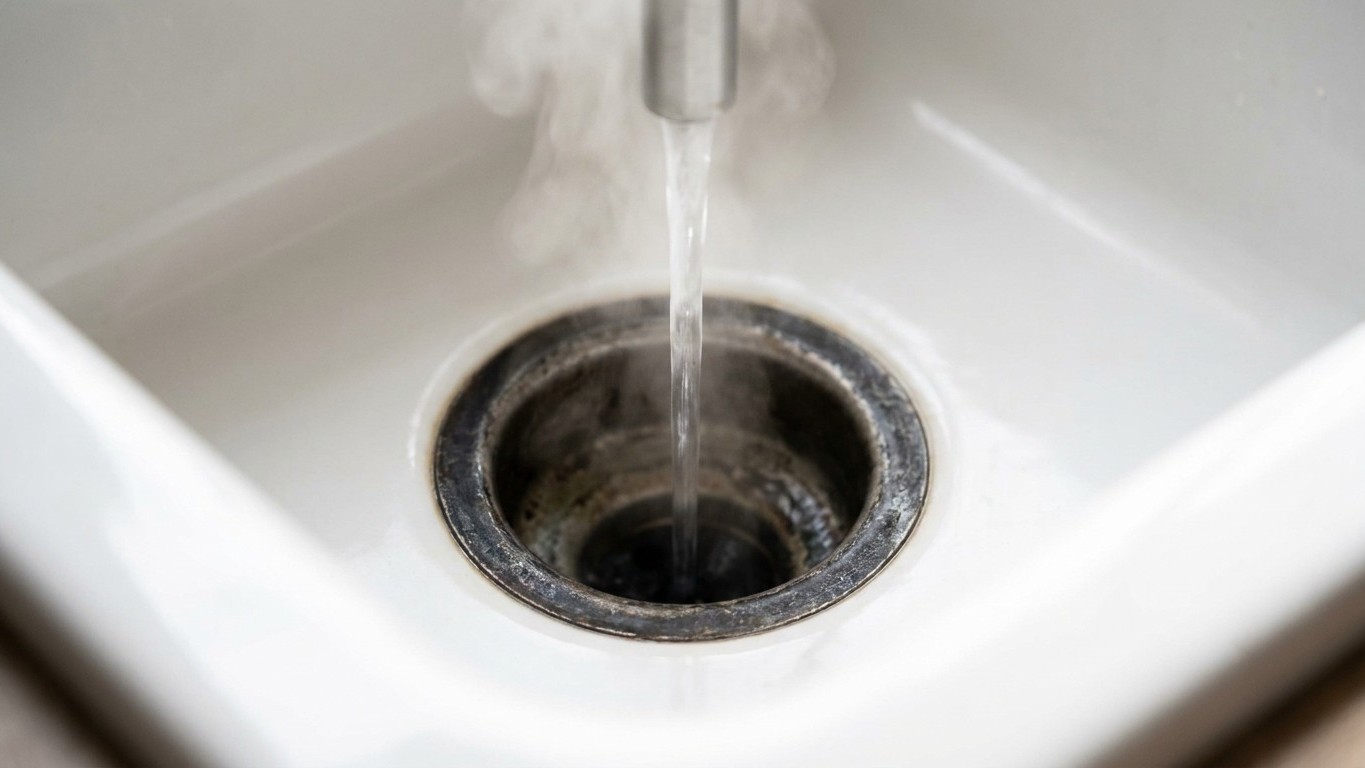
Four days. That’s how long it took for the swarm to reappear after a full purge of the fruit bowl, complete with a trash bag sent straight to the outdoor bin. No bananas, no peaches, not even a stray potato with a soft spot. And yet there they were again, circling the kitchen sink like nothing had happened. The reason turns out to have nothing to do with fruit at all.
Key takeaways
- The fruit bowl was never the actual crime scene—it was just where the evidence landed
- A single female fruit fly lays up to 500 eggs in your drain’s biofilm, hatching in 24-30 hours
- Store-bought traps catch adults while hundreds more develop unseen in the slimy P-trap beneath your sink
The real nursery was never the counter
The #1 breeding ground for fruit flies in homes isn’t your fruit bowl, it’s your kitchen and bathroom drains. Every rinsed plate, every washed vegetable, every dribble of juice down the drain leaves behind microscopic residue. Every time you rinse produce, wash dishes, or dispose of food scraps, tiny organic particles wash down your drain, and over time these particles accumulate in the curved pipe trap beneath your sink, creating a layer of biofilm, a warm, moist, nutrient-rich environment that fruit flies absolutely love. That slimy coating clinging to the inside of the P-trap isn’t just gross, it’s a five-star nursery.
The math explains why tossing the bananas felt like a solution that lasted about as long as a sneeze. Fruit flies begin life as eggs, which adult female fruit flies lay on moist, organic surfaces where their larvae can feed and develop, and a single female can lay up to 500 eggs, often depositing them in areas rich with decaying food or organic buildup, like the inside of your sink drain. From there, the clock moves fast. Eggs hatch within 24 to 30 hours, larvae feed on the organic matter and bacteria thriving in the damp environment for about 4 to 6 days, and pupation follows for roughly 4 days before emerging as adult flies. Add it up and you land almost exactly on that four-day reappearance, plus a couple more days for the visible swarm to build back to an annoying density.
Emptying the fruit bowl removes the smell that first drew flies indoors, sure. But you don’t have fruit flies because you have fruit, you have fruit flies because you have breeding sites, and the biggest one is probably right under your sink. Kill the adults, and the larvae already embedded in the drain film just keep developing on schedule, blissfully unaware that the counter upstairs is now spotless.
Why store-bought traps keep you busy without finishing the job
Vinegar traps, sticky paper, plug-in zappers, they all share the same blind spot. Traps only catch adult flies and do absolutely nothing about the hundreds of eggs hatching in your drain every day, so while you’re catching ten adults in your vinegar trap, a hundred more are developing in the biofilm beneath your sink. It creates the illusion of progress, a jar full of drowned flies feels like a win, while the actual factory downstairs keeps humming.
Federal pest-management guidance backs this up in plain terms. According to EPA integrated pest management principles, effective pest control requires eliminating breeding sites, not just catching adults, because traps are reactive while prevention is proactive. the fruit bowl was never the crime scene. It was just where the evidence happened to land.
Telling a fruit fly apart from its cousin, the drain fly, matters too, since the fix differs slightly. Fruit flies have bright red eyes that are easy to see while drain flies have small, dark eyes, and this simple check tells you which pest you have right away. Drain flies are weak fliers that stay close to drains, while fruit flies dart around quickly near produce and garbage. Both, though, treat a neglected P-trap as prime real estate.
Clearing out the biofilm, not just the flies
Boiling water is the cheapest first move, and it works better than most people expect when it’s actually boiling, not just hot from the tap. Pour boiling water directly down affected drains to kill larvae and eggs, most effective when done in the evening after the drain hasn’t been used for several hours, and repeat daily for at least three days to break the breeding cycle. A single dousing rarely clears an established colony; consistency over the better part of a week matters more than intensity on any single day.
Baking soda and vinegar add mechanical scrubbing power to the heat. Mix half a cup of baking soda with a cup of white vinegar, since the foam will kill the flies and eggs, then let it fizz for 30 minutes before rinsing with boiling water to flush out loosened residue. For drains that have clearly gone untouched for months, a stiffer approach helps loosen what’s stuck to the pipe walls. Use a long drain brush or plumbing snake to scrub the inside of the drain and dislodge organic matter. This is the unglamorous part nobody mentions on the label of a spray bottle, but it’s where the actual larvae live, wedged in a layer of gunk you can’t see from above the sink.
Enzyme-based products offer a gentler, longer-term follow-up once the initial buildup is gone. Instead of harsh chemicals, enzyme-based drain cleaners use natural bacteria to break down food particles and grease. Monthly maintenance with one of these, paired with a weekly hot-water flush, keeps the biofilm from reaching the thickness that turns a drain into a breeding chamber again. Skip that maintenance, and the whole cycle restarts quietly, waiting for someone to notice the flies before noticing the smell.
The overlooked culprits beyond the kitchen sink
Bathroom drains, floor drains in basements, and even the overflow hole on a bathroom sink can harbor the same biofilm, often ignored because nobody associates fruit flies with a room that has no fruit in it. They enter occupied spaces through floor drains, sink drains, and any drain opening that lacks a functioning seal. A rarely used guest bathroom, dry-trapped for weeks, can quietly become the source while the kitchen gets blamed and re-scrubbed for nothing.
Garbage disposals deserve a second look too, since their nooks trap produce scraps long after the visible mess is gone. Running one with ice cubes and a splash of citrus peel helps scour the blades, but it won’t reach the biofilm coating the drainpipe below, which is exactly why the vinegar-and-baking-soda routine still matters even in homes that grind their scraps religiously. The fruit bowl was never lying. It just wasn’t the whole story, and the sink downstream had been keeping the rest of it the entire time.
Sources : trident-plumbing.com | terminix.com