
Rain was coming, the forecast said so, and the potato tops had already flopped over in the bed. Pulling them early felt like a smart move: beat the weather, get the tubers out of wet soil, tuck them away before the ground turned to soup. Three months later, cracking open that storage crate in December revealed a mess of soft, weeping spots and a smell that meant only one thing. The potatoes hadn’t rotted from bad luck. They rotted because the step between “dug up” and “stored” got skipped entirely.
Key takeaways
- Flopped foliage doesn’t mean harvest-ready—potatoes need 2-3 more weeks for skin maturation
- A mysterious two-week ‘curing’ process seals potato wounds and thickens protective skin layers
- One damaged tuber in a sealed crate can trigger a chain reaction that destroys an entire winter supply
Foliage flopping over is only half the signal
Yellowing, wilting leaves tell you the plant has stopped feeding the tubers, but that moment alone isn’t the green light for a harvest destined for winter storage. For main crop potatoes that will last through winter, gardeners are advised to wait another two to three weeks, until the foliage has completely died back and the skins toughen up. That extra waiting period isn’t wasted time. Once the stems of the potatoes have completely died back, the potatoes can remain in the garden for up to another 2-3 weeks as long as the soil isn’t overly wet, too hot, or freezing. Skipping straight from flopped-over tops to the shovel means digging up tubers with paper-thin skins that bruise if you look at them wrong.
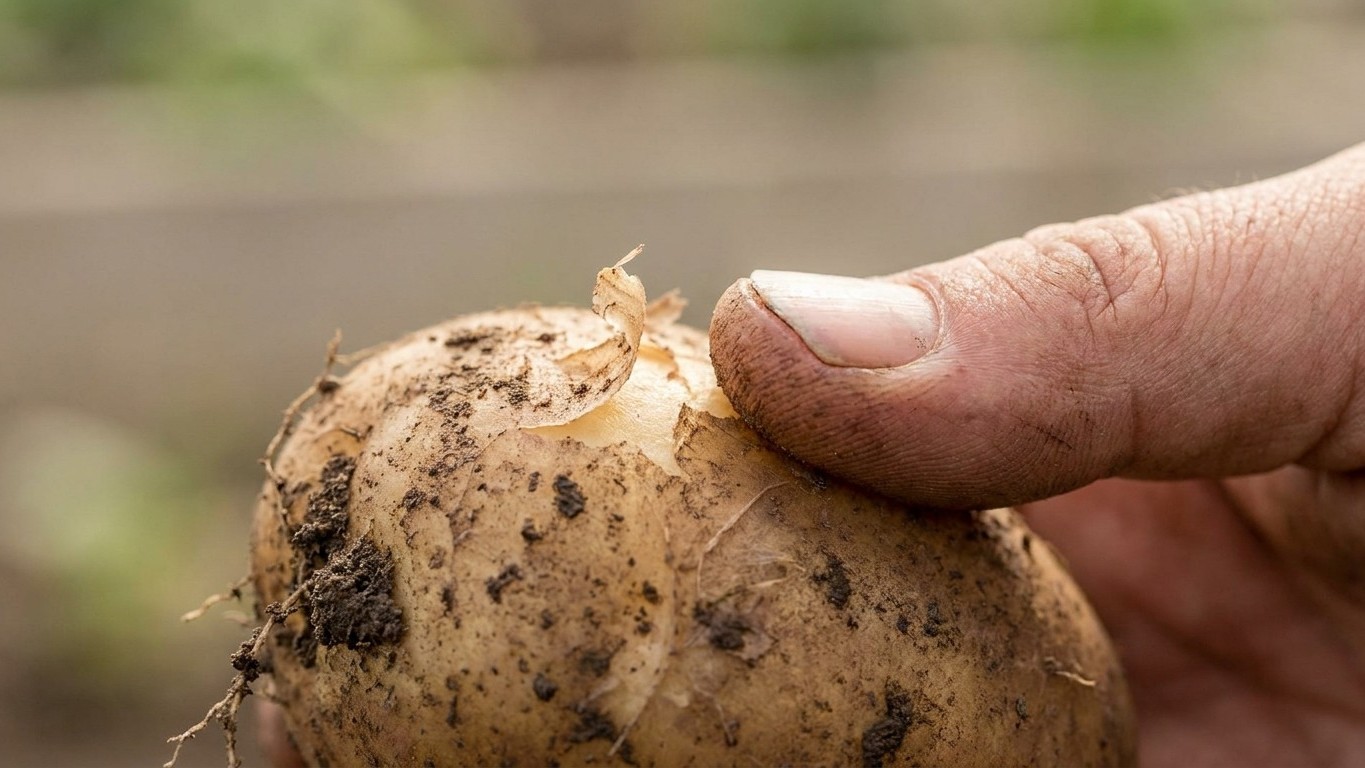
Skin thickness matters more than most gardeners realize. Dying back means the potatoes are fully grown and starting to get a tougher skin, which makes them ready to store, and if you harvest potatoes before they die back, you will get less of them and they won’t store well. A thumb rub is the simplest test: press firmly on a tuber’s skin. If it scuffs off easily, the potato isn’t ready for a crate destined to sit untouched until December. Mature potatoes have firm skins that don’t rub off easily when touched, and this thicker skin protects the tubers during storage.
Curing is the step that got skipped
Here’s what likely doomed that crate: potatoes went from muddy garden bed straight into a container, with no pause in between. That pause has a name, curing, and it’s not optional if the goal is months of storage rather than days. Before placing potatoes in storage, the tubers should be cured at a temperature of 45-60°F and high relative humidity of 85-95% for two weeks, which allows healing of minor cuts and thickening of the skin. That two-week window is when a potato seals its own wounds.
The science behind it is almost like a scab forming. These conditions promote suberization, where the potato forms a protective, cork-like layer beneath the skin and over any wounds, and this newly formed layer is the tuber’s natural defense against invading pathogens and dehydration during storage. Skip that window, or rush it in a cold, damp garage, and the story changes fast. If the humidity is too low, the wounds will not heal properly, leading to poor suberization and excessive moisture loss. A rushed cure is barely better than no cure at all.
Damage from the harvest itself compounds the problem. Every nick from a garden fork, every tuber dropped an inch too hard into a bucket, becomes an open door for decay if it doesn’t get time to heal. Wounds from harvesters, drops, clods and stones create entry points, and every bruise, cut or shatter bruise on a tuber invites bacteria and fungi to move in. Combine that with soil moisture still clinging to the tubers and the outcome writes itself. Free water from rain-wet skins or condensation helps pathogens move and multiply, and wet surfaces close off lenticels, suffocate tissues and create the conditions for soft rots to explode. A rushed, rain-beating harvest packed straight into a sealed crate checks every one of those boxes.
What actually happens inside a sealed crate
December’s discovery had a predictable mechanism. Soft rot doesn’t stay contained to one bad potato; it spreads. Rot in the potato spreads in storage by physical contact with water, and if the potatoes are in contact with a pool of water, there is a greater possibility of the spread of rot. One damaged tuber sweating in a closed container becomes a source of moisture for its neighbors, and the chain reaction runs quietly for weeks before anyone opens the lid.
Ventilation, or the lack of it, plays just as big a role as humidity. Ventilation is essential during storage because it removes field heat, excess moisture that may condense on colder tubers, and carbon dioxide and heat produced by respiration. A tightly closed plastic crate stacked in a basement corner does the opposite of all three. Extension guidance from Nebraska recommends a simple habit that most home growers skip: check stored potatoes periodically and remove any that are sprouting or show signs of rot. Nobody checked that December crate until it was already too late.
Getting it right next season
None of this requires a walk-in cooler or fancy equipment. Sort damaged tubers out immediately, since damaged potatoes should be used for fresh eating as soon as possible because they are likely to rot in storage. Cure the rest somewhere cool and dark, not the sunny back porch, for a solid two weeks before boxing them up. Skip the wash: there’s no need to wash the potatoes before storage, as moisture can promote rot. A cardboard box or paper bag, loosely closed, beats a sealed plastic crate every time, since air needs somewhere to go.
One more habit worth stealing from commercial growers, who don’t get to guess: don’t mix “good” and “bad” lots in the same storage, and place lots with possible problems nearest the door so they can be removed without impacting other lots. Translated for a home pantry, that just means checking the crate every few weeks through fall, pulling anything soft, and never assuming a good-looking harvest in October will still look that way by the time the holidays roll around.
Sources : potatonewstoday.com | evergreeneh.com