
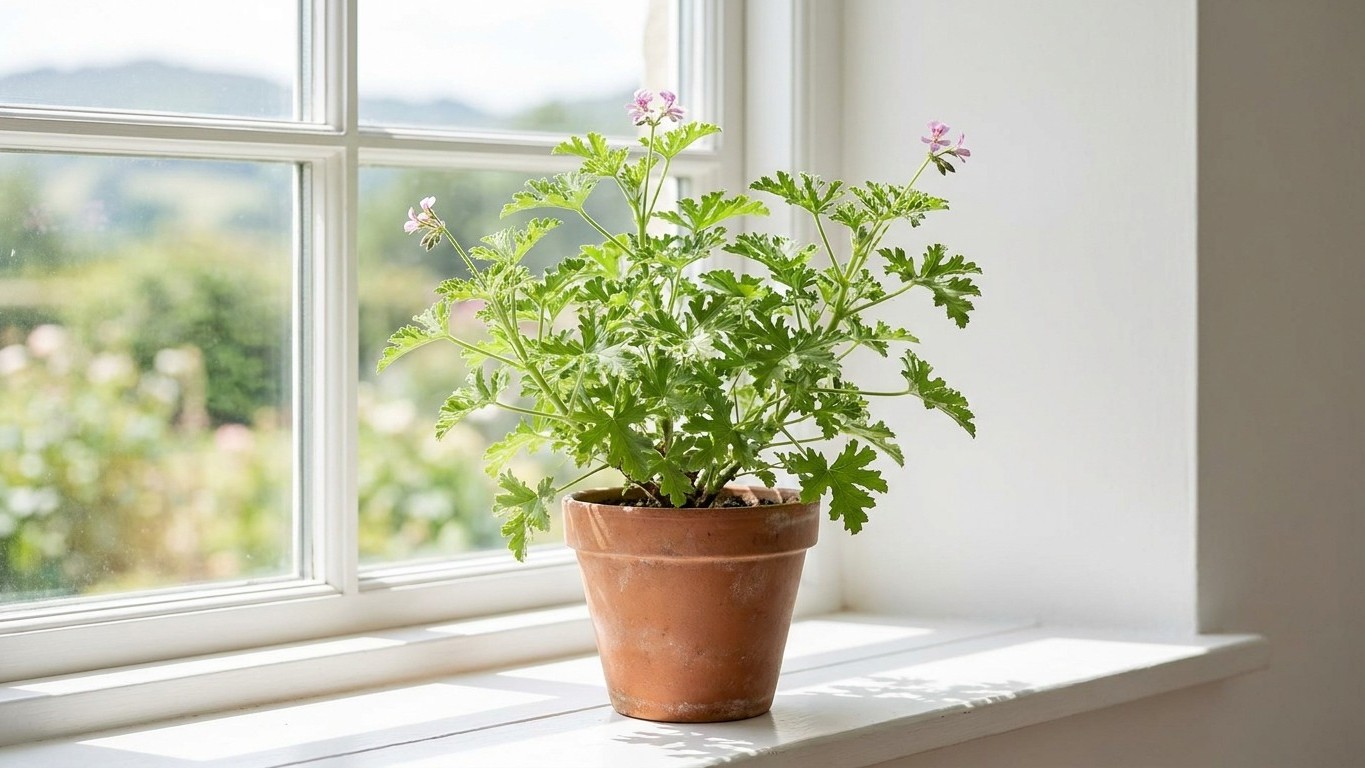
One lemon-scented geranium on a windowsill, and suddenly the tiger Mosquitoes vanish after every summer downpour? It’s a satisfying story. It’s also almost certainly a coincidence, and the science on this particular plant has been surprisingly clear for decades.
Scented geraniums, sold under names like citronella geranium or “mosquito plant,” have been marketed as bug repellents since the late 1980s. The backstory itself is a bit of a scandal: the plant was developed in the late 1980’s by a Dutch horticulturist who claimed it was a genetically engineered hybrid of an African rose-scented geranium and Chinese citronella grass, a claim that was later exposed as a hoax. What actually landed on nursery shelves was simply a scented geranium, with a fragrance that strongly resembled the familiar smell of citronella, not a genetically engineered mosquito-killer.
The chemistry explains why the smell fools our nose but not the mosquitoes. According to the Herb Society of America’s own analysis, “the plant’s oil composition was very similar to rose geranium, including only .09% citronellal,” one of the active components in citronella oil. That’s a trace amount. And when researchers actually tested it on people rather than just admiring it in a pot, the results were blunt: “the citrosa plant did not protect human subjects from mosquito bites more than controls, and in one field trial mosquitoes actually landed on the plant.”
Key takeaways
- A popular plant sold as a ‘mosquito killer’ since the 1980s was actually based on a hoax from a Dutch horticulturist
- The oils that supposedly repel mosquitoes are locked inside leaf tissue and don’t release into the air unless crushed
- Scientists tested it directly on human subjects, and mosquitoes landed on the plant anyway
Why a windowsill plant can’t do the job a candle can’t either
Here’s the mechanism problem, and it applies to almost every “repellent plant” sold at garden centers. The oils that supposedly ward off mosquitoes are locked inside the leaf tissue. Mississippi State University Extension horticulture specialist Gary Bachman put it plainly: while citronella geraniums may smell good, research shows little scientific proof of effectiveness in repelling mosquitoes, and he warns that a few scattered plants are unlikely to have a significant impact on the overall mosquito population around your home. A single pot sitting quietly on a sill releases essentially nothing into the air. You’d have to crush the leaves and rub the oil directly on your skin, which is a very different mosquito strategy than “decorate with a pretty plant.”
University of California researchers reached the same conclusion after watching the plant up close: while they are pretty and pleasantly scented, studies have shown them ineffective in repelling mosquitos. Even the plant’s fiercest defenders admit the oil has to physically move from leaf to air to skin to matter, and a geranium doing its own thing in a corner of the kitchen just doesn’t generate that kind of volatile cloud. One horticultural review summed up the mechanism gap directly: without actually rubbing leaves, which breaks open the tiny glands on the leaves where the oils accumulate, the oils will not volatilize to the air, so just having plants in the garden or in planters won’t have much effect.
So what actually kept the mosquitoes away this summer? Almost certainly not the plant. Tiger mosquitoes (Aedes albopictus) are container breeders through and through. The Asian tiger mosquito needs only a small amount of water to lay eggs. Bowls, cups, fountains, tires, barrels, vases and any other container storing water make a great “nursery.” One cup of water can produce thousands of mosquitoes. After a heavy summer rain, the real deciding factor is whether a clogged gutter, a saucer under a flowerpot, or a forgotten bucket nearby got topped off with fresh water. If it didn’t, or if it got emptied within a few days, there was simply no local hatch to worry about, geranium or not.
What the research says actually helps at your window
If the goal is genuinely mosquito-free rooms after a storm, entomologists keep pointing to the same short list, and it isn’t decorative pot plants. Physical exclusion works, plainly and reliably: keep mosquitoes out by putting screens on windows and doors, using a fine mesh to prevent the small Aedes mosquitoes from getting in. That’s the actual reason a lemon-scented geranium owner might not be seeing bugs indoors: a decent screen door does more work than any houseplant ever could.
Source reduction matters just as much, more. Public health agencies are consistent on this point: EPA-registered mosquito repellents applied to clothes and exposed skin can help prevent bites, and it is also important to dump and drain standing water, even very small sources, around your home to keep Aedes mosquitoes from breeding. Rhode Island’s environmental agency adds a detail easy to overlook: clogged rain gutters and puddles formed on tarps also can support the larvae of this species. Walk the perimeter of the house after the next big rain and check every gutter, tarp fold, and plant saucer. That five-minute inspection almost certainly matters more than any windowsill décor.
None of this means scented geraniums are worthless. They smell wonderful, they’re easy to grow, and some varieties double as flavoring for teas and desserts, as herb growers note. They just don’t belong in the pest-control conversation on their own merits. If a household wants a plant that at least has some laboratory backing, lemon thyme has actually outperformed the citronella geranium in controlled comparisons, and the same study found that lemon thyme was more effective, and because lemon thyme is lower, many varieties have a mat-forming growth habit, it is suited for walking on. Walking on it, and crushing the leaves underfoot, is precisely the part that makes it work. A geranium sitting still on a sill was never going to do that job by simply looking nice.
Sources : ucanr.edu | dem.ri.gov