
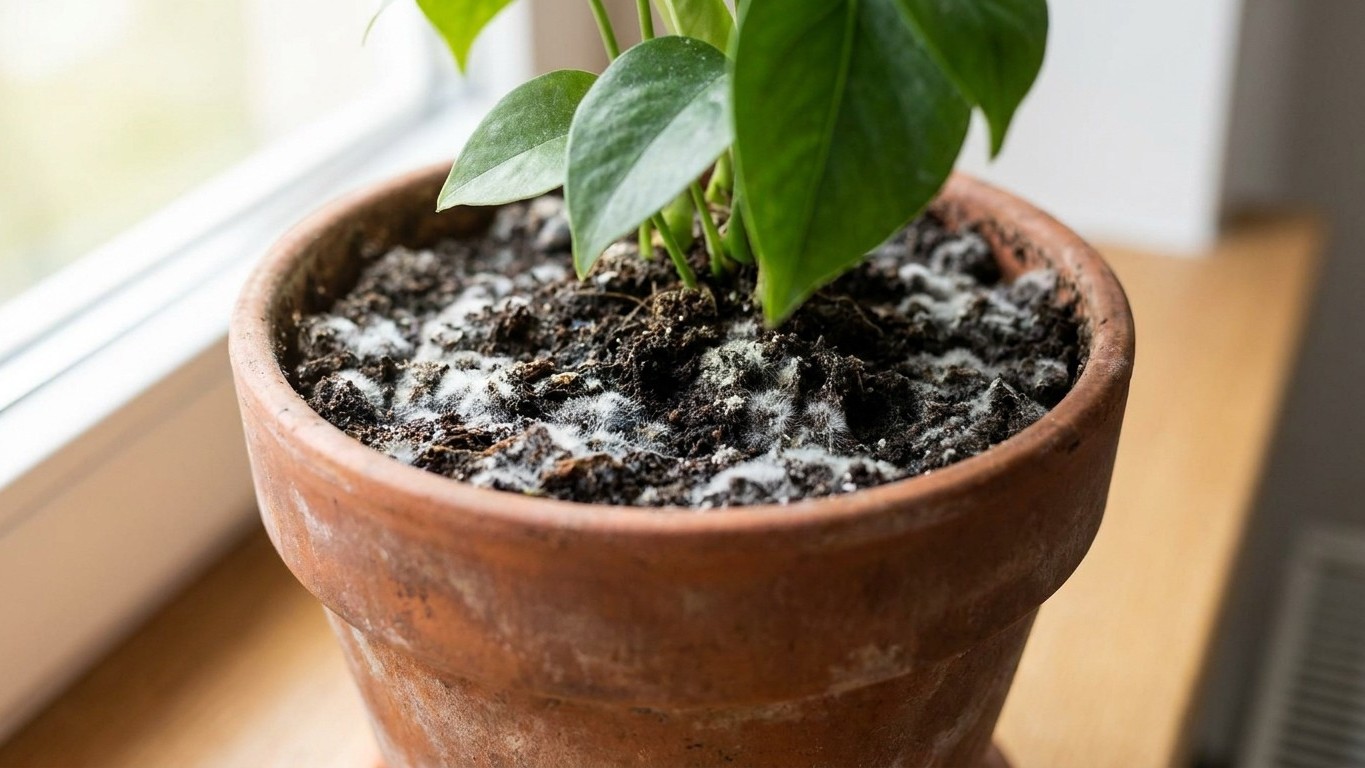
Three weeks after repotting, a thin white film had crept across every pot. Not a stray patch here or there, but a near-uniform fuzz, like frost that refused to melt, sitting on top of soil that had come straight out of a sealed bag. The plants themselves looked fine. The soil looked contaminated. And the instinct to panic, to assume months of careful plant care had just been undone, turned out to be the wrong reaction entirely.
Key takeaways
- A mysterious white coating suddenly appeared on every repotted plant—but the gardener’s instinct to panic was wrong
- Fresh potting soil contains dormant fungal spores that bloom under the perfect conditions of moisture and stillness
- The fix is simpler than you think, and prevention comes down to one surprisingly overlooked habit
What that white fuzz actually is
The culprit almost certainly isn’t a threat to the plants at all. The fuzzy growth of white mold on the soil of houseplants is usually a harmless growth of a saprophytic fungus, an organism that gets its nutrients from decaying organic matter. Bagged potting mix is packed with exactly that kind of material, bark chips, peat, compost fragments, so the fungus has plenty to feed on the moment moisture and warmth arrive.
This white fuzzy growth is most likely a saprophytic fungus, an organism that feeds on decaying organic matter in the soil rather than on the plant, and its spores are already present in most potting mixes and in the air. That’s the part that surprises most people: the mold wasn’t introduced by anything the gardener did wrong. It was already dormant in the bag, waiting for the right combination of dampness and stillness to wake up. Bags of potting soil can arrive carrying mold spores, especially if stored in damp conditions or if the bag was punctured, and if mold appears immediately after repotting, the soil is the likely source.
A soil scientist quoted in coverage of the phenomenon put the scale of it in perspective: “A person breathes in between 10,000 and 20,000 litres of air every day, and every breath contains between 1 and 10 spores,” according to Viviane Després of Johannes Gutenberg University Mainz. Spores aren’t a contamination event. They’re background noise in every room, every bag of soil, every breath. The only thing that changed after repotting was that conditions finally lined up for them to bloom.
Why it shows up right after repotting
Fresh soil, ironically, is the perfect trigger. Certain potting mixes already contain fungal spores that bloom once the soil gets wet, and mold appearing soon after repotting or using a fresh bag of soil is a telltale sign. The first watering after transplanting saturates all that undisturbed organic matter at once, and a newly repotted plant often sits in a spot with less airflow around the root ball while it settles in.
Indoor growing conditions make the timing worse. These fungi love peat, compost, and bark chunks that haven’t fully broken down yet, and the growth is super common after repotting or in winter when rooms feel stuffy. Add a container without drainage holes, increasingly popular for their looks, and the problem compounds. The current resurgence on the market of pots without drainage holes is one reason the presence of white mold is more common than in years past.
There’s a second possible explanation worth ruling out, since it looks similar at a glance but has a different fix. White soil on houseplants often indicates mold or a type of fungus, though other causes can be minerals and salt build-up from tap water and fertilizers. Mineral crust tends to look powdery and crusty rather than fuzzy, and it won’t spread the way living fungus does. If a light scrape reveals a hard, chalky layer rather than soft filaments, tap water minerals, not fungus, are the more likely cause, and switching to distilled or filtered water solves it.
Fixing it without tearing the whole plant apart
The good news: this rarely calls for repotting a second time. Taking a fork and scraping off the upper surface of potting soil to a depth of about an inch, then replacing it with fresh soil, is usually enough. Discard that top layer rather than working it back in, since it’s carrying the bulk of the active spores.
A few follow-up steps make regrowth far less likely. Sprinkling a light dusting of ground cinnamon over the soil surface after scraping works because cinnamon contains cinnamaldehyde, a natural antifungal compound that inhibits mold regrowth without harming roots, though it should stay a thin layer since excess cinnamon can itself trap moisture. Sunlight helps too, in moderation. If the plant can tolerate it, exposing it to additional sunlight for a short time can kill the mold on the surface without additional chemicals, though it’s worth being careful about burning leaves that are sensitive to sun exposure.
If the fuzz keeps coming back despite scraping and drying out the surface, the fix needs to go deeper than the top inch. If mold persists through the lighter treatments, or if the plant looks unwell, it’s worth removing it from its pot entirely, shaking off all old soil, rinsing the roots gently, and repotting in fresh, dry mix in a clean pot, using the opportunity to check for root rot. Healthy roots should be firm and pale; anything mushy or dark brown signals a genuinely serious problem, and mold on the surface would then be the least of the plant’s worries.
The habits that actually keep it from returning
Prevention comes down to airflow and restraint with the watering can, not the brand of soil in the bag. Overwatering invites the growth of mold and fungus, so it helps to stick a finger into the top inch of soil before adding more: if it’s damp, the plant doesn’t need water yet, and if it’s dry, it’s fine to go ahead. Bottom watering, letting a pot sit briefly in a shallow dish so roots draw moisture upward, keeps that vulnerable surface layer dry longer than watering from above ever will.
For plants prone to sitting damp, a heavier hand with drainage material at the next repotting pays off. If soil stays wet for days, adding aeration ingredients like perlite, orchid bark, or pumice during the next repotting gives excess water somewhere to go instead of pooling around organic matter that mold treats as a buffet. None of it requires throwing out a perfectly good plant collection over a problem that, three weeks in, looked far more alarming than it actually was.
Sources : laidbackgardener.blog | foodcycler.com