
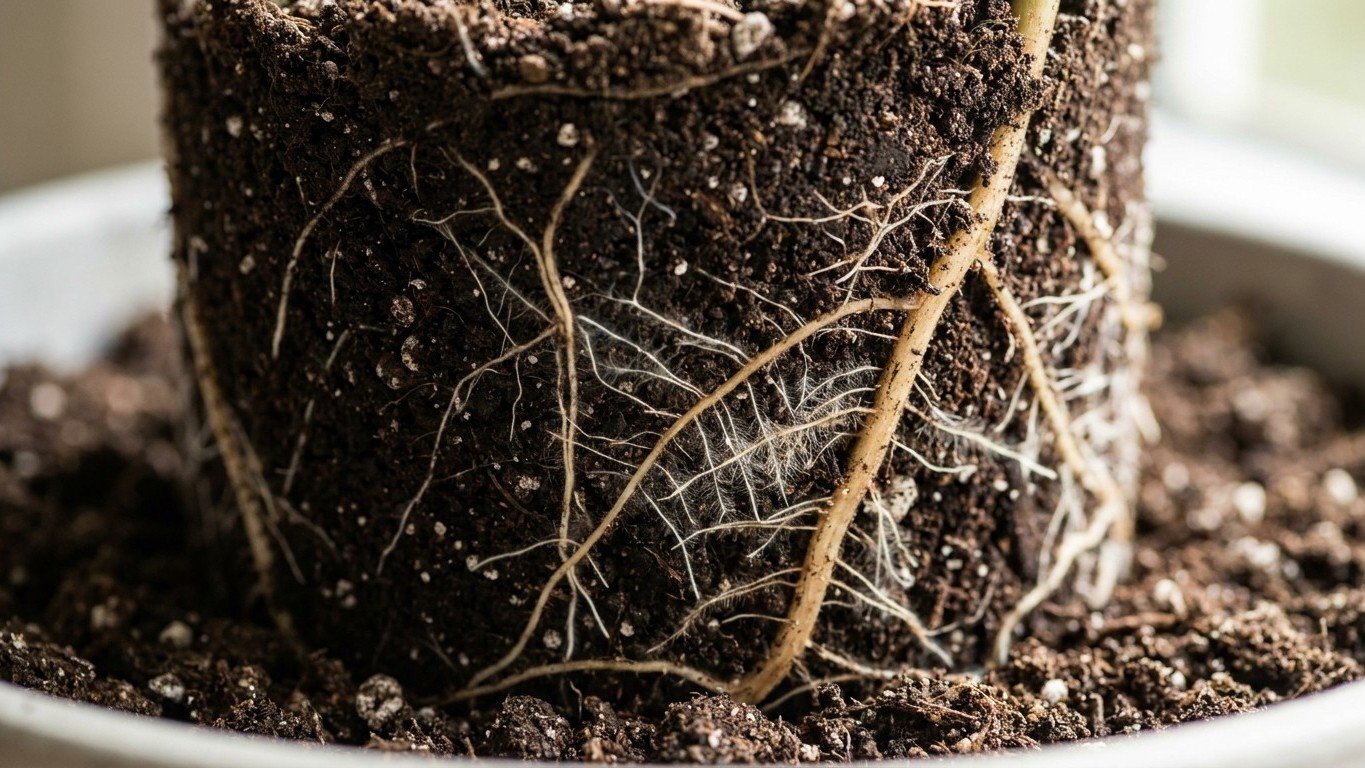
Three weeks. That’s how long it took for a spoonful of gray powder to rewrite what was happening inside a pot that had, frankly, given up. The potting mix was old, compacted, drained too fast and held onto nothing. But when I finally lifted the plant to check, the roots had pushed clear past the edges where my watering can had ever reached, threading into corners of the container that hadn’t seen moisture in months.
The powder in question was a mycorrhizal inoculant, a product built around fungal spores that most gardeners have heard of but few actually use indoors. And the science behind why it worked is more interesting than the trick itself.
Key takeaways
- Mycorrhizal fungi extend plant roots into soil zones your watering can never reaches—but bagged potting mix strips them out entirely
- Research shows AM-inoculated plants absorb 86% more phosphorus and produce 49% more growth under stress—numbers that aren’t marginal
- Direct root contact is critical; sprinkling powder on the surface does almost nothing, and high-phosphorus fertilizers can kill the fungi you just introduced
What’s actually happening underground
Mycorrhizal fungi colonize plant roots and extend their thread-like hyphae into the surrounding soil, increasing the effective surface area for resource uptake, forming an extensive mycelial network that explores soil volumes far beyond the reach of the plant’s root system. In practical terms, the fungus becomes an extension of the root, reaching into pockets of the pot the plant’s own tissue never would have colonized on its own. The network greatly enhances the plant’s ability to absorb water and essential nutrients, and in return, the plant supplies the fungi with carbohydrates produced through photosynthesis. It’s a trade, not a gift.
The numbers behind this exchange are not marginal. A 2022 meta-analysis published in the Journal of Fungi looked at dozens of studies on arbuscular mycorrhizal fungi and drought stress, and the results were striking: AM inoculated plants had 49% higher plant growth promotion than non-mycorrhizal plants under drought stress, with root dry weight increasing by 49%, and root length, surface, and volume all showing substantial gains. Nutrient uptake told a similar story, with phosphorus uptake increasing by 86%, nitrogen by 35%, and potassium by 46% in inoculated plants. That’s not a rounding error. That’s a plant operating with a completely different toolkit.
What surprised me most wasn’t the growth itself but where it happened. The extended hyphal network acts like a micro-irrigation system around the root zone, with ultra-fine filaments able to access water films in soil pores too small for roots to exploit. My watering can delivers water from the top, and gravity does the rest, meaning the driest, most neglected zones of a pot are usually along the sides and in the lower corners, exactly where compacted mix tends to repel moisture rather than absorb it. Those were the exact zones where I found new root growth after three weeks. Coincidence seems unlikely given what the research describes.
Why store-bought potting mix needs the help
This is the part that surprised me when I started reading. Bagged potting soil, the stuff sold in every garden center, is essentially sterile by design. Potting mixes and other manufactured soil blends don’t contain mycorrhizae, but you can add them before or during planting. Manufacturers heat-treat or process these mixes to eliminate pathogens, and the beneficial fungi get wiped out along with everything harmful. Unlike the soil found in the wild, market variety potting soil does not feature mycorrhizae, and this results in countless houseplants requiring a lot more intensive care in terms of feeding and watering.
That explains why a plant sitting in the same pot for two or three years starts to look exhausted even with regular fertilizing. It’s not just that the mix has physically broken down into fine, compacted particles. It’s that the plant has been working alone the entire time, with no fungal partner to help it scavenge nutrients from the parts of the pot roots can’t easily reach on their own.
How to actually apply it (and where people get it wrong)
The method matters more than the product. There’s no benefit to foliar feeding with mycorrhizal fungi, as they need to touch the roots, so the best approach is to rub the fungi directly on the root ball if possible, or sprinkle in the planting hole. Powder scattered on the soil surface and left there does almost nothing, because the spores need direct contact with living root tissue to germinate and colonize.
For an established houseplant that isn’t being repotted, the practical move is what I did: gently loosen the root ball, dust the powder directly against the exposed roots, then return it to the pot and water normally. The goal is to ensure direct contact between the powder and the roots, lightly watering afterward to help spores contact the roots, and avoiding placing the powder too deep or too far from the root ball. One detail worth knowing before you buy a fertilizer to pair with it: mycorrhizae don’t work as well in synthetic-heavy soils or with high-phosphorus fertilizers, which can inhibit the fungal growth. Loading up on phosphorus-rich bloom booster right after inoculating is, in effect, sabotaging the thing you just introduced.
Frequency is another point people overdo. Mycorrhizal products shouldn’t need to be applied more than once to each plant, unless your management practices are harming them. Once the relationship establishes, it tends to persist and even spreads to new roots as the plant grows, so repeated dosing every month is mostly unnecessary and, for indoor growers on a budget, a waste of product.
Not every plant needs this, and that’s the nuance worth knowing
Before treating this as a fix for every sad-looking houseplant, one caveat matters. A small number of plants, such as many members of the Brassicaceae family, are non-mycorrhizal, but for most crops and ornamentals, adding mycorrhizae is highly beneficial. Indoors, that mostly rules out a handful of edible brassicas grown on windowsills, not the typical houseplant lineup of pothos, monstera, ficus, or palms, all of which form these relationships readily in the wild.
What I didn’t expect, going into this, was how visible the effect would be in a container as small as a six-inch pot. The assumption is that mycorrhizal networks matter for orchards and farm fields, not a fiddle-leaf fig on an apartment windowsill. But mycorrhizae can scavenge all the water and nutrients that are in any way available to them in the volume of local soil within a container, providing plant owners with a safety net in the event they are unable to fertilize or water their plants consistently. For anyone who’s ever forgotten to water for two weeks straight and watched a plant sulk in response, that safety net is worth more than the few dollars a small bag of inoculant costs.
Sources : ncbi.nlm.nih.gov | biorxiv.org