
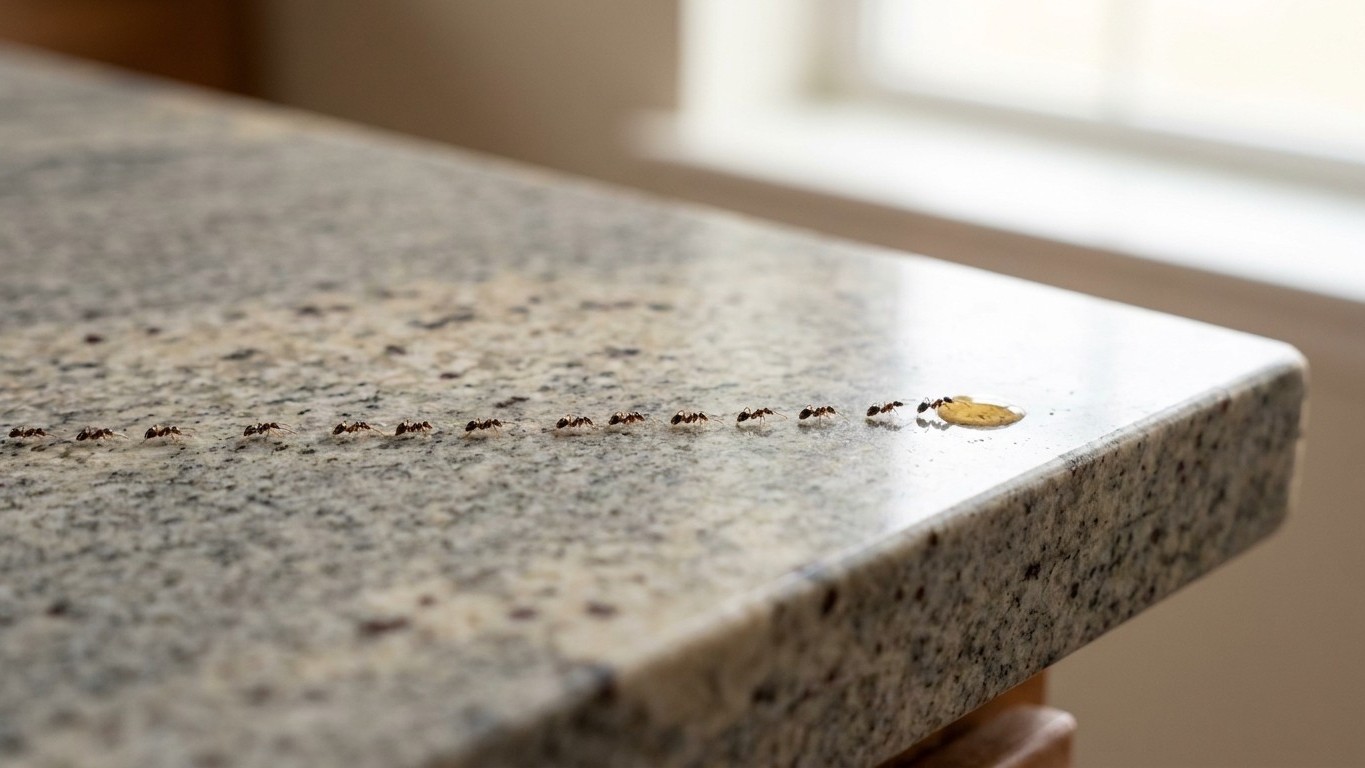
You wiped the counter. You even added a squirt of dish soap, scrubbed the spot twice, and watched the water run clear. Two hours later, the same procession of ants reappears, marching along the identical path, like nothing happened. The soap didn’t fail because it’s weak. It failed because it’s fighting the wrong battle.
Ants don’t wander your kitchen by chance. The defined trail they’re making is no accident, since those ant scavengers are following pheromone trails, natural scent chemicals left behind by scouts to guide their peers toward promising food and water sources. A single scout that stumbles on a crumb doesn’t just eat and leave. When a worker ant finds food, it leaves behind a microscopic trail of scent markers as it returns to the nest, and these ant pheromone trails act as a navigation system, directing other ants back to the same location. Every ant that follows reinforces the signal, which is why a trickle of two or three ants can turn into a highway by dinner time.
Key takeaways
- Ants aren’t randomly wandering—they’re following invisible pheromone trails laid down by scout ants
- A quick wipe with soapy water moves visible dirt but leaves molecular scent residue untouched
- Even vinegar and essential oils only temporarily disrupt trails without eliminating the colony sending new scouts
The invisible highway hiding under your worktop
Here’s the part most people miss: the trail isn’t a stain you can see. It’s a chemical signature laid down molecule by molecule, and these trails intensify with ant traffic, since each pass strengthens the scent and invites more ants. That’s the mechanism behind the eerie precision of ant lines, why they hug the exact same seam of countertop, the same crack in the tile, the same six inches of baseboard, day after day. When a scout ant finds food, it returns to the nest while laying a chemical scent behind it, and other ants pick up that scent and follow it, strengthening the trail every time they travel over it.
A quick wipe with a damp cloth moves visible dirt around, but the residue that ants can detect sits at a molecular level, often absorbed into grout lines, wood grain, or the microscopic scratches every worktop accumulates over time. Bleach is a strong oxidizer and vinegar is acidic, but neither is formulated to break down the specific molecular structure of ant trail pheromones, so they overpower the scent temporarily, and once that smell fades, usually within a few hours, the original chemical trail is still intact underneath, waiting to guide the next wave of workers. That’s the trap so many home cooks fall into: the ants vanish for an afternoon, cleaning feels like a win, and then the same line reappears right on schedule the next morning.
Why “a bit of soapy water” rarely finishes the job
Soap isn’t useless. It’s just usually applied wrong. The trick is to mix a small amount of dish soap with warm water, soak a cloth or sponge, and wipe two to three feet beyond the visible trail in both directions, since the surfactants in dish soap help lift the pheromone residue from the surface, not just move it around. Most people wipe exactly where they see ants and stop there, leaving the edges of the trail, the parts scouts use to reconnect with the route, completely untouched.
There’s also a mechanical problem: a quick swipe with a barely damp sponge often just smears the scent compounds sideways rather than lifting them off the surface. Dish soap and warm water form the base of many ant trail cleaning routines because the soap mixes with oils and grease that trap the scent molecules, then lets you lift them off the surface, but that only works if you actually scrub, rinse, and dry rather than dabbing once and moving on. Skipping the rinse step leaves a thin film that can, ironically, hold onto trace pheromone residue rather than removing it.
What actually clears the scent, and why it’s still not the whole fix
Vinegar earns its reputation for a reason. White vinegar is a popular natural home remedy for ant control, as its strong scent disrupts the ants’ pheromone trails, which they use to navigate and communicate. Mixed roughly half and half with water and sprayed directly onto the path, then wiped after a minute of contact time, it does a noticeably better job of breaking the chemical signal than soap alone. Essential oils work on a similar principle: certain essential oils like peppermint, tea tree oil, or lemon eucalyptus oil can disrupt pheromone trails when diluted with water and sprayed on surfaces. Cinnamon oil functions the same way, though the effect fades fast, since it offers only a temporary solution and its scent dissipates within a day or two, allowing ants to return.
None of this touches the colony itself, though, and that’s the uncomfortable truth pest professionals keep repeating. Vinegar may wipe away ant trails, but it won’t get rid of the colony, and it doesn’t address the root of the problem. A colony can number in the thousands, tucked into a wall void or under a slab, and the queen and most of the colony remain safely hidden in their nest, ready to send out more workers, who will find new paths. Clean the counter perfectly and the ants simply reroute through a different gap within a day or two.
Cutting the trail off at both ends
Real progress means treating cleaning as step one, not the whole plan. Wipe well past the visible line, dry the surface completely so no soapy or vinegar film lingers, and pair that with removing whatever drew the scouts in the first place, since even a small smear of jam, a few grains of sugar, grease around a cooker, or residue under an appliance can be enough to encourage renewed activity. Sealing the actual entry point matters just as much: one way ants get inside is through small gaps, cracks, and openings, so inspecting the spaces around windows, doors, walls, and utility lines and sealing them with caulk or weather stripping closes the door scouts used in the first place.
For anything beyond an occasional stray line, bait outperforms both soap and vinegar, because it lets workers carry poison back to the nest rather than just disrupting the surface trail. Using sprays on ant lines may feel satisfying, but it usually backfires, since sprays only kill the ants you can see, not the colony hidden in the walls or underground, and the most reliable way to eliminate ants is to bait them. The next time that line reappears in the exact same spot on your worktop, remember it’s not a hygiene failure. It’s a chemical map that soap alone was never designed to erase.
Sources : squishempestsupplies.com.au | yourpestassassin.com