
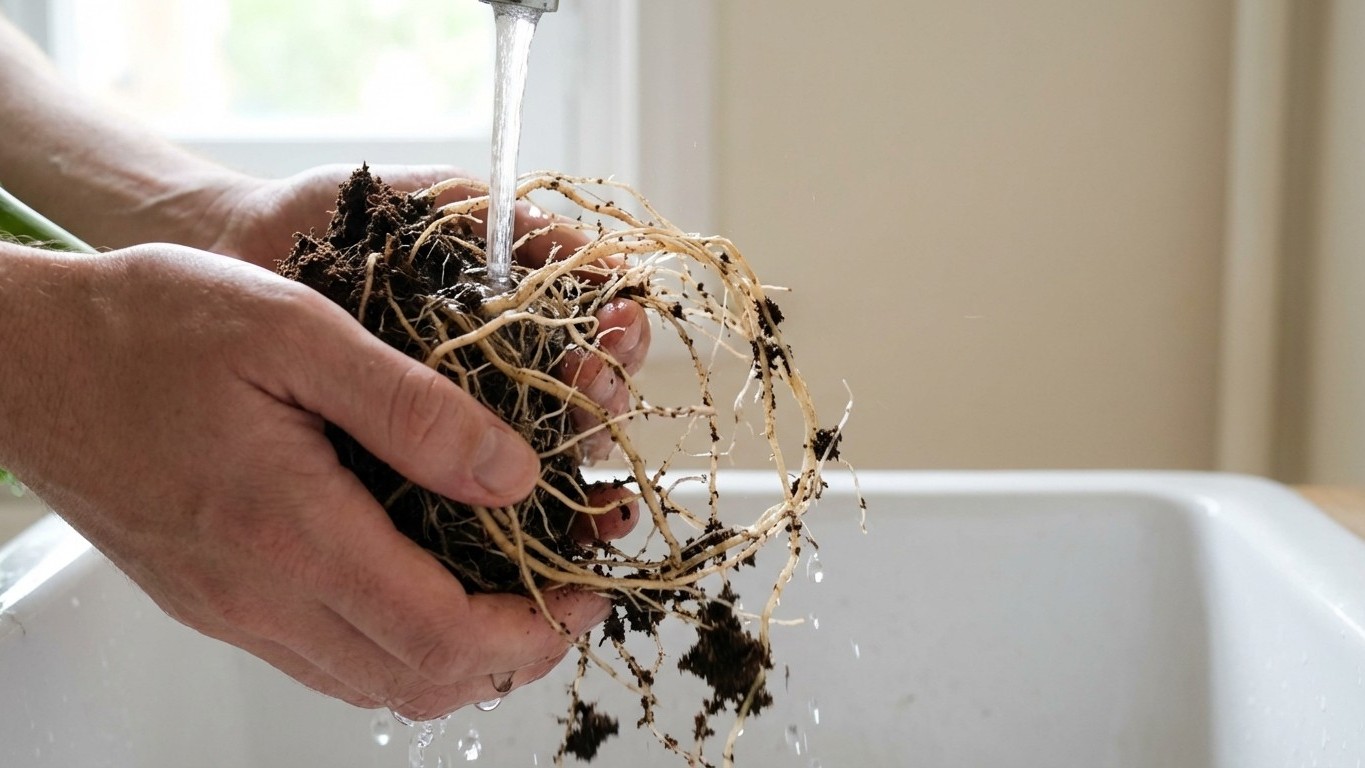
Pull a rootbound plant from its pot and you’ll see it immediately: that dense, spiraling mass of roots coiled around themselves like a fist. Every gardening guide tells you to loosen it, score it, or massage it apart before repotting. Fair advice. But here’s what those same guides quietly skip over, the real damage isn’t happening at the bottom of the pot. It’s happening above it, in the soil you’ve been watering for the past two years.
Key takeaways
- What looks like a root problem is usually a soil problem that’s been invisible the whole time
- Old potting mix transforms into something that actively harms plants—and most gardeners don’t see it coming
- The standard repotting approach leaves the real damage in place, solving only a fraction of the crisis
The root ball is a symptom, not the disease
When roots run out of room, they do what any living thing does: they adapt. They circle. They compress. They push toward any available oxygen. By the time you see that tight spiral at the drainage hole, the plant has already been in survival mode for months. The root congestion is visible, dramatic, and easy to address. The problem is that it draws all your attention away from what’s sitting above it.
Old potting mix, the kind that’s been in a container for 18 months or more, undergoes a slow but significant transformation. The perlite that once kept things airy starts to break down into fine dust. The bark particles that created pockets of oxygen decompose into a dense, compact layer. The mycorrhizal fungi that were factory-added to that bag of premium mix? Gone. What remains is a compressed, hydrophobic, nutrient-depleted medium that repels water rather than absorbing it. You’ve seen it: water pools on the surface, then rushes straight down the sides of the pot without ever soaking in. That’s the real crisis.
What degraded soil actually does to a plant
A plant growing in exhausted potting mix is essentially running on fumes. The roots that do manage to push through the compacted layers find almost nothing useful waiting for them. Nitrogen, phosphorus, and potassium leach out of standard mixes within six to twelve months of regular watering, a timeline most Houseplant owners dramatically underestimate. What’s left behind can Actually work against the plant: salt deposits from tap water and fertilizer accumulate in the upper layers of the soil, creating a low-grade toxic environment right at the crown of the root system.
This salt buildup is worth pausing on. You might have noticed a white or yellowish crust forming on top of the soil, or crusting around the drainage holes. That’s not mineral-rich soil doing Something quirky. That’s accumulated sodium and chlorine compounds from your water, mixed with residual fertilizer salts, sitting right where your plant’s most sensitive feeder roots are trying to work. Flushing the pot with water helps temporarily, but in a degraded mix with poor drainage, the water doesn’t move evenly enough to carry those salts away efficiently.
There’s also the microbial angle, and it matters more than people realize. Healthy potting mix hosts a complex community of bacteria and fungi that help roots access nutrients and fight off pathogens. In a compacted, salt-stressed, oxygen-poor environment, that community collapses. What tends to move in instead are the anaerobic bacteria that thrive in waterlogged conditions, the same ones responsible for root rot. So a plant that appears to have a watering problem often has a soil health problem that’s been misread.
Why repotting alone doesn’t fix it
Most people repot the way they were taught: shake off some old soil, loosen the roots, drop the plant into a bigger container with fresh mix, water thoroughly. This is better than nothing. But if you’re only going up one pot size and leaving a significant portion of the old mix clinging to the root ball, you’ve solved maybe 30 percent of the problem. The degraded soil compressed around the root system comes along for the ride, creating what some horticulturalists call a “soil interface problem”, the old dense mix and the new airy mix don’t integrate well, causing uneven moisture distribution and root hesitation.
The fix is more aggressive than most houseplant owners are comfortable with: remove as much of the old Potting mix as possible before repotting. Bare-rooting isn’t just for trees. Gently working the old soil away from the roots under a gentle stream of lukewarm water gives you a true reset. You see the actual root health clearly, you remove the damaged and circling roots cleanly, and you give the plant a genuinely fresh start in a new medium. Yes, the plant will sulk for a few weeks. That’s normal transplant stress, not failure.
Building a mix worth repotting into
The container you choose matters less than what goes inside it. Standard bagged potting mix from a big box store is a starting point, not a finished product. For most tropical houseplants, pothos, monsteras, philodendrons, a blend of roughly 60 percent potting mix, 20 percent perlite or pumice, and 20 percent orchid bark creates a structure that stays open and drains well for years rather than months. The bark pieces slow decomposition and maintain air pockets that roots genuinely need to thrive.
For succulents and cacti, the ratio tilts even further toward inorganic material. Some growers go 50/50 or even heavier on the grit, accepting that the plant will need more frequent feeding to compensate for the reduced organic content. The trade-off is a mix that essentially never compacts into that hostile, hydrophobic slab.
One thing to add back that store-bought mix rarely contains in meaningful quantities: a small amount of worm castings worked into the top layer. Not as a fertilizer substitute, but as a biological inoculant. Castings introduce diverse microbial life back into the mix, which is what was quietly doing the hardest work in the first place.
The tight circle of roots is the alarm going off. What caused the alarm to trigger in the first place is the silent degradation happening in the inches of soil above it, and that’s the part that deserves your full attention next time you roll up your sleeves and start unpotting.