
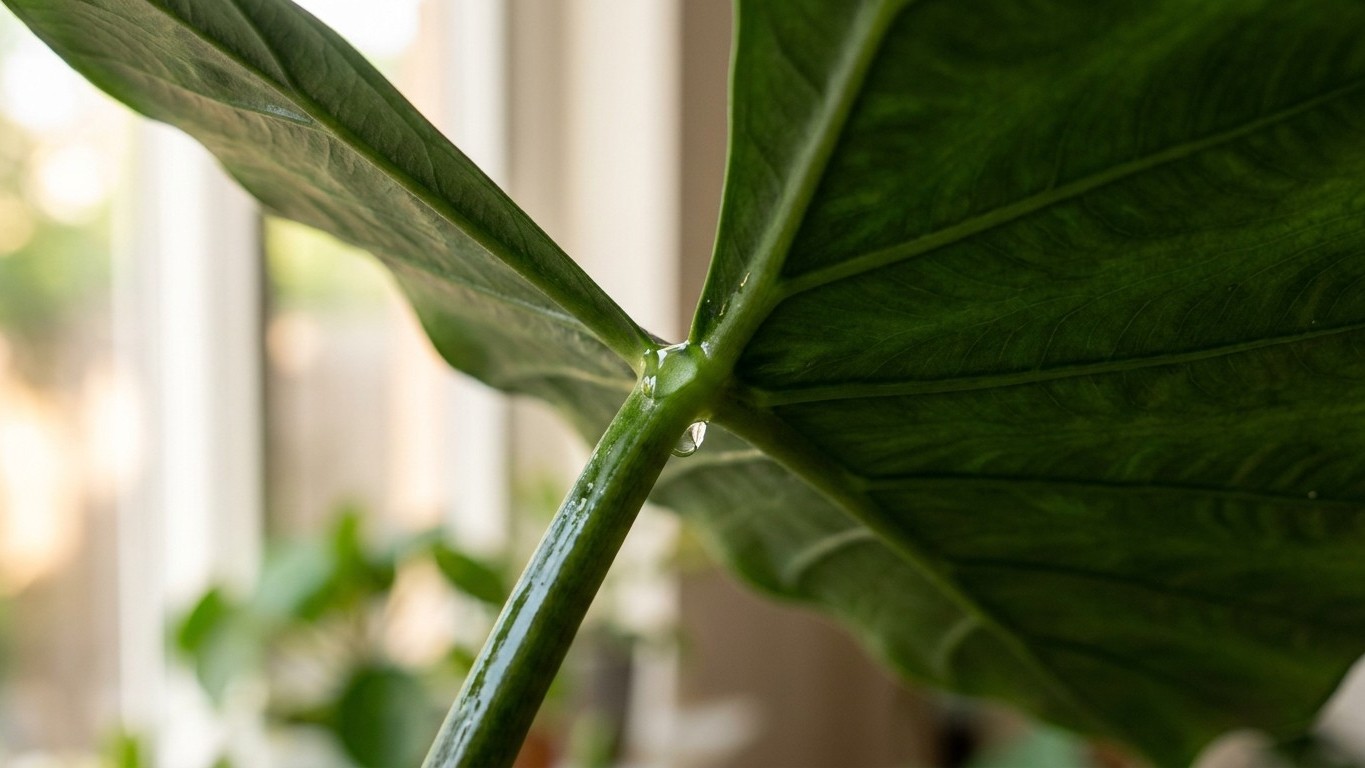
A small puddle of water sitting in the crook where an Alocasia leaf meets its stem is not a quirk of the plant. It is a warning. By the time that pooling is visible, the conditions that lead to crown rot, fungal infection, or bacterial collapse have likely been building for days. Most growers miss it entirely, because the rest of the plant looks fine, the leaves are still glossy, the stems upright. That window of deception is exactly what makes Alocasia one of the trickier aroids to keep long-term.
Key takeaways
- Water pools at the petiole junction specifically because Alocasia leaves are designed to channel moisture there—the plant’s own anatomy creates the problem
- Crown rot can spread from the leaf base into the central stem in just 72 hours once infection begins, making early detection your only real window
- Blotting away standing water, adding gentle airflow, and switching to bottom watering are simple practices that prevent the majority of Alocasia crown rot cases
Why Water Collects There in the First Place
Alocasia leaves are engineered to shed water toward the center. The waxy, often deeply veined surface channels moisture downward through a process botanists call the “leaf drip tip” effect, a trait common in tropical rainforest plants where shedding water quickly prevents fungal growth on the leaf itself. The irony is brutal: the same anatomy that protects the leaf surface funnels water directly into the most vulnerable point of the plant, the petiole-stem junction.
That junction, where the petiole (the stalk connecting leaf to main stem) attaches to the corm or central stalk, is dense with vascular tissue. It stays moist longer than any other part of the plant. When water pools there regularly, whether from overhead watering, misting, or even high humidity combined with poor airflow, you create a microenvironment that Phytophthora and Pythium species, the primary culprits behind crown rot, find perfectly hospitable. Both are water molds, technically oomycetes rather than true fungi, and they spread through free moisture at a speed most gardeners underestimate.
The Trouble Moves Faster Than You Think
Three days. In warm indoor conditions (above 65°F), active crown rot can travel from the petiole junction into the central stem in roughly 72 hours. By the time the leaves begin to yellow or the stem shows a soft, water-soaked brown lesion, the infection has already moved well past the point of origin. This is why the puddle matters: catching it early is genuinely the only moment when intervention is straightforward.
The soft brown discoloration that signals rot has a distinctive smell, faintly sour, sometimes described as fermented. If you press the affected area and it gives under light pressure, you are past the cosmetic stage. At that point, the plant needs to be unpotted, the rotted tissue cut back to healthy white or cream-colored corm material, and the wound treated with powdered sulfur or a diluted hydrogen peroxide solution (3% is standard) before any attempt at recovery.
Alocasia owners often assume a wilting plant needs more water. With this genus, that instinct gets reversed. A wilting Alocasia with pooled water at the base of its petioles is telling you it cannot uptake water efficiently, usually because the roots are already compromised. Watering more accelerates the problem.
What to Do the Moment You See Pooling
The first response is simple: remove the water immediately. A clean paper towel or a soft dry cloth pressed gently into the junction pulls out standing moisture without disturbing the plant. Do this every time you water, or after any humidity spike. It sounds tedious, and it is, but Alocasia care has always demanded attention to detail that other houseplants forgive you for skipping.
Beyond blotting, the structural fix is airflow. A small USB fan running on its lowest setting, positioned to create gentle circulation around the base of the plant rather than blasting it directly, reduces surface moisture retention by enough to matter. Growers who keep multiple Alocasias, the hobbyist collections that can number fifteen or twenty specimens on a single shelf, consistently report that adding airflow cuts crown rot incidents by a significant margin even without changing any other variable.
Watering technique deserves a hard look too. Bottom watering, setting the pot in a tray of water and allowing the soil to draw moisture upward through the drainage holes — keeps the petiole junction completely dry. The plant gets the hydration it needs, the vulnerable crown stays dry, and you sidestep the problem at its source. The tradeoff is that bottom watering requires more time and attention to avoid overwatering the lower root zone, so monitoring soil moisture with a probe rather than guessing by weight becomes more important.
The Soil Mix Is Part of the Equation
Even perfect watering technique fails if the soil holds water too long. Standard potting mixes designed for tropical houseplants often retain moisture at levels that suit most aroids but push Alocasia into chronic stress. A blend that incorporates perlite at 30 to 40 percent by volume, or chunky orchid bark mixed with coco coir, drains quickly enough to reduce the window during which pathogens can establish. The goal is a medium that stays evenly moist — not wet, not bone dry, and returns to a barely moist state within 48 to 72 hours after watering.
Pot choice amplifies the effect. Terracotta, which wicks excess moisture through the pot wall, is consistently more forgiving for Alocasia than glazed ceramic or plastic containers of the same size. The difference in drying time between a terracotta pot and a plastic one of equivalent volume can be two to three days, which, given the 72-hour rot window, is the difference between a close call and a lost plant.
One detail rarely mentioned in care guides: the corm itself (the thick rhizome at the base of most Alocasia species) stores water and nutrients, giving the plant a buffer during drought conditions. This means Alocasia can tolerate drying out far better than most owners believe, the corm sustains it. That resilience in drought is the exact reason why erring toward dryness, rather than consistent moisture, tends to produce healthier plants over a full growing season.