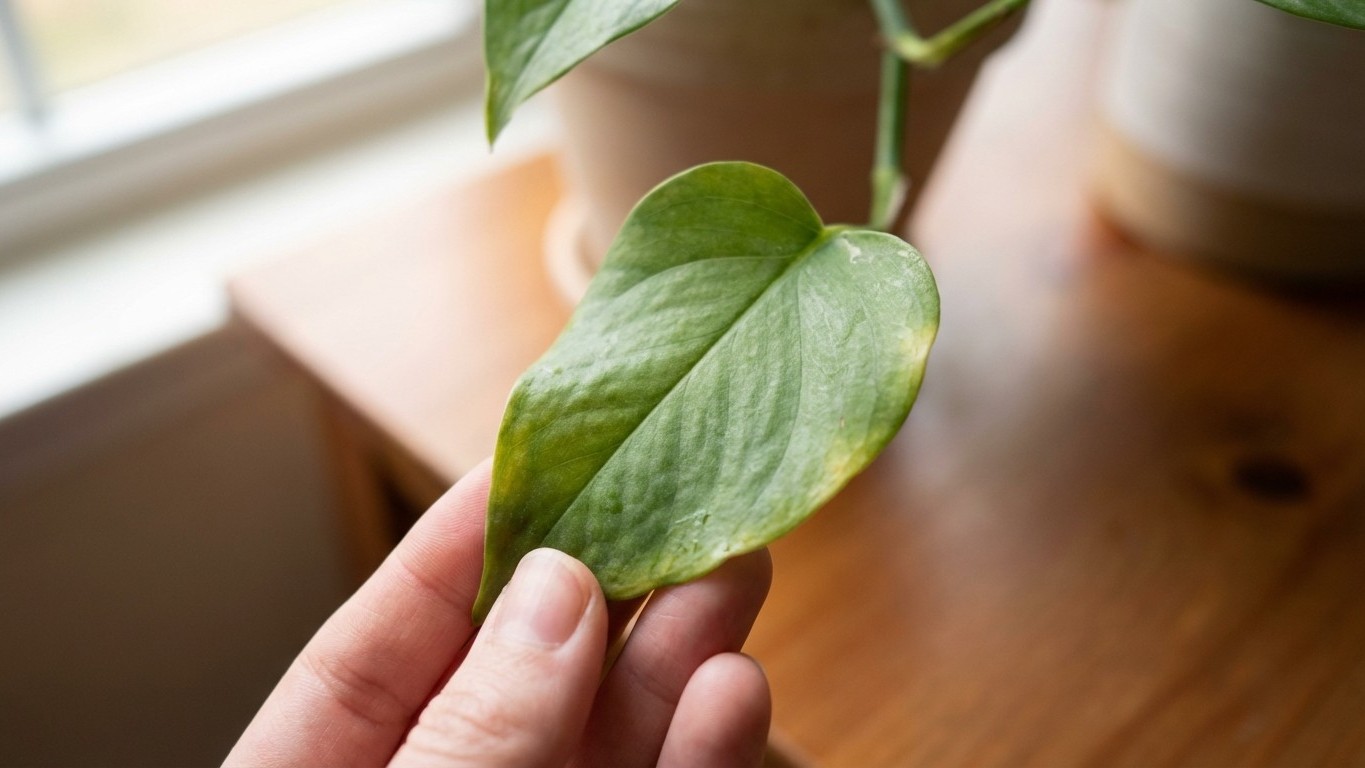
The plant looked fine. Or at least, that’s what I kept telling myself every morning while watering it on autopilot. Then one day I actually looked at it, really looked, and caught something I’d been walking past for weeks: the edges of the lowest leaves had turned a very faint yellow-green, barely different from their usual color, and they were slightly soft to the touch rather than firm. That was the moment I realized my pothos wasn’t thriving. It was drowning. Slowly, quietly, right there on my windowsill.
Key takeaways
- A single detail on the lowest leaves reveals whether your plant is thriving or slowly suffocating from root rot
- Why the top of the soil can feel completely dry while roots are drowning beneath the surface
- A simple 90-second weekly habit that catches plant problems before they become fatal
The Sign Nobody Talks About
Most houseplant guides jump straight to the dramatic symptoms: yellowing leaves, brown crispy tips, complete collapse. Those are the emergency room cases. The subtle warning I’d missed sits upstream from all of that, in a phase where the plant is still technically alive but actively declining. The soft, slightly discolored lower leaves weren’t a random quirk. They were the plant telling me its root zone had been sitting in stagnant moisture for too long.
Here’s what makes this sign so easy to overlook: the top of the soil can feel dry. Even bone dry. This happens because water accumulates at the bottom of the pot, especially in containers Without adequate drainage, while the upper layer dries out at a normal rate. You press a finger into the soil, feel dryness, and water again. Each cycle adds more moisture to roots that were already suffocating. The plant’s lower leaves go soft before they go yellow, because the cells are waterlogged rather than dehydrated, they lose structural integrity first, color second.
A houseplant pathologist would call this the early stage of root rot. The rest of us just call it “my plant seems a bit off lately.” The gap between those two descriptions is where plants die.
Why We Miss It (And Why That’s Not Entirely Our Fault)
There’s a reason experienced plant people develop what feels almost like a sixth sense about their collection. They’re reading micro-signals continuously, not just during weekly watering sessions. For most of us with jobs, kids, commutes, and approximately forty other things competing for attention, a houseplant registers as background scenery until it reaches crisis level.
Lighting complicates this further. Many indoor plants live in corners or on shelves where the ambient light is dim, which makes subtle color changes genuinely hard to spot. A leaf that’s 15% less saturated in color simply doesn’t register visually when you’re glancing at it from across the room. The softness is even harder to notice because you’d have to actively touch the leaves, something most people don’t think to do unless they’re already suspicious.
There’s also a deeply human tendency to explain away early symptoms. “It’s probably just a bit cold near the window.” “Maybe I forgot to water it last week.” “It’s winter, plants always look a bit rough.” All of these can be true. Sometimes they are. But that rationalization is exactly how a recoverable problem Becomes a dead plant.
What To Do Once You Catch It Early
Speed matters, but panic doesn’t help. The first thing to do is stop watering immediately and let the soil dry out more completely than you normally would. Remove any standing saucers of water under the pot. If the pot has no drainage hole, now is the time to address that, repot into something with drainage, or at minimum add a layer of drainage material and commit to a strict watering schedule going forward.
Tip the plant gently out of its pot after a few days and inspect the roots. Healthy roots are white or light tan and firm. Roots affected by rot are brown, mushy, and often smell slightly sour. Trim away anything that falls into that second category with clean scissors, let the roots air out for an hour or two, then repot in fresh, well-draining soil. A mix designed for succulents works well here, even for tropical houseplants that seem to need more moisture, because it allows for recovery Without creating another wet environment.
The leaves that triggered your alarm in the first place? Remove them. They won’t recover, and keeping them attached draws energy the plant needs for new growth. Within a few weeks of correct conditions, appropriate light, restrained watering, good drainage, you should see new leaves emerging from the nodes. That’s the signal that the root system has stabilized.
Building a Better Observation Habit
The more useful lesson from all of this isn’t about root rot specifically. It’s about attention. Most houseplant failures aren’t caused by ignorance of care requirements. People know not to overwater. They know plants need light. The failure happens in the gap between knowing and noticing, between general advice and the specific plant in front of you.
One practice that genuinely helps: handle your plants during every watering session, not just look at them from a distance. Pick up the pot to feel its weight (heavy means moisture is still present). Touch a few leaves on different parts of the plant. Tilt the plant slightly and check the underside of lower leaves, where pests and early discoloration tend to appear first. The whole process adds maybe ninety seconds per plant. For a collection of ten plants, that’s fifteen minutes a week, less time than a single Netflix episode, and considerably more useful.
My pothos recovered completely, by the way. It’s sitting in a terracotta pot now, which wicks moisture from the soil far better than the glazed ceramic I had it in before, and I haven’t seen soft lower leaves since. But I think about that quiet warning sign more than I expected to. How many other signals are we walking past every day, in our homes and beyond, because we’ve stopped actually looking at the things we think we know well?