
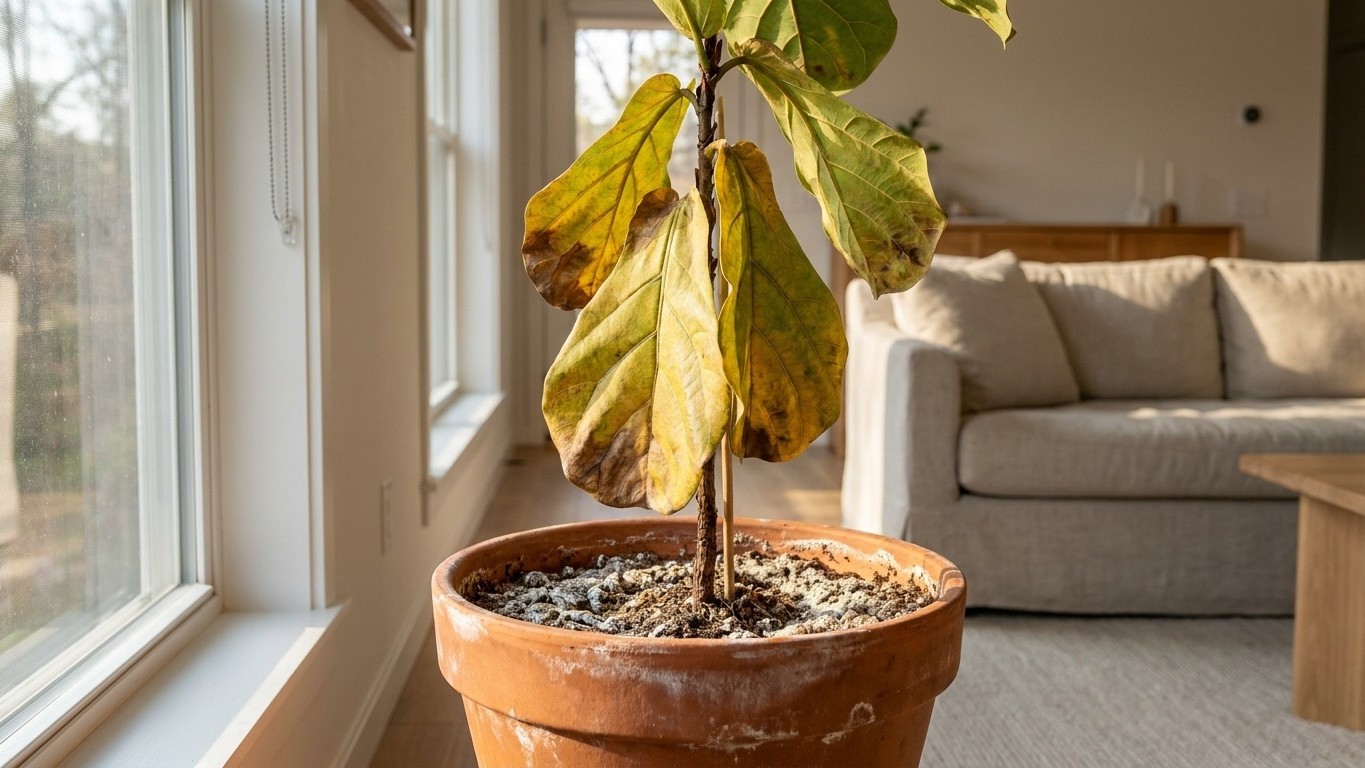
Root burn. That’s what was killing my fiddle leaf fig, not the heat itself. After three weeks of a stubborn heatwave, I’d been feeding my houseplants weekly instead of my usual monthly schedule, convinced extra nutrients would help them push through the stress. When I finally unpotted the fig to check on it, the roots were brown, brittle, and pulling away from the soil entirely. The fertilizer hadn’t helped. It had cooked them.
The logic seemed sound at the time. Plants under stress need support, right? But heat stress and nutrient deficiency are two completely different problems, and treating one like the other turns houseplant care into a slow-motion disaster. At 95°F and above, a plant’s biology shifts into survival mode, and that shift changes everything/”>Everything about how fertilizer behaves in the soil.
Key takeaways
- What happens to fertilizer salts when potting soil dries out in extreme heat
- Why heat-stressed plants show the same symptoms as nutrient-starved plants—but need opposite treatment
- The counterintuitive watering and feeding strategy that saved the houseplants I caught in time
Why Fertilizer Turns Toxic When Temperatures Spike
Plants don’t drink fertilizer directly. They absorb dissolved mineral salts through their roots along with water, a process that depends entirely on consistent soil moisture. During a heatwave, potting mix dries out fast, sometimes within a single day for smaller pots. As the water evaporates, the fertilizer salts left behind become concentrated in whatever moisture remains near the root zone.
That concentration creates a chemical problem called fertilizer burn, and it’s essentially a reverse-osmosis effect. Roots normally pull water in because the soil solution is more dilute than the fluid inside root cells. When salt concentration in the soil spikes too high, the gradient flips. Water gets pulled out of the roots instead of into them. The plant ends up dehydrated even when the soil isn’t fully dry, because its own roots are leaking moisture back into overly salty ground.
The EPA notes that soil salinity issues intensify dramatically under high evaporation conditions, which is exactly what a heatwave produces indoors near sunny windows or on covered patios. I’d essentially been salting my plants’ roots while they were already struggling to manage water loss through their leaves.
What Heat Stress Actually Looks Like on a Plant
A heat-stressed plant and an underfed plant show surprisingly similar symptoms, which is exactly why I got confused in the first place. Both produce yellowing leaves, slowed growth, and a general wilted, defeated look. But the underlying mechanisms differ completely, and mistaking one for the other is an easy trap.
When temperatures climb past a plant’s comfort zone, most tropical houseplant species start closing their stomata, the tiny pores on their leaves that regulate gas exchange and water vapor release. This is a defense mechanism. Closing those pores conserves water, but it also shuts down photosynthesis almost entirely, since carbon dioxide can no longer get in efficiently. A plant in this state isn’t short on nutrients. It’s metabolically paused, waiting out the heat like a hiker crouched in whatever shade it can find.
Feeding a paused plant doesn’t wake it up. It just dumps unusable salts into soil the plant can’t process, and those salts sit there accumulating until watering (or heat-driven evaporation) concentrates them further. My fig wasn’t hungry. It was trying to survive, and I kept handing it something it had no way to use.
The Fix: What to Do Instead During Extreme Heat
Once I understood the actual mechanism, my approach flipped completely. Fertilizing during a heatwave should stop, not increase. Most indoor plant specialists, including horticulture extension programs at universities like Penn State, recommend suspending feeding entirely once temperatures push a plant into dormancy or stress mode, and resuming only once conditions stabilize.
Water management becomes the priority instead. Checking soil moisture daily, rather than sticking to a weekly calendar, matters far more during a heat spike, since evaporation rates can shift dramatically day to day depending on humidity and sun exposure. I moved my most sensitive plants (the fig included) a few feet back from windows to cut direct heat exposure while keeping the same amount of ambient light.
Humidity trays and grouping plants together also helped more than I expected. Clustering pots creates a localized moisture bubble as plants transpire near each other, buffering against the harsh dryness a heatwave drags into a room. For plants that had already taken on fertilizer damage, I flushed the soil with plain water, running it through the pot several times to physically wash out excess salts before they did more damage. It’s a simple fix, but one most people don’t think to do until the roots are already compromised.
My fig didn’t fully recover. It lost about a third of its leaves before I caught the problem, and new growth took nearly two months to appear once temperatures normalized. But the plants I stopped feeding immediately, a snake plant and two pothos that had also been getting the extra treatment, bounced back within a couple of weeks once I switched to a water-only routine and let the soil dry slightly between waterings.
The lesson wasn’t really about fertilizer at all. It was about resisting the urge to intervene when a plant looks like it needs help. Sometimes the most useful thing to do during extreme heat is exactly nothing, beyond keeping the soil at a steady, moderate moisture level and getting the plant out of direct thermal stress. Next heatwave, my feeding schedule goes on pause the moment the forecast crosses 90°F, and I won’t touch it again until temperatures drop and stay down for at least a week.