
Water your garden at high noon during a heat wave and you’ll lose up to 30% of it to evaporation before roots ever touch it. That single fact explains why so many well-intentioned gardeners watch their tomatoes wilt despite daily watering. Timing matters as much as volume, and technique matters more than either.
The soil temperature tells the real story. At 2 p.m. in July, soil surface temps can hit 100°F even when air temperature reads 90°F. Water poured onto that surface doesn’t soak in, it steams off. Worse, droplets on leaves act like tiny magnifying glasses under direct sun, scorching foliage in a pattern gardeners often mistake for disease.
Key takeaways
- One watering mistake costs you a third of your water to evaporation before roots ever touch it
- Morning watering wins over evening for a reason most gardeners don’t expect
- The difference between shallow daily watering and deep infrequent watering determines whether plants survive or collapse
Why Sunrise Beats Sunset
Most extension services, including Colorado State University’s, recommend watering between 5 and 9 a.m. rather than in the evening. The logic is simple: morning watering lets foliage dry before nightfall, cutting down on fungal issues like powdery mildew that thrive in damp, warm darkness. Evening watering feels intuitive, since the air has cooled, but it leaves plant crowns wet for eight or more hours overnight, a window fungal spores exploit happily.
There’s a second reason morning wins. Plants transpire most actively between 10 a.m. and 4 p.m., pulling water from roots to replace what’s lost through leaf pores. Watering at dawn means the moisture is already in the root zone when demand peaks, rather than arriving late as a stressed-out rescue attempt.
None of this means evening watering is forbidden. If mornings aren’t realistic because of work schedules, watering right after sunset still beats midday by a wide margin. The goal during a heat wave isn’t perfection, it’s avoiding the worst two or three hours of the day, roughly 11 a.m. to 3 p.m., when almost every drop applied works against you.
Depth Over Frequency
A five-minute daily sprinkle trains roots to stay shallow, right where soil dries out fastest. Deep, infrequent watering pushes roots downward into cooler, moisture-retentive soil layers that buffer plants against heat stress for days rather than hours. The USDA’s Natural Resources Conservation Service notes that most vegetable gardens need roughly one to one and a half inches of water per week, delivered in one or two sessions rather than seven light ones.
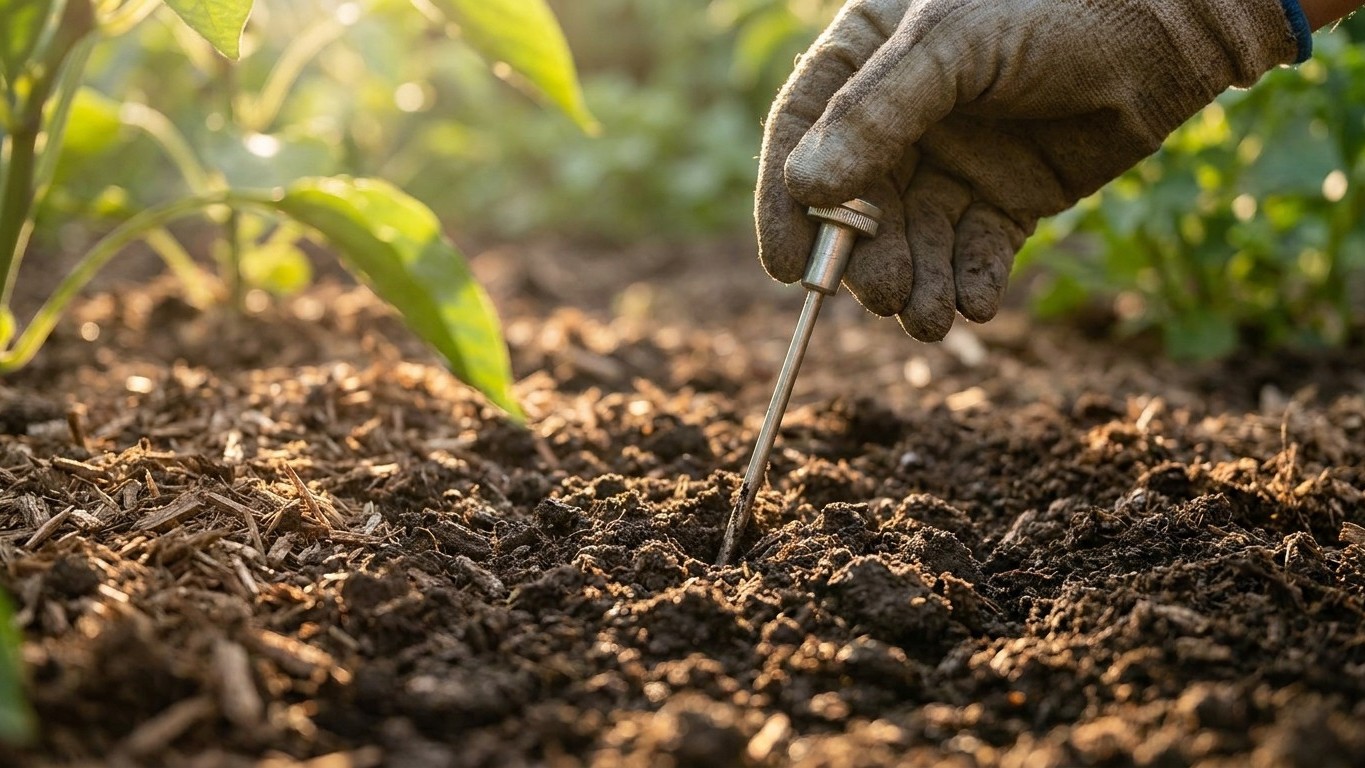
Testing depth is unglamorous but effective: push a screwdriver or a wooden dowel into the soil an hour after watering. If it slides in easily to six inches, you’ve done the job. If it stops at two inches, the water never made it past the surface crust, and you’re irrigating dust, not roots.
Container plants flip this rule. Pots heat up fast, sometimes losing moisture twice as quickly as in-ground beds because heat radiates through the container walls from all sides. During a heat wave, containers may genuinely need water once or even twice daily, especially unglazed terracotta, which is porous and loses moisture through its own walls in addition to the soil surface.
Mulch, Drip Lines, and the Overlooked Value of Shade Cloth
A two- to three-inch layer of mulch, whether wood chips, straw, or shredded leaves, can lower soil temperature by 10 to 15 degrees and cut evaporation dramatically. It’s the single cheapest heat-wave insurance policy available, and yet it’s the step most home gardeners skip because it feels like an extra chore rather than a watering technique. Treat it as one. Mulch is a watering technique, just a slower-acting one.
Drip irrigation and soaker hoses outperform overhead sprinklers for a reason that has nothing to do with technology and everything to do with physics: water applied at soil level doesn’t have to survive a trip through hot air first. Sprinklers can lose a meaningful share of their output to evaporation mid-air on a 95-degree afternoon, particularly if there’s any breeze. A soaker hose snaked through a vegetable bed, run for 30 to 45 minutes in early morning, delivers water almost entirely to where it’s needed.
Shade cloth, the 30 to 50% shade variety used by market growers, is worth considering for anything grown in full sun during a multi-day heat event. Draping it over lettuce, spinach, or newly transplanted seedlings for the hottest part of the day reduces the water they need in the first place, which matters when many municipalities impose watering restrictions exactly when plants need water most.
Reading the Plant, Not Just the Calendar
Wilting at 3 p.m. isn’t always a distress signal. Many plants, tomatoes and squash especially, droop their leaves at peak heat as a protective mechanism, reducing surface area exposed to sun, then bounce back fully by evening. Watering in response to that afternoon slump often means overwatering, since the plant wasn’t actually short on water, just managing heat. The real test is whether leaves are still wilted the following morning, before sunrise, when temperatures have dropped and transpiration has slowed. Persistent morning wilt is the signal that actually calls for more water.
Established, deep-rooted perennials and trees can often coast through a short heat wave, three to five days, on existing soil moisture if they’ve been watered deeply beforehand. It’s new transplants, container plantings, and vegetables in their fruiting stage that need the closest attention, since their root systems haven’t developed the reach to tap deeper, cooler soil moisture yet.
One detail surprises a lot of gardeners: overwatering during heat stress can look identical to underwatering, since both cause root function to fail and leaves to droop. Waterlogged soil during a heat wave suffocates roots of oxygen, and a plant that’s drowning wilts exactly like one that’s parched. Checking actual soil moisture with a finger or moisture meter before adding more water prevents a mistake that’s remarkably easy to make when the instinct during a heat wave is simply to water more.