
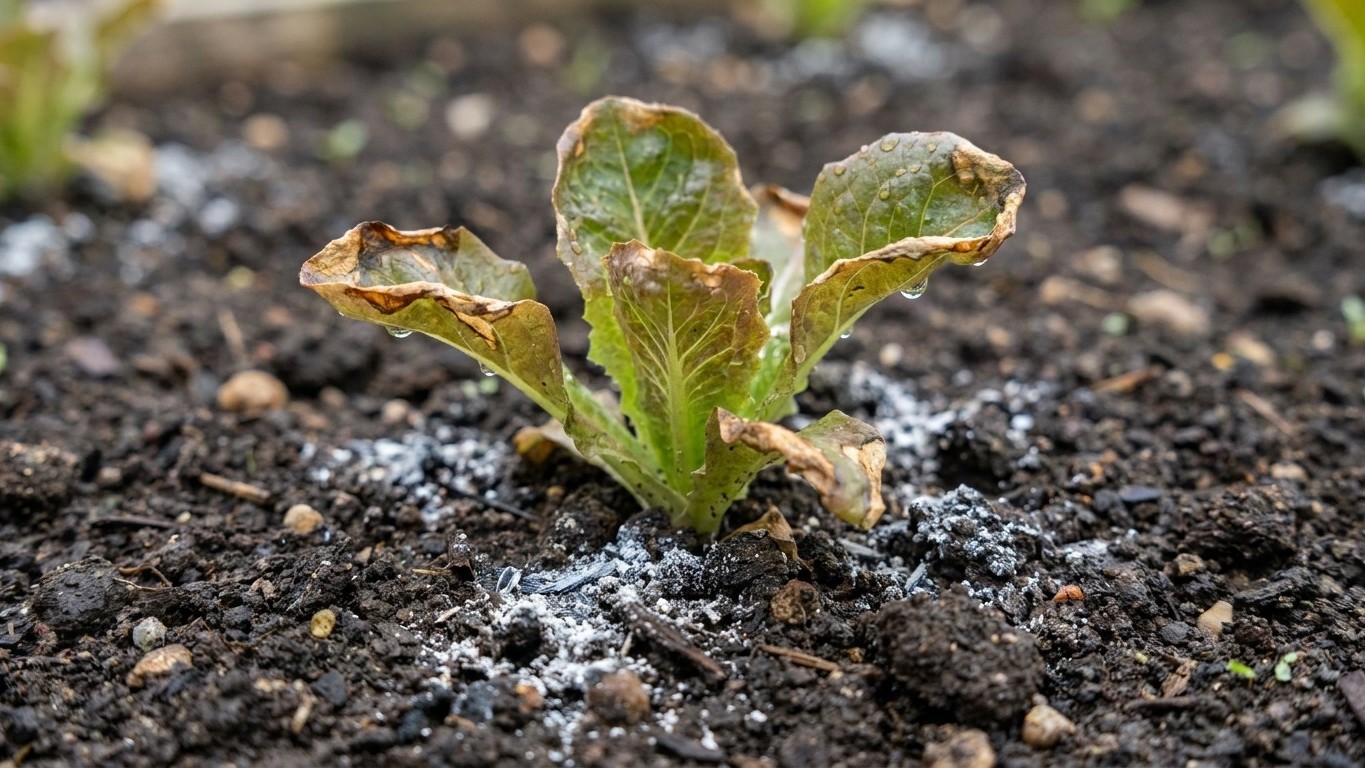
Wood ash sounds like the perfect free pesticide: sprinkle it around lettuce, watch slugs recoil from the gritty texture, and never touch a chemical spray again. Then rain falls, and days later those same lettuce seedlings look scorched at the edges, curling and browning as if someone had poured hot water on them. The ash itself is the culprit, and the chemistry behind that transformation explains exactly why so many home gardeners make this same costly mistake every spring.
Slugs really do avoid wood ash, and for good reason. Slugs do whatever they must to avoid contact with wood ash because their soft bodies can’t tolerate it, since the texture is too abrasive and salts found in the ash will harm and rapidly dehydrate them. That’s the appeal: a barrier made from something you’d otherwise throw away, working as a natural desiccant against pests that turn lettuce leaves into lace overnight. But the very quality that makes ash lethal to slugs, its causticity and salt load, is exactly what turns against tender lettuce foliage once water gets involved.
Key takeaways
- Wood ash becomes caustic lye when wet—the same substance ancestors used as a cleaning agent 5,000 years ago
- Rainwater dissolves ash’s alkaline salts and delivers them directly to fragile seedling roots and leaves
- Lettuce’s shallow roots and thin tissue make it uniquely vulnerable compared to other garden plants
What Actually Happens When Ash Meets Rainwater
Dry wood ash sitting on top of soil is relatively inert to the touch. Add water, and the chemistry shifts fast. Ash is essentially the mineral residue of burnt cellulose, loaded with calcium, potassium, and other oxides that react with moisture to form hydroxides, the same basic principle behind making lye. Ancestors learned to make lye, a caustic cleaning agent, at least 5,000 years ago by running water through wood ash. That’s not a historical footnote. It’s a preview of what happens in your garden bed the moment a rain shower hits a layer of ash you spread around seedlings.
The pH of fresh wood ash can be startlingly high. Wood ash has pH values as high as 13.0, which can cause deficiencies in micronutrients such as iron, copper and zinc, toxic shock to young seedling plants, and localized mineralogical changes in the soil environment where it is placed. For comparison, household ammonia sits around pH 11. Rainwater dissolves that alkaline material and carries it straight down into the root zone and onto leaf surfaces, delivering a concentrated caustic solution to exactly the part of the plant least equipped to handle it: fragile new lettuce tissue that hasn’t developed the thicker cuticle of a mature leaf.
Salt is the second half of the problem, and it’s often the one gardeners underestimate. Soluble salt contents of wood ash, measured as electrical conductivity, can reach 40 dS/m, a level that would be considered severely saline in almost any agricultural context. When rain dissolves that salt and it moves into the root zone, it disrupts the plant’s ability to absorb water through osmosis, essentially pulling moisture out of root cells rather than letting the plant draw it in. Leaf margins scorch first because that’s where water stress shows up quickest, which lines up precisely with the “burning” appearance so many gardeners describe after a rain event.
Why Lettuce Reacts So Badly
Not every plant responds to ash exposure the same way, and lettuce sits near the sensitive end of the spectrum. Leafy greens have thin, fast-growing tissue and shallow root systems that stay close to the soil surface, exactly where ash concentrates after a rain. Extension research on wood ash as a soil amendment flags this directly: gardeners should avoid applying ash to germinating seeds, since the high salt content can negatively affect germination. Young lettuce transplants are functionally in the same vulnerable window as germinating seed, still building root mass and unable to buffer a sudden salt spike.
Quantity matters more than most people realize. Extension guidance is specific here: gardeners should not apply more than 20 pounds of wood ash per 1,000 square feet, as high rates may cause short-term salt injury. A casual “sprinkle” from a fireplace bucket, especially concentrated in a ring right at the base of a few lettuce plants rather than spread thin across a bed, can easily blow past that threshold in the exact spot where it does the most damage. The same guidance recommends a fix that most people skip entirely: mixing ash into the soil thoroughly before planting and hosing off any ash that settles on actively growing plants to prevent burning the foliage. Left dry and undiluted on leaves, then hit by rain, that ash essentially becomes a slow-release caustic wash.
Using Wood Ash Without Torching Your Greens
None of this means wood ash deserves the trash bin. It means the timing and placement were probably backwards. Composting instructions and garden extension guides converge on a few practical adjustments that keep the slug-repelling benefit while cutting the burn risk dramatically.
- Apply ash to bare soil weeks before transplanting, not around plants already in the ground, giving rain time to neutralize it before roots are present
- Keep ash off leaves entirely and confine it to a thin ring in the soil around the base, away from direct stem contact
- Reapply after every rain rather than assuming one application lasts the season, since water dilutes and washes away the slug-stopping salts wood ash contains, meaning a soaked layer is doing nothing for pest control while still sitting in contact with roots
Testing your soil first changes the calculation too. Ash works as a liming agent, so it’s genuinely useful on acidic soil that needs a pH lift, but a garden already near neutral gets pushed into territory where nutrients become locked up and roots struggle regardless of slugs. Commercial growers dealing with far larger volumes of ash run soil tests before every application for exactly this reason, and a home gardener with a five-dollar pH kit can avoid the guesswork entirely.
The irony worth sitting with is that the ash didn’t fail as a slug deterrent. It likely worked exactly as intended, right up until the rain turned a protective barrier into a caustic soak the lettuce couldn’t buffer. Diatomaceous earth, crushed eggshells, or a simple copper tape barrier accomplish the same pest control without the chemistry lesson written across your leaves.
Sources : aol.com | extension.unh.edu