
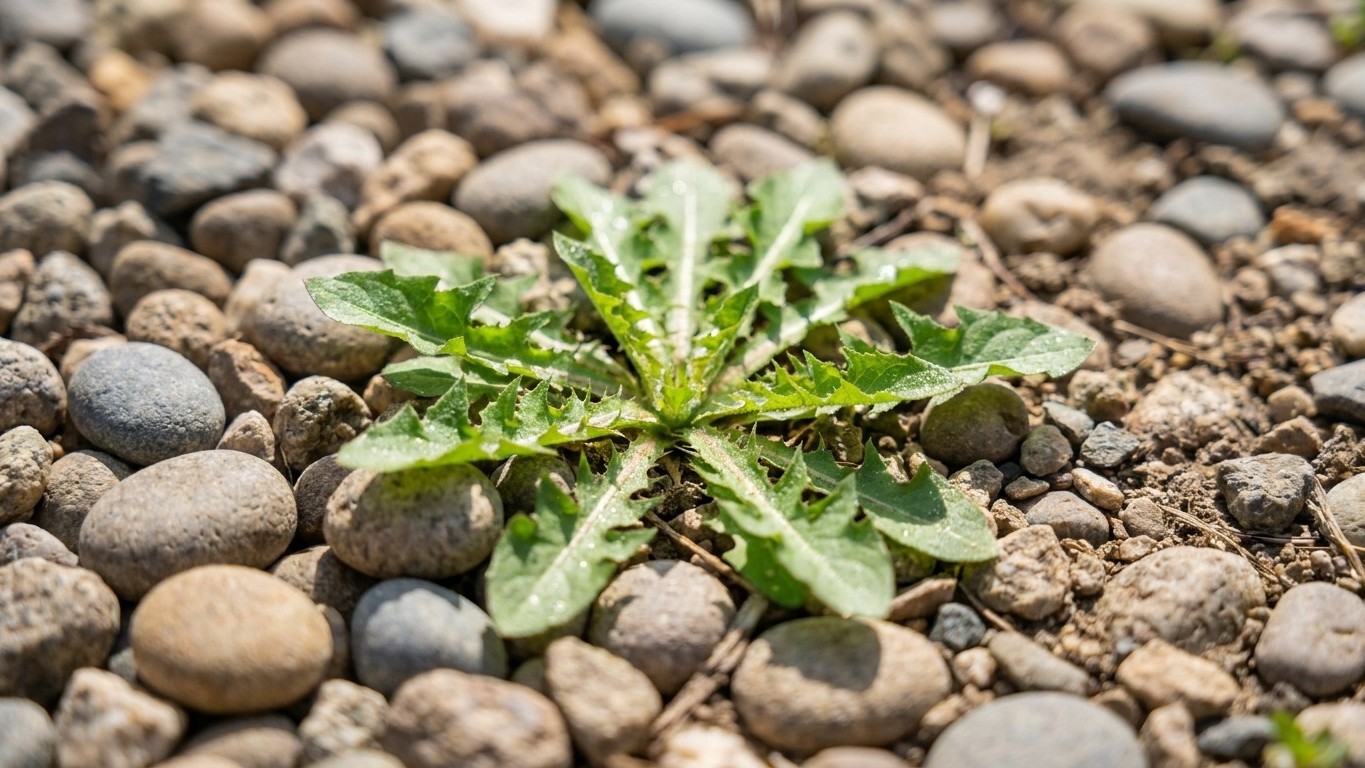
Two weeks. That’s how long the dandelions and crabgrass in my gravel path took to shrug off a full bottle of white vinegar and push right back through the stones, greener than before. The leaves had browned within hours of spraying, curled up like they’d been through a heat wave, and I genuinely thought the job was done. It wasn’t. What survived underground is the part nobody mentions in the “natural weed killer” posts that keep circulating: the root.
Acetic acid, the active compound in vinegar, is what horticulturists call a contact herbicide. It acts as a contact herbicide, meaning it impacts only the parts of the plant it touches, and it ruptures plant cells, causing fluids to leak and plant tissues to dry out. That’s exactly what I saw. The problem is what happens the moment that acid hits the soil line. It has almost no effect on the root system because it is a contact herbicide that is not absorbed by the plant, and when it reaches soil level it is quickly neutralized and converted to harmless acetate salts which have little effect on the weed. The plant doesn’t die. It just loses its leaves for a while, like a haircut it didn’t ask for.
Key takeaways
- A bottle of vinegar browned the weeds within hours, but they returned greener just two weeks later
- Acetic acid only touches what’s above ground; the underground root system it never reaches is already planning its comeback
- Even industrial-strength horticultural vinegar achieves less than 45% control on established weeds, despite what viral gardening posts claim
The mechanism nobody explains before you buy the spray bottle
Unlike glyphosate or other systemic herbicides, vinegar never travels through the plant’s vascular system. The acetic acid in vinegar is not absorbed by plant systems the way chemicals in commercial weed killers do, so it doesn’t travel to the roots, and vinegar is quickly neutralized by contact with soil. That single detail explains almost every disappointed comment section under every vinegar tutorial online. A dandelion’s taproot can run eight inches down. Bindweed and Bermuda grass spread through underground rhizomes that stretch feet away from the visible leaf. Spraying the foliage of these plants with vinegar is a bit like painting over a water stain and expecting the leak to stop.
The USDA actually tested this properly, and the results line up with what showed up in my gravel. Researchers found that 5- and 10-percent concentrations killed the weeds during the first two weeks after emergence from the soil, while older plants required higher concentrations of vinegar to kill them. My weeds weren’t seedlings anymore. They were established, with real root mass already banked as energy reserve. Even so, perennial weeds, such as Canada thistle, were only temporarily knocked back; the roots survived to sprout new shoots. Two weeks isn’t a coincidence in my case either. It’s roughly the window during which stored root energy pushes out fresh foliage after the top growth gets torched.
Concentration and timing matter, but they don’t solve the root problem
Some gardeners swear that horticultural vinegar, the industrial-strength version sold at 20 to 30 percent acetic acid, finishes the job that grocery-store vinegar starts. There’s some truth to that, and also a real safety trade-off. Using higher (20%) concentrations of acetic acid and increasing the application volume can improve weed control, and a 2006 USDA-ARS study found total crabgrass and grass weed control ranging from 28 to 45 percent. Less than half, even at industrial strength and heavy application rates. That’s not the “one spray and done” result the internet promises.
The higher concentration also comes with a handling problem rarely mentioned alongside the miracle claims. 20% vinegar can cause chemical burns, blindness if it makes contact with your eyes, and the fumes can even burn your nostrils, while also corroding concrete, metal, and wood. And here’s the detail that surprised me most while digging through the research: on paper, vinegar isn’t even the gentler option people assume it is. Toxicity is measured as an LD50 value, and the oral LD50 in rats for glyphosate is 4320 mg/kg, which is less toxic than vinegar at 3310 mg/kg, since lower numbers mean more toxic. “Natural” and “safe” aren’t the same word, whatever the label implies.
What actually clears a gravel path for good
None of this means vinegar is useless, just misapplied. It genuinely earns its place against weeds that are one or two leaves old, sprayed on a sunny, dry day so the acid isn’t rinsed off before it dehydrates the tissue. Vinegar needs to stick to weeds without being washed away, applied on a sunny, dry day. Add a few drops of dish soap so the spray clings to the waxy leaf surface instead of beading off, and target seedlings the week they emerge rather than waiting for them to establish a root system worth defending.
For anything past that seedling stage, the fix has to attack what’s underground, not just what’s green. Removing gravel and hand-digging out the root crown works, though it’s tedious in a layered driveway where digging through the different layers can destabilize it, and the ground may be compacted from being driven on, making it harder to dig through. A cleaner long-term fix, especially for a path you’re willing to rebuild properly, is a woven landscape fabric or a compacted sub-base laid before the gravel goes back down, since it blocks light and root penetration from below rather than fighting regrowth from above every two weeks.
Steam and boiling water land somewhere in between, and they’re worth a look if you want to skip chemicals entirely. One gardener who tested both against vinegar found the difference striking: “I was skeptical, but it really does get down to the roots, even with the crabgrass.” The catch is that boiling water and steam are just as indiscriminate as vinegar. They’ll kill whatever’s living in that gravel bed, including the earthworms and beneficial insects doing quiet work in the soil beneath your feet, so treat them as a spot tool rather than a monthly ritual over the whole path.
What finally cleared my own path wasn’t a stronger spray. It was pulling the gravel back a few inches along the worst-affected edge, cutting a strip of landscape fabric, and resetting the stones on top of it. Three weeks later, nothing has come through. The vinegar bottle is still in the shed, useful now for exactly what it’s good at: the odd seedling that pokes up before it’s had time to grow a root worth protecting.
Sources : gardendif.com | researchgate.net