
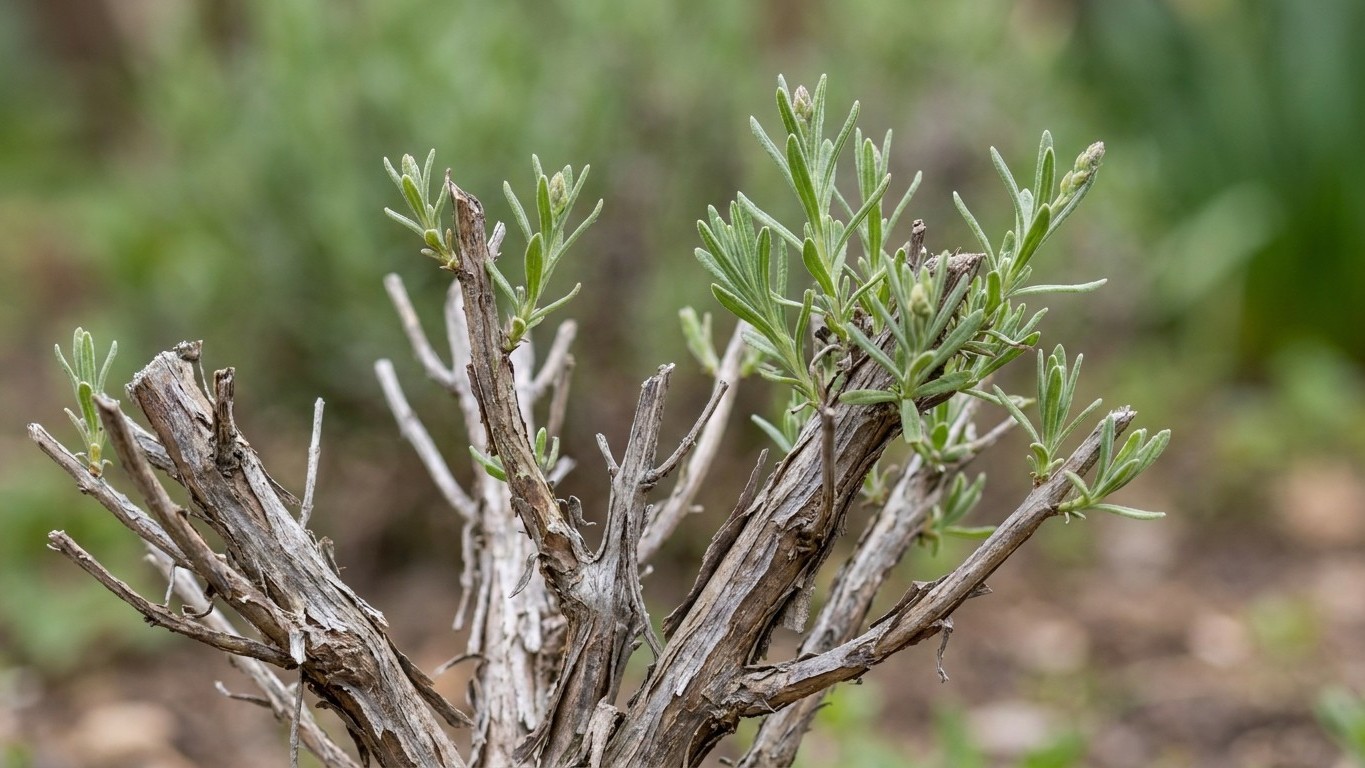
The lavender looked like every other shrub in the yard: leggy, sprawling, begging for a hard cut. So that’s exactly what happened, loppers included, right down into the thick brown stems near the base. By spring, the plant that once perfumed the whole patio was a collection of gray, brittle sticks. No green tips, no buds, nothing. Just dead wood standing where a thriving perennial used to be.
This is one of the most common ways gardeners accidentally kill lavender, and it happens because lavender doesn’t behave like the boxwoods, hydrangeas, or butterfly bushes people are used to pruning hard every year. Lavender stems are very specialized, growing watertight bark without many openings to the outside air to help the plant survive drought. That adaptation comes at a cost: this drought specialization came at the cost of propagation, since buds on old wood cannot sprout through the bark to turn into leaves and new stems. Cut into that brown, woody base, and there’s simply no living tissue left to push out new growth.
Key takeaways
- One pruning mistake can kill your lavender permanently—but most gardeners don’t know what it is
- The brown, woody base of lavender holds a biological secret that makes it fundamentally different from every other shrub you prune
- There’s a narrow window each year when you can actually shape lavender without risking the entire plant
Why the “cut it like a shrub” instinct backfires
Plenty of shrubs reward the aggressive approach. Butterfly bush, for instance, can be hacked back to eight inches every year and comes roaring back. Lavender plays by different rules. Every lavender pruning failure traces back to the same cause: cutting into old wood, the brown, hard, woody base of the plant, stems that have fully lignified and lost their green, leafy tissue. That wood still holds the plant up, structurally speaking, but it has stopped participating in growth altogether.
The biology behind this is oddly precise. As stems mature and lignify, the axillary buds that form at each leaf node, the growth-initiating cells responsible for new shoots, are gradually lost, and meristematic tissue exists only where green tissue remains. Once that green tissue is gone, so is any chance of recovery from that particular stem. One gardening resource that tracks lavender failures noted a grim but useful timeline: without green tissue, the plant has no resources to push new growth, and the result is usually death within 6 to 8 weeks. Six to eight weeks. Long enough to convince yourself the plant is just “taking its time,” and just short enough that by the time you accept it’s dead, the growing season is already gone.
What correct pruning actually looks like
The fix isn’t complicated once you know the rule, but it does require patience most first-time lavender growers don’t expect. The cardinal principle: always make pruning cuts above new leaf growth rather than into the woody sections of the plant, since lavender will not form new growth on old wood. The one exception is dead or damaged stems, which can be removed right down to the base. In practice, that means locating the line where gray-green foliage meets brown bark, and cutting an inch or two above it, never below.
Timing matters just as much as depth. Most guidance points to two windows a year: a general rule of thumb is to prune twice a year, once after the main flowering flush in late summer or early autumn, and then a lighter tidy-up in spring, typically from late August through September depending on region. The late-summer session is the one that actually shapes next year’s bloom. The late-summer prune is the productive cut, it stimulates the new growth that carries next year’s flower buds. Spring pruning, by contrast, should stay conservative. A lighter prune in early spring, just as new growth begins to emerge, is the time to remove any dead or frost-damaged branches that became apparent over winter, and lightly shape the plant. Skip the late-summer cut and try to compensate with a brutal spring hack, and you’re setting up the exact scenario that kills so many plants. As one lavender-focused source bluntly put it, that’s the worst possible response, since one mistake worth calling out is gardeners who skip the late-summer prune and arrive in spring with an overgrown, leggy plant then compensate with a hard spring cut.
If the damage is already done
Not every case is hopeless, though the odds aren’t great. Before writing off a plant that’s been cut too hard, check for tiny signs of life. A simple scratch test on a woody stem, gently scraping the surface with a fingernail, reveals green underneath if that part of the stem is still alive; brown and dry means it’s likely dead wood. If you spot any green shoots low down near the base, there’s a real, if narrow, path forward. Start by cutting out any clearly dead, brittle stems with no signs of life back to the ground, then on remaining live stems, cut back about one-third to one-half of the length, always just above a node or cluster of new green shoots.
Resist the urge to help the plant along with fertilizer. It feels intuitive, but it works against the plant’s nature here. Lavender prefers lean conditions, and excess nutrients, especially nitrogen, will encourage weak, leggy growth rather than strong regeneration. Water it, be patient, and don’t expect a comeback overnight. And if nothing stirs after a full season of coaxing, it’s worth accepting the loss and replacing the plant rather than nursing a stump indefinitely. A young lavender from a rooted cutting will outperform the elderly shrub within two seasons anyway, so a fresh start often pays off faster than anyone expects.
One detail that surprises a lot of gardeners: not all lavender varieties tolerate the same treatment. Compact English types handle a fairly hard annual cut, but even small English lavender types can have root zones as wide as 6.5ft but just an inch or two deep, which explains why they sulk in tight containers and why drainage, not just pruning technique, decides whether a plant even has the reserves to recover from a bad cut in the first place.
Sources : bloomingexpert.com | tomsguide.com