
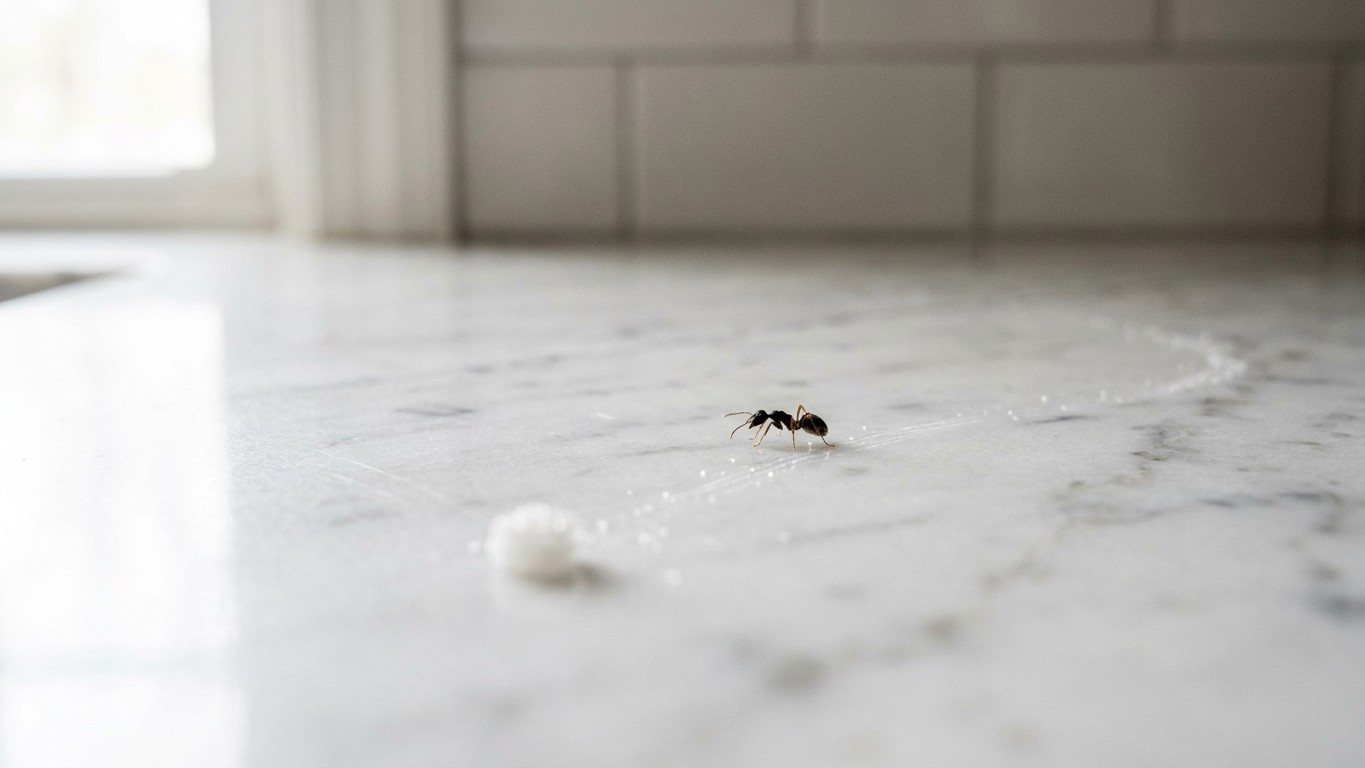
Squashing an ant on your countertop doesn’t stop the next one from showing up. In fact, it might make things worse. That first ant you flattened had already done the damage on its way back to the nest, leaving behind an invisible chemical signature that told every other worker in the colony exactly where to find your kitchen’s food supply. Understanding this changes how you fight an ant problem, because killing the messenger does nothing to erase the message.
Key takeaways
- The ant you squashed had already left an invisible chemical signature stronger than you realize
- Your kitchen counter holds a secret highway that survives soap, water, and even bleach
- One common household item can actually destroy what standard cleaners miss
The Secret Highway on Your Counter
Ants don’t just wander aimlessly into your home. They’re guided by invisible highways made of scent, pheromone trails laid down by the first scouts to find a food source. A single scout ant stumbles across a crumb, a drop of syrup, or a smear of grease near the toaster, and on its way home it deposits a chemical marker with every step. This trail becomes stronger as more ants travel the route, reinforcing it with every pass. What starts as a single forager can quickly become hundreds following the same path with precision.
What surprised me most was learning that each ant adds to the scent of the trail as they move along it, reinforcing the message they leave behind, essentially broadcasting “good food this way” to the rest of the colony. That’s why a single ant on Monday can turn into a small parade by Wednesday. The system is almost absurdly efficient. When a worker ant finds food, it leaves behind a microscopic trail of scent markers as it returns to the nest, and these pheromone trails act as a navigation system directing other ants back to the same location.
Here’s the part that reframes everything: killing that first ant does nothing to the trail itself. Simply killing the ants you see won’t solve the problem. The ant pheromone trail they’ve created doesn’t disappear when the ants are killed. It remains as a navigator trail for other ants to follow. Even if you eliminate all visible ants, new ones will continue to show up because they’re following an established ant pheromone trail. Squashing ants one by one is like unplugging a single streetlight and expecting the highway to disappear.
Why Wiping With Water Isn’t Enough
Most people react to ants the way I did: a quick swipe with a damp sponge, maybe some all-purpose spray, and a satisfied feeling that the problem is handled. It isn’t. Soap and water can disrupt the scent trail from a food source back to the nest, as Oregon State University Solve Pest Problems recommends, but a quick countertop wipe may miss the full path. The trail rarely stays confined to the two feet of counter you actually cleaned.
A spotless counter can still hold traces of sugar or grease too small for you to notice but perfectly detectable to foraging ants. Their antennae are built to pick up concentrations of chemicals that are, to a human nose, nonexistent. And the trails themselves are surprisingly durable. These scent trails are especially resilient indoors. Smooth kitchen surfaces like countertops, floors, and baseboards can hold pheromone residue for days.
That explains the maddening pattern so many homeowners describe: clean today, ants tomorrow, same spot, same time. Ants do not remember locations the way people do. Instead, they rely on a network of scent trails and environmental cues that direct them toward resources discovered by other workers. The colony isn’t being clever or stubborn. It’s just following a map that’s still technically valid.
What Actually Breaks the Trail
Standard household cleaners often fall short here, and bleach in particular has a surprising weak spot. Bleach is surprisingly bad at dissolving fatty, waxy substances like ant pheromones. It essentially bleaches the surface and leaves behind a residue, but the structural integrity of the pheromone trail often survives, and once the smell of the bleach fades, the ants can pick the scent trail right back up.
Vinegar works differently, and better. White vinegar contains acetic acid, and this acid breaks down and dissolves the lipid-based pheromones completely. Vinegar does not just mask the scent; it structurally destroys the chemical markers the ants left behind. A simple fifty-fifty mix of white vinegar and water in a spray bottle, applied generously and wiped with a paper towel, is the fix pest professionals reach for first. Disrupting the ant pheromone trails is critical because these are what ants use to communicate the location of a food source and navigate to and from their nests, and to stop them returning, the trails need wiping out so other ants don’t know to navigate into your home.
Lemon juice offers a similar acidic punch if vinegar isn’t on hand, and lemon juice works the same way, since the acidity disrupts the pheromone signal so other ants cannot follow the path back to your food sources. Dish soap has its own role too, though it plays a different position on the team: it’s excellent for killing ants on contact but weaker at fully erasing the chemical residue on porous surfaces.
One detail that gets overlooked: the trail almost never ends exactly where you can see it. Clean several feet beyond the visible trail, since scent paths often extend farther than what’s immediately visible. Treating only the section of counter where ants were marching, and ignoring the baseboard or windowsill they came from, just resets the clock. And because reinforcement occurs as ants walk the same route repeatedly, a single treatment sometimes isn’t enough. Repeating the vinegar wipe over a day or two, alongside sealing up crumbs and sugary spills before they even get a chance to attract a scout, is what actually shuts the highway down for good.
Sources : homesandgardens.com | sagepestcontrol.com