
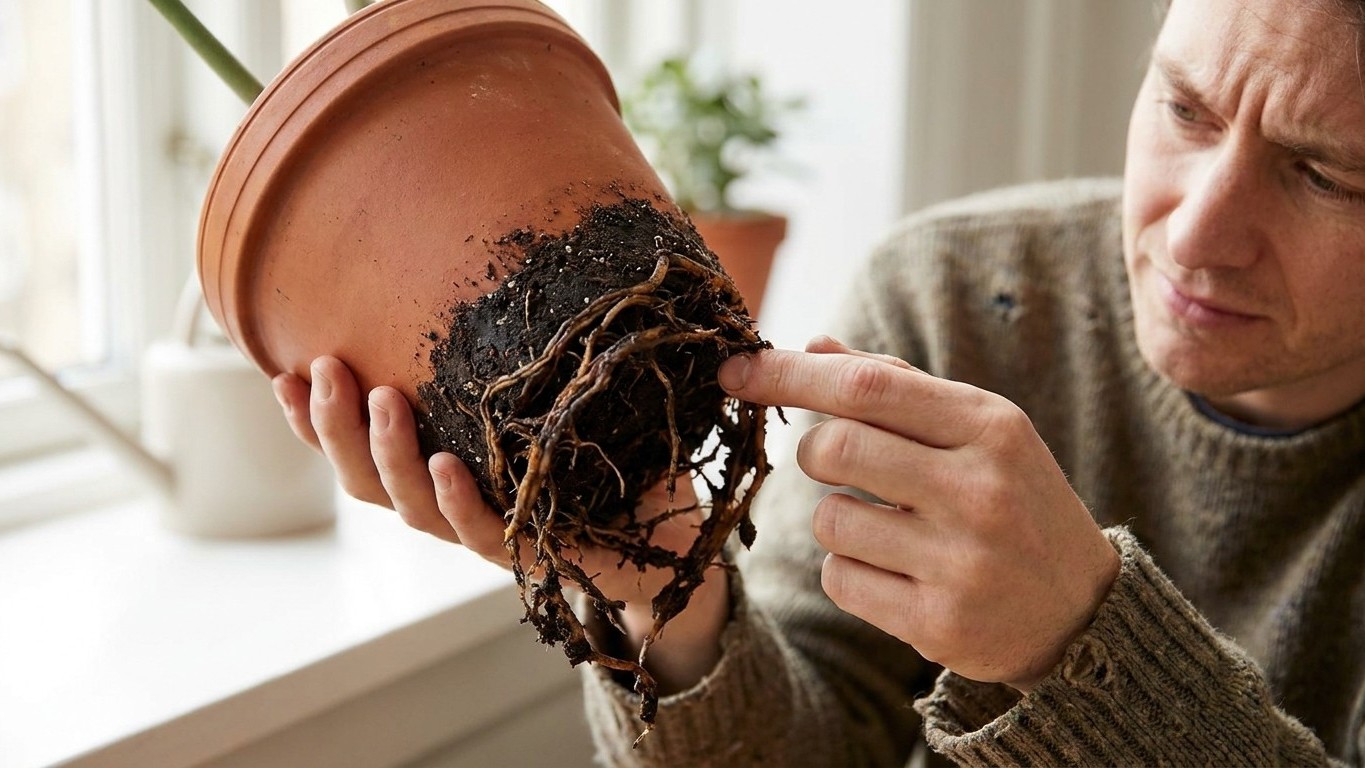
The roots had turned to mush. Black, slimy, falling apart at the slightest touch, they smelled faintly like something left too long in a forgotten lunch bag. That’s what a week of “rescue” watering had done to a plant that looked, on the surface, like it was dying of thirst.
The leaves had been drooping for days. Edges curling, color fading to a sickly yellow-green, the whole plant sagging like it hadn’t seen a drop of water in weeks. So the instinct kicked in: water it, then water it again the next day, just to be safe. Seven days later, lifting it out of the pot to repot it into something fresh, the truth was sitting right there in the soil. The plant hadn’t been thirsty at all. It had been drowning.
Key takeaways
- Wilting leaves and yellow edges can mean the opposite of what you think—your plant might be drowning, not thirsting
- Healthy roots are white and firm; what was found underground looked nothing like that after a week of rescue watering
- One simple habit with your pot could have prevented this disaster entirely
Why a Wilting Plant Isn’t Always a Thirsty One
This mix-up trips up even people who’ve kept plants for years, and there’s a biological reason for it. If a plant is slowly wilting and the leaves are turning yellow, crisping around the edges, or dropping, it might be dealing with root rot, and the problem with root rot is that its symptoms look an awful lot like the symptoms of underwatering. The two conditions produce almost identical warning signs above the soil line, even though what’s happening underground is the exact opposite.
The mechanism behind this confusion is almost cruelly ironic. Rotten roots are unable to absorb water for the rest of the plant, so while the roots are wet the leaves may be dying of thirst. the plant is sitting in a swamp and starving at the same time. Watering it more doesn’t fix anything. It just drowns roots that are already failing to do their one job.
Toms Guide, covering the same phenomenon, notes that another warning sign is wilting even when the soil feels moist, and it might seem strange, but overwatered Houseplants can wilt just as they do when thirsty, because their roots are suffocating and unable to absorb water properly, despite its abundance. Add in soft stems and mushy leaves, and you’ve got a plant that’s sending every signal of thirst while actually needing the opposite treatment.
What Was Really Happening Underground
Pulling a struggling plant out of its pot is the only way to know for certain what’s going on. Healthy roots are firm and white or cream-colored, while rotted roots are brown or black, soft, and mushy. In more advanced cases, the outer layer of the root may slough off easily, and root rot often has a noticeable odor, similar to rotting vegetables. That smell is often the first real confirmation, long before the eyes catch up.
The root cause, quite literally, comes down to oxygen. Gardeners’ World explains that root rot occurs when the roots of a plant become waterlogged and can no longer take in air, leading to the decay and death of the root tissues. Roots don’t just drink water, they breathe. Soil that stays saturated for days on end suffocates them the same way a person would suffocate underwater, and once the tissue dies, fungal decay moves in fast.
Heavy, compact potting mixes make this worse. Heavy compact soils play a big part in root rot because they hold huge amounts of water and very little air, and even with careful watering habits, a growing medium that behaves like a giant sponge will cause problems sooner or later. A pot without adequate drainage holes, or one sitting in a saucer that never gets emptied, turns even modest watering into a slow flood.
Reading the Signs Before It’s Too Late
The good news is that the diagnosis doesn’t require guesswork once you know what to check. Leaf texture is the fastest tell: leaves that are soft and limp, not crispy, point to overwatering, because the texture is the giveaway, overwatering looks like ‘wet wilt’. Crispy, brittle, curling leaves paired with soil pulling away from the pot’s edges point the other direction, toward genuine drought stress.
Pot weight is a second, almost foolproof clue. Lift the pot: a heavy pot with wet or damp soil and soft yellow leaves is overwatered, while a light pot with bone-dry soil and crispy curling leaves is underwatered. This single habit, done before reaching for the watering can, prevents most of the guessing that leads to disaster in the first place.
Long term, the fix isn’t a stricter schedule but abandoning the schedule altogether. Signal-based watering, using the finger test, pot weight, or both, solves both problems at once. A calendar reminder to water every Sunday ignores humidity, season, light levels and pot size, all of which change how fast soil actually dries.
Recovery, If There’s Anything Left to Save
Once root rot is confirmed, the fix is surgical rather than gentle. Damaged tissue has to go. Remove the plant, prune away all decayed roots, and repot in fresh, well-draining soil, then use the finger test going forward, watering only when the top two inches of soil are dry. Trying to save mushy, blackened roots rather than cutting them away just reintroduces the fungus into fresh soil.
Recovery speed depends heavily on the plant itself and how much damage was done before anyone noticed. Recovery time often depends on the level of damage, with pothos sometimes bouncing back in two weeks if the roots are largely fine, while Succulents such as aloe vera may struggle for longer if overwatered, though once repotted in fresh soil and given indirect light, new growth is the sign that healing is underway. A mild case, caught early, tends to resolve simply by backing off entirely. A gently overwatered plant will often recover if you let it dry out in a warm, bright spot.
Here’s the detail most people miss when they finally do the autopsy: it’s rarely the water itself that kills the plant, it’s the stagnant water sitting below the roots with nowhere to go. A pot with a single drainage hole and a layer of dense, water-retentive soil can trap moisture for a week after the surface looks bone dry. Next time a plant looks thirsty, check underneath before reaching for the watering can. Sometimes the kindest thing you can do is nothing at all.
Sources : rockledgegardens.com | almanac.com