
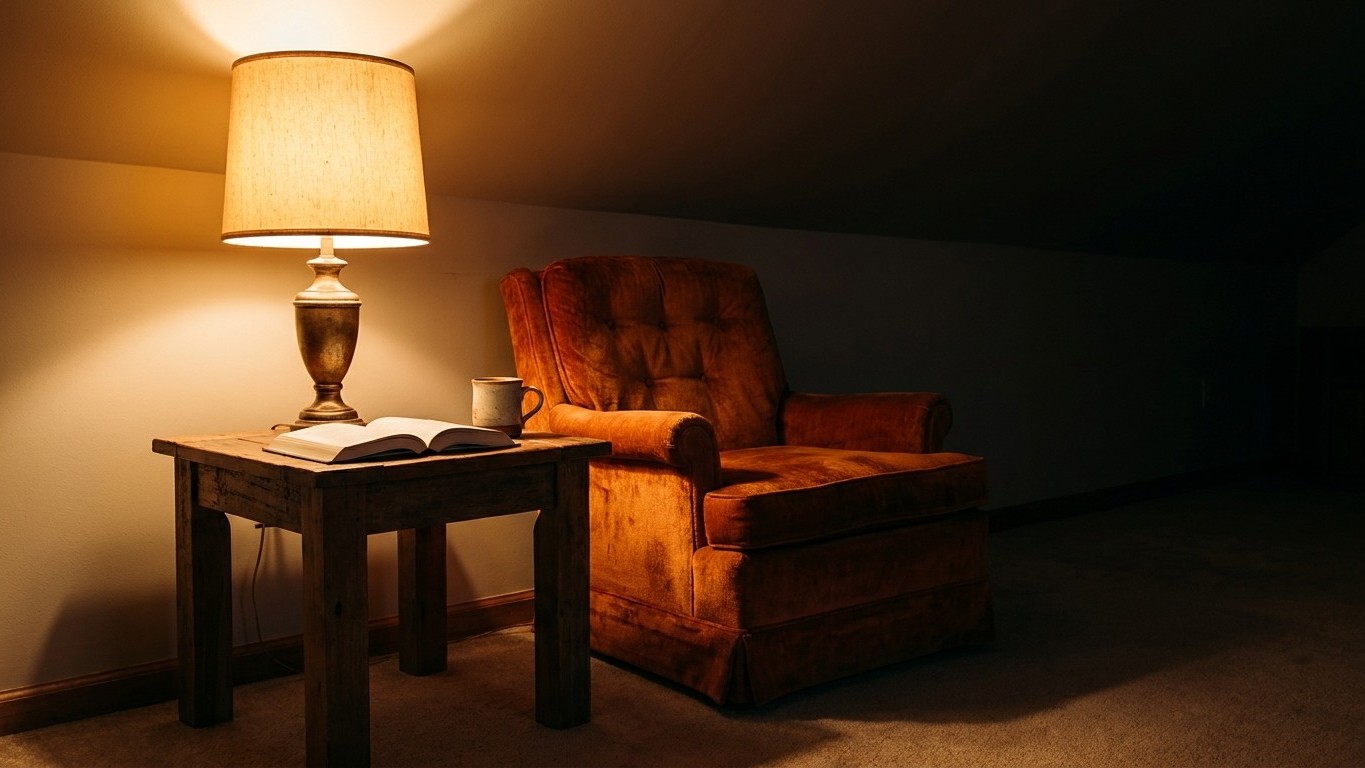
Two lamps. That’s all it took. Swap the harsh overhead bulb for a pair of small 2700K table lamps, and suddenly the ceiling light switch turns into the least-used control in the house. This isn’t a coincidence or a fluke of taste. There’s real science behind why a warm, low glow beats a single bright source, and it explains why so many living rooms start feeling like sterile waiting areas the moment someone flips on that one ceiling fixture.
Key takeaways
- A living room’s ceiling light suddenly became the most-ignored switch after introducing just two small warm lamps
- 2700K light mimics candlelight and suppresses melatonin less than cool white bulbs, making evenings feel naturally different
- Professional designers call this ‘layering’—and it’s not about brightness, it’s about where light is allowed to fade
Why 2700K Feels Like a Different Room
Light at 2700K is soft, golden, and reminds one of the light of old incandescent bulbs or candlelight. That’s not marketing language, it’s physics: the lower the Kelvin number, the more red and amber the wavelength mix, the higher the number, the more blue and clinical it reads. Color temperature doesn’t affect brightness, that’s measured in lumens, so a 2700K bulb and a 5000K bulb can both be 800 lumens but look and feel completely different in a room. Most ceiling fixtures installed by builders skew toward 3000K or higher, precisely because that range reads as “functional.” Functional is exactly what a living room isn’t supposed to feel like after 8 p.m.
Hospitality designers figured this out decades ago. In hospitality premises like hotels, lounges, and waiting rooms, 2700K light is considered luxurious and warm, which helps guests feel comfortable. That “hotel suite” feeling readers describe isn’t an accident, it’s the same design logic showing up at home. A lobby doesn’t rely on one blazing chandelier; it layers pools of low, warm light at different heights so no single source dominates the eye.
The Real Reason Nobody Reaches for the Switch
Ceiling lights fail for a structural reason, not just a color one. When lighting sits entirely at the same level, it can make a living room feel one-dimensional, and when all illumination comes from similar levels, the space lacks much-needed depth. Mixing ceiling fixtures, table lamps, floor lamps, and wall-mounted lighting introduces layers and visual interest. A single downlight flattens shadows, erases texture, and makes a sofa look like an exhibit rather than somewhere to collapse after work. Two lamps at sofa height do the opposite: they create shadow and highlight, the visual cues our brains associate with a lived-in space rather than an inspection room.
There’s also a biological piece to this puzzle that goes beyond aesthetics. A 2026 study published in Scientific Reports measured actual melatonin suppression across dozens of lamp types and found that “cool” white LED (median 12.3% MSV) and “cool” white CFL (12.1% MSV) lamps induce considerably greater melatonin suppression than “warm” white LED (3.6%), “warm” white CFL (2.6%), or traditional incandescent (1.5%) lamps. Translation: that bluish ceiling light isn’t just visually harsher, it’s quietly telling your body it’s still daytime. Harvard’s sleep researchers back this up too, noting that while light of any kind can suppress the secretion of melatonin, blue light at night does so more powerfully. Two small warm lamps aren’t just softer on the eyes, they’re softer on your sleep cycle.
How to Build on Two Lamps Without Overdoing It
Professional lighting designers call this “layering,” and it’s built on three roles rather than one. Ambient lighting provides general illumination, making an entire room visible, welcoming and easy to navigate, and chandeliers, recessed lights and floor lamps are often used to create this layer. Table lamps, meanwhile, blur the line between ambient and task lighting, acting as versatile assets that blend ambient and task lighting wherever they’re needed most, and placed next to a couch or an armchair, they serve as an easy-access reading light. The two-lamp setup that made the ceiling light obsolete is, whether by accident or instinct, a textbook execution of this principle.
The temptation now is to add more fixtures at random. Resist it. Consistency matters more than quantity here. Mixing 2700K and 4000K in the same space can look off and distract the eye, because one lamp at 2700K and overheads at 4000K essentially fight each other. If a third light gets added, whether it’s a floor lamp in the corner or an accent light behind a shelf, it should match that same 2700K temperature, not introduce a cooler competing tone. Designers at Warm by Design frame it simply: living rooms usually feel finished when warm light comes from several heights, not one ceiling source, and a strong lighting plan does not try to make every square foot equally bright.
Dimmers help too, though they’re optional if the lamps already sit at a gentle glow. Because living rooms serve different functions throughout the day, ambient lighting should always be dimmable to allow for brightness to shift naturally as the evening goes on. A lamp on a low-wattage bulb already does part of that job without any extra hardware.
What’s happening in that living room isn’t really about abandoning the ceiling light forever. It’s daylight and cleaning sessions that still call for full brightness, and a single overhead fixture still earns its keep there. But for the hours people actually spend on the sofa, the two-lamp trick proves something interior designers have been saying for years: a room feels finished not when every corner is lit, but when the light has somewhere to fall short. That’s the gap the ceiling switch used to fill badly, and now doesn’t need to fill at all.
Sources : citylightssf.com | nature.com