
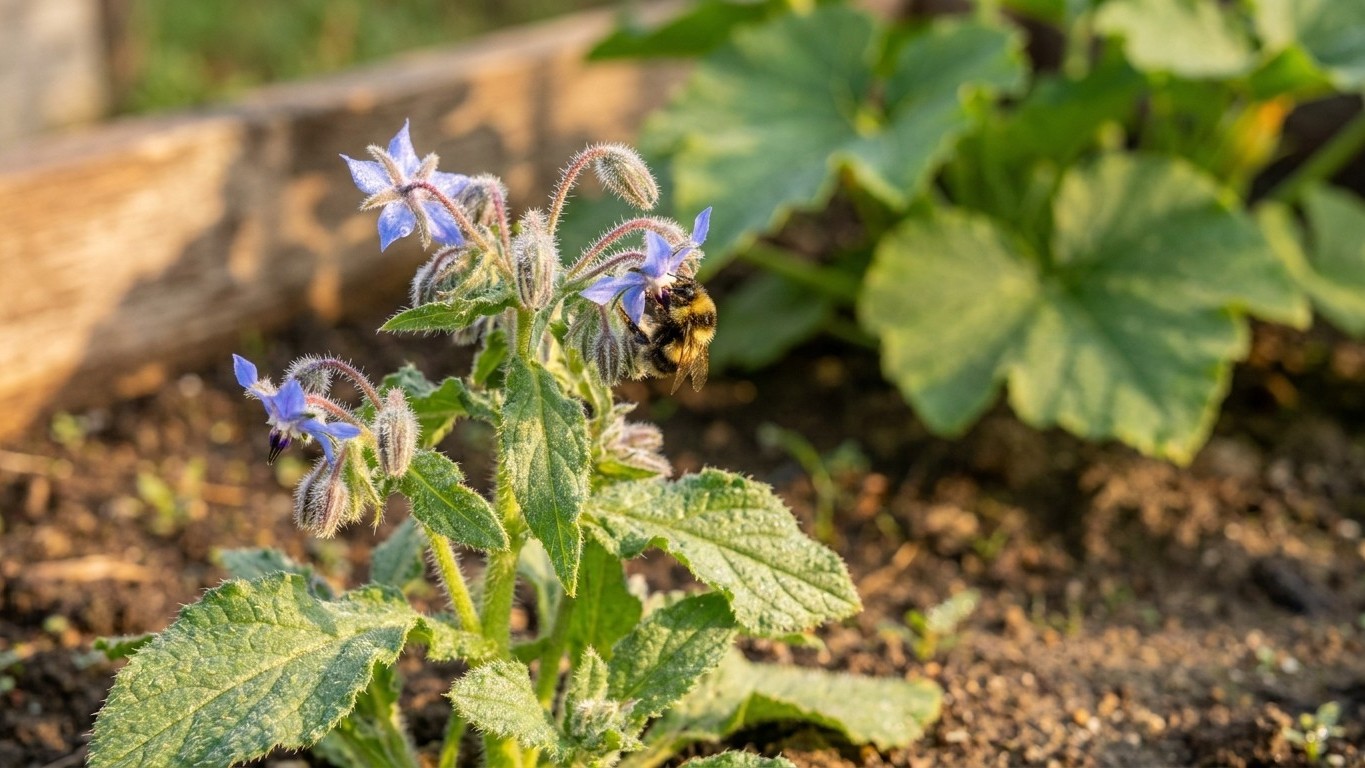
Every summer, the same ritual plays out in vegetable gardens across the country: an alarm set for dawn, a small paintbrush in hand, and a race against squash flowers that slam shut by midmorning. Growers dab pollen from male blossom to female blossom, one flower at a time, hoping to beat the clock before the bloom wilts. There’s a simpler fix, and it grows two feet away from the squash bed: borage, sown right between the rows, gets bees working the patch before most gardeners have poured their coffee.
Key takeaways
- Squash flowers only stay open for one morning and need 8-12 bee visits to set fruit—but what if the bees were already there before you woke up?
- Borage’s nectar refills every few minutes, making it irresistible to honeybees, bumblebees, and native pollinators who then drift straight into nearby squash blooms
- The spacing matters more than most people realize—one borage plant at the edge doesn’t work, but several planted along the rows creates a pollinator corridor that captures bees right when squash flowers open
Why squash needs so much help in the first place
Squash flowers are demanding by design. A female blossom gets just one morning to be pollinated. It opens at sunrise, closes by afternoon and never opens again. That’s a brutal deadline for a plant that depends entirely on outside help, since squash produces separate male and female flowers rather than the self-contained kind found on tomatoes or peppers. During that narrow window, research suggests it typically takes about 8-12 bee visits to deliver enough pollen for a well-formed squash. Miss that window, and the tiny fruit behind the female flower simply shrivels and drops.
That’s exactly why hand pollination became a go-to technique. The key is identifying male and female flowers correctly, working between 6:00 a.m. and 10:00 a.m. when pollen is most viable and stigmas are receptive. It works. But it also means checking blossoms every single morning, often before breakfast, for the entire fruiting season. Gardeners who’ve done it for a full summer know the appeal of finding a shortcut that doesn’t involve a paintbrush.
The plant that shows up before the bees even wake up properly
Borage isn’t a trendy discovery. Old-timers called it “bee bush” for a reason: other names for borage include bee bush and bee bread. It is a favorite plant of honeybees (with especially nutritious blue pollen), bumblebees, and small native bees, all of which aid pollination in the vegetable patch. The star-shaped blue flowers refill with nectar every few minutes, which keeps foragers cycling back over and over rather than visiting once and moving on.
That constant traffic matters more than most people realize. Commercial beekeepers used to plant fields of it specifically to boost hive output: at one time, beekeepers grew it to boost honey production, yielding 200 pounds of honey per acre and 60-160 pounds of pollen. Put that same magnetism a few feet from a squash hill, and the bees that would otherwise be scattered across the neighborhood end up parked in your garden at first light, working borage blossoms and drifting straight into the open squash flowers nearby.
One seed-saving gardener documented exactly this timing while trying to hand-pollinate zucchini for a seed-saving project. They open early in the morning and pollinators will get in there before you. (I hand-pollinated and took these pictures at about 7am, and the pollinators were already busy on the open flowers.) That’s the whole case for borage in one sentence: by the time a gardener walks out with a brush, the bees drawn in by the borage have often already finished the job.
Planting it right, not just planting it somewhere
Borage isn’t fussy, which is part of its appeal for anyone tired of babying finicky companion plants. It grows tall enough to compete with squash’s sprawling leaves without smothering the crop, and its deep taproot pulls minerals from soil layers the squash roots never reach. Nurseries and extension-adjacent growers recommend giving it a bit of breathing room rather than crowding it right against the stem: transplant these companions at the same time, leaving about 18″ between the zucchini and the borage plant.
Sowing it directly between rows, rather than off to one side, is what makes the early-bird effect work. Squash sprawls outward fast, and a single borage plant tucked at the edge of a bed does little for flowers thirty feet away. Spacing a few borage plants along the row, spread every several feet, means no matter where a female squash blossom opens that morning, there’s a borage flower close enough to have already pulled bees into the immediate area. For anyone growing more than a couple of hills, that spacing detail is the difference between “we still had to hand-pollinate half the patch” and skipping the brush altogether.
Sweet alyssum and phacelia get mentioned in the same breath as borage for similar reasons. Borage and sweet alyssum planted within 10 feet (3 m) of your squash patch create a reliable pollinator corridor that keeps bees moving between your flowering companion plants and your squash blossoms. But borage has an edge in raw appeal to bees, and its blue flowers are unmistakable against squash’s yellow blooms, making it easy to track where the pollinator traffic is concentrating.
What this means for a gardener who’s over the paintbrush routine
Nobody’s claiming borage eliminates the need to check on squash altogether. Cool, rainy stretches still slow bee activity no matter what’s blooming nearby, and gardens in truly isolated spots, a rooftop with no wild bee population within reach, may still need occasional hand intervention. But for the typical backyard or community garden bed, sowing borage between the squash rows turns pollination from a daily chore into something that mostly happens on its own, well before most people are even out of bed. Save the seed packet, though. Borage self-sows aggressively once established, so next year’s patch may show up on its own, right on schedule.
Sources : gardenbetty.com | sowrightseeds.com