
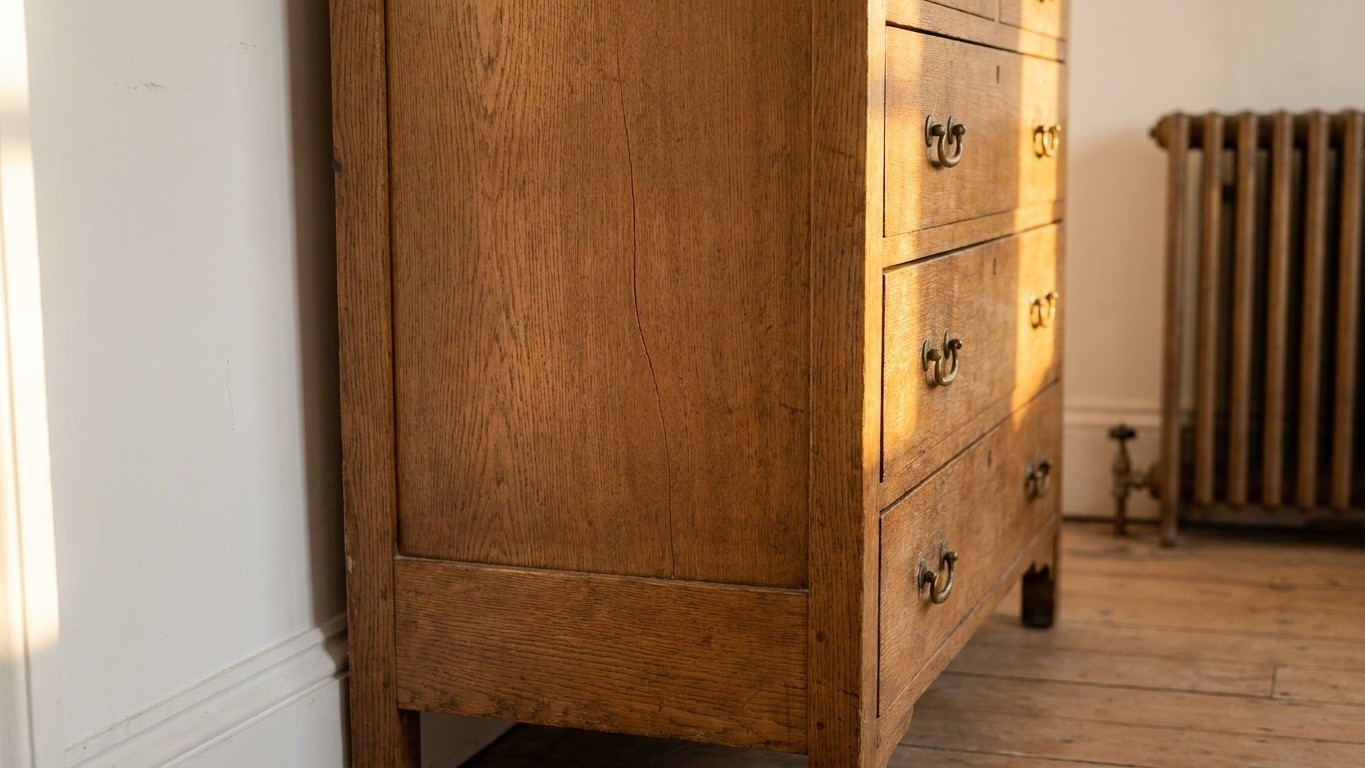
Two years ago, I dragged a solid oak chest of drawers out of a neighbor’s garage sale for forty dollars, wedged it against the wall in my bedroom, and felt smart about it. It sat eighteen inches from the radiator. Cheap heat solution, I thought, free furniture upgrade. Then last winter I opened the top drawer and heard a sound like a knuckle cracking. That’s when I noticed the hairline split running down the side panel, right along the grain, exactly where the wood had been baking for two heating seasons.
I hadn’t broken anything. I’d just done what thousands of people do every winter without thinking twice: parked a piece of solid wood furniture in the one spot in the room that dries out fastest.
Key takeaways
- A $40 used oak chest developed structural damage after sitting 18 inches from a radiator for two heating seasons
- Wood absorbs and releases moisture constantly, but radiator heat accelerates the process to destructive levels
- The safe humidity zone for solid wood furniture is 35-55% RH, but winter heating can drop indoor air to desert-like 15-25%
Why Radiators Are Furniture’s Quiet Enemy
Wood is what specialists call hygroscopic, meaning it constantly absorbs or releases moisture depending on the air around it. Wood is hygroscopic – it absorbs and releases moisture with the surrounding air. Under normal conditions that exchange happens slowly enough that nobody notices. Next to a radiator, it doesn’t. This consistent heat can do the same thing as a hot attic. The warm air pulls moisture from within the wood and weakens the structure.
The mechanics are almost mundane, which is what makes them easy to ignore. If the air is too dry, wood loses moisture, which causes tiny gaps and cracks to occur. When the humidity rises again, the wood expands and closes the surface flaws. That back-and-forth sounds harmless in isolation. Repeated every winter for years, right next to a heat source, it isn’t. If humidity remains too low and temperature too high over a longer period, the wood can be damaged permanently. My chest went through two full heating cycles before the damage became visible, but the stress had almost certainly been building the entire time.
What surprised me most was learning how narrow the safe zone actually is. Most conservators and furniture makers converge on roughly the same range: The “safe zone” for most solid wood furniture sits between 35% and 55% relative humidity, with an ideal target around 45% RH. My bedroom, heated by an old cast-iron radiator that runs most of the winter, probably never got close to that. In winter, when heating systems run constantly, indoor RH can plummet to desert-like levels of 15-25%. Below that safe threshold, the risk of damage increases sharply.
The Crack Wasn’t the Only Symptom
Once I started paying attention, I realized the chest had been telling me something for months. The bottom drawer had gotten stiffer to open every October, then loosened up again by June, a seasonal rhythm I’d chalked up to “old furniture being old.” It wasn’t. Joints loosen as tenons shrink inside mortises. That looseness in winter, followed by swelling and sticking in summer, is the wood literally breathing in and out of tolerance with the seasons, and a spot next to a radiator exaggerates both extremes.
There’s also a sound to listen for that I’d been hearing without registering. You might hear faint cracking or popping sounds from furniture at night as the house cools and wood contracts further. I remember mentioning it to my partner once, half-joking that the chest was “settling in.” It was actually shrinking, night after night, a little more than it could recover from.
The specific placement I chose turns out to be one of the most commonly flagged mistakes in furniture care guides. For example, keep furniture at least two feet away from heating vents and radiators. Mine sat well inside that margin. And the underlying pattern is one that shows up constantly in homes that otherwise look perfectly climate-controlled: the culprit isn’t the bathroom or kitchen, it’s the spot near a heating vent or radiator that blasts dry air in winter and then gets ignored in summer when outdoor humidity pours in through open windows.
Fixing It (and What I’d Do Differently)
The crack itself turned out to be manageable. Structural failure and cosmetic damage are two different animals, and mine, fortunately, was the second kind. Minor humidity damage like slight warping or swelling can sometimes be reversed by stabilizing humidity levels. However, severe damage such as deep cracks or structural warping may require professional repair or be irreversible. For a hairline split that hadn’t compromised the joinery, the fix was almost embarrassingly simple: clean it out, fill it, sand it, refinish the spot. Clean the affected area with a soft cloth to remove any dust or debris. Apply a wood filler to the crack, making sure to fill it completely. Use a putty knife to smooth out the surface, and let the filler dry according to the manufacturer’s instructions. Sand the area with fine-grit sandpaper until it’s smooth.
The bigger fix was moving the chest. I shifted it to the opposite wall, a good four feet from the radiator, and picked up a $15 hygrometer to actually see what my bedroom air was doing instead of guessing. It turns out that’s the standard advice, not a personal quirk: You can use a hygrometer to measure the humidity, which will allow you to determine if you need a humidifier or dehumidifier. On the driest January nights, I now run a small humidifier nearby, which brings the room close to the range every guide seems to agree on, generally between 30% and 50% relative humidity.
None of this cost much. A tube of wood filler, a cheap hygrometer, a humidifier I already had in a closet from a dry-skin phase two winters back. The forty-dollar chest is still forty dollars well spent. But the real lesson wasn’t about the crack. It’s that “saving money” on secondhand solid wood only works if you also budget, mentally at least, for where you’re going to put it. A radiator wall might be the most convenient spot in the room. It’s rarely the safest one for anything made of real oak.
Sources : roomconcepts.com | dutchcrafters.com