
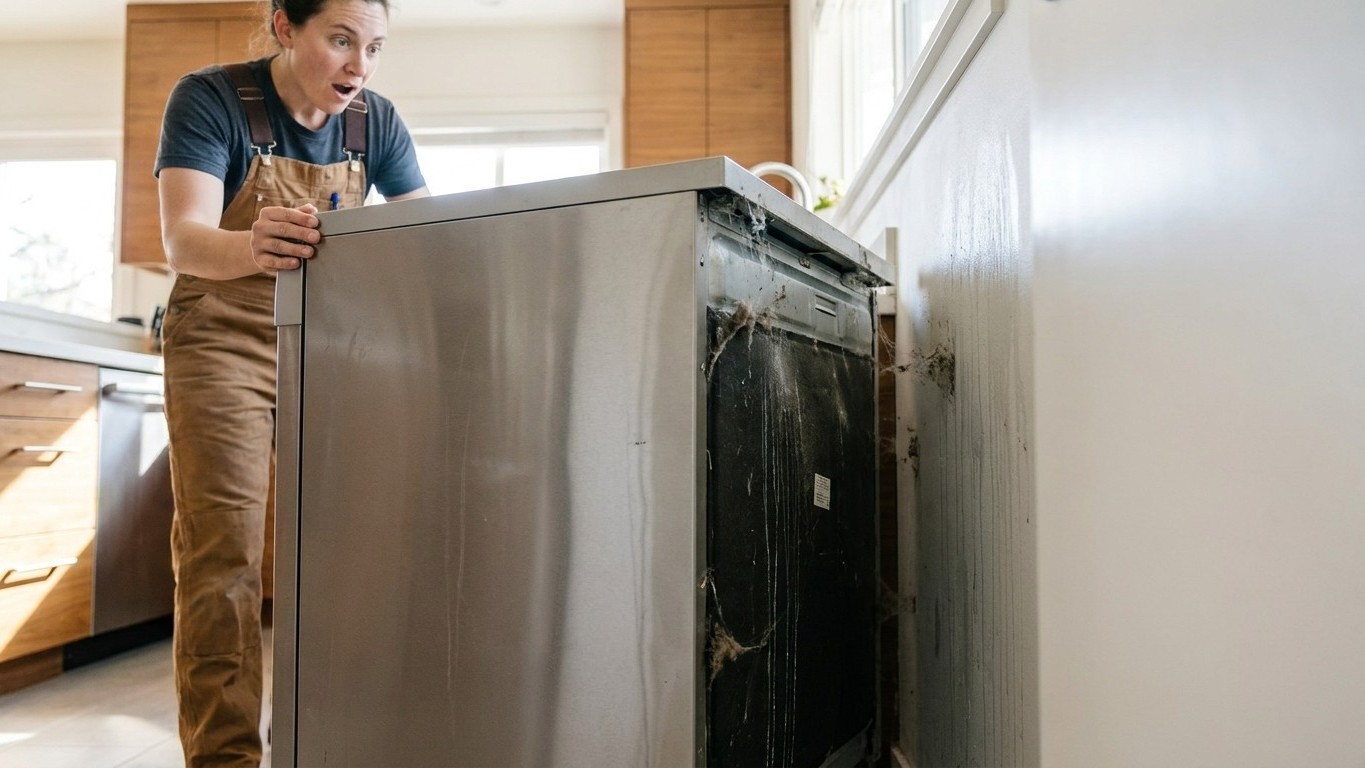
Two months. That’s how long I let dried bay leaves and cotton balls soaked in peppermint oil sit in the narrow gap behind my dishwasher, tucked against the wall where the appliance’s warm exhaust vents out. When I finally wrestled the machine forward to check on my little experiment, the leaves had gone brittle and grayish, the peppermint scent was faint at best, and what I found waiting behind them wasn’t a fortress of dead bugs. It was a thin layer of dust, a few strands of hair, and the unmistakable smell of a space that had been quietly incubating warmth and moisture for who knows how long.
That’s the part nobody warns you about. The dishwasher motor and drying cycle generate real heat, and that heat has nowhere to go except into the cavity behind and beneath the unit. Pest control companies consistently flag this exact spot as a hotspot precisely because of that combination. Cockroaches hide in warm, dark spaces behind refrigerators, stoves, microwaves, and dishwashers, and the warmth from appliances helps release the scent of any repellent placed there, which also means it helps release whatever else is lurking, including humidity that never fully evaporates.
Key takeaways
- A two-month experiment with natural pest repellents reveals why herbs lose their potency in warm, moist spaces
- Lab-tested peppermint oil kills roaches in controlled conditions—but behind a dishwasher, it’s a different story
- The space behind appliances is a pest magnet for reasons that have nothing to do with missing bay leaves
What Bay Leaves and Peppermint Actually Do (And Don’t)
I didn’t pick these two ingredients at random. Both show up constantly in home pest-control advice, and both have a kernel of legitimate science behind them, mixed with a lot of wishful thinking. Bay leaves get credit for containing natural compounds that irritate insect senses, and roaches steer clear of bay leaves because these leaves contain compounds that are naturally repellent to roaches and other pests. The catch is durability. Bay leaves should be replaced periodically to maintain their strength, since over time the fragrance may diminish, reducing its effectiveness. Two months behind a heat-generating appliance is roughly two months too long for a leaf that starts losing potency within days.
Peppermint carries a stronger scientific track record, at least in lab conditions. A study by the Department of Entomology and Plant Pathology at Auburn University found that peppermint oil can be an effective repellent against roaches and other insects. Some sources go further, claiming the oil isn’t just a deterrent. In that research, when German and American cockroaches were fumigated with 50 microliters of 100% peppermint oil, they experienced knockdown within roughly 7 to 9 hours, and after 24 hours, both species were completely killed. That’s a controlled fumigation chamber, though, not a cotton ball drying out behind a dishwasher for eight weeks. Real-world pest control companies are more cautious about the claim. Peppermint oil for cockroaches has very mixed results and scientific evidence is limited, and even when it causes roaches to avoid treated areas, the effect tends to be temporary. My cotton balls had gone bone-dry within a couple of weeks, meaning most of those two months were spent with essentially no active scent at all.
The Real Lesson Was Behind the Machine, Not On It
What struck me most wasn’t the bugs I didn’t find (thankfully, none). It was the condition of the space itself. Dust had matted into the vent grille. A faint film of grease clung to the wall where steam from the drying cycle had been condensing and evaporating for who knows how many cycles. This is exactly the environment pest professionals describe as a magnet, and it’s why they recommend pulling appliances out for cleaning far more often than most of us actually do. Pantry shelves near grains, cereals, pasta, and other dry goods are prime targets, and corners or spaces behind food containers matter just as much as the appliance gaps themselves, the dishwasher is just one link in a kitchen-wide chain of warm, damp, crumb-adjacent hiding spots.
If you’re going to bother with a natural deterrent at all, layering matters more than any single ingredient. Combining scents can improve effectiveness, since a blend of peppermint, tea tree, and eucalyptus oil creates a broad-spectrum repellent that targets multiple cockroach sensory pathways. Even then, professionals are blunt about the ceiling on what these methods accomplish. Bay leaves alone may not entirely eliminate a well-established infestation and work best as part of a comprehensive approach that includes cleanliness and other preventive measures. That’s the honest takeaway: herbs and oils are a supporting act, not the headline.
What I’d Actually Do Differently
Refresh the leaves every one to two weeks instead of letting them go stale for a season. Skip the cotton-ball approach for peppermint and mix it into a spray instead, since a liquid solution stays active longer and covers more surface area. A straightforward peppermint oil solution combines water and peppermint oil in a spray bottle, and adding dish soap helps it stick to surfaces better when sprayed along baseboards and behind appliances. And critically, pull the dishwasher out at least twice a year to actually clean behind it, not just to check on herb sachets. Wipe down the vent, vacuum the dust, and let the wall breathe for an afternoon before pushing the machine back into place.
The bay leaves and peppermint weren’t wasted, exactly. They just weren’t doing the heavy lifting I assumed. The real culprit behind that warm, slightly stale pocket of air was moisture with nowhere to escape, and no amount of dried herb was ever going to fix that on its own. Sometimes the fix isn’t a smarter ingredient. It’s just remembering to move the appliance more than once every two months.
Sources : zunexpestcontrol.com | bughousepestcontrol.com