
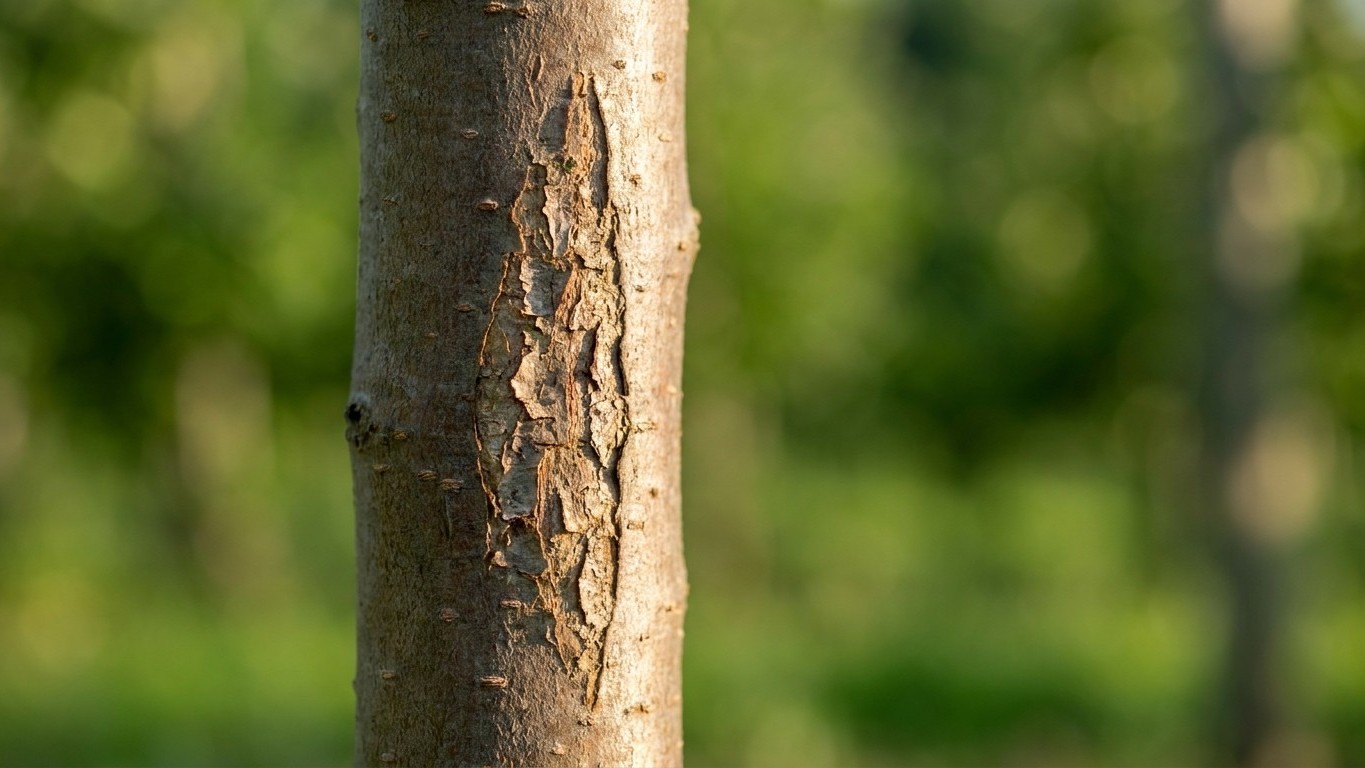
Bare bark looked beautiful in November. By March, it told a different story: a strip of dead, sunken tissue running up the southwest face of the trunk, roughly where a hand rests when checking a tree for pests. That damage has a name, and it’s older than most orchard tools still in use today.
Key takeaways
- Winter sun can heat a tree trunk 28°C warmer on one side while it refreezes at night—in the same afternoon
- Young trees with thin bark are prime targets, especially on the southwest side where low winter sun hits directly
- A simple coat of diluted white paint prevents 90% of sunscald damage, yet most people never use it
The physics hiding behind “sunscald”
What happened on that trunk is called sunscald, or southwest winter injury, and it’s a well-documented seasonal hazard for young, thin-barked trees. During cold months, the low winter sun hits the southwest side of a trunk directly, heating the bark well above the surrounding air temperature even while the ground stays frozen. In classic southwest injury, the damage is done in late winter when the temperatures are below freezing, and the sun strikes the tree, warming a portion of the southwest side of the trunk well above freezing. When the sun drops or a cloud passes, that warmed tissue refreezes in minutes.
Research on peach and apple trunks measured just how dramatic that swing can be. Cambial temperature differences between the north and south sides were as high as 28 to 31°C in the peach tree trunks and 17 to 20°C in the apple tree trunks. That’s not a gentle temperature nudge, it’s the equivalent of the bark experiencing a full seasonal shift in the space of an afternoon, then snapping back to winter by nightfall. Living cells just under the bark can’t handle that kind of whiplash indefinitely.
The tissue at risk sits right beneath the outer bark. Sunscald injury refers to a process in which living cells just inside the outer bark (mostly phloem and cambium) are damaged by day to night temperature fluctuations during the winter months. Phloem is a zone of vascular tissue in the inner bark that carries food to where it is needed in the tree. The cambium is located just inside the phloem and outside the wood or xylem and is a thin layer of cells that divides to form new phloem to the outside and new xylem to the inside. Kill that thin layer and the tree loses its ability to grow new wood and bark in that exact spot, permanently.
Why running a hand over the bark reveals it
By March, the damage rarely announces itself with obvious color. Early symptoms of trunk injury may be discolored back and small vertical cracks, while late stage sunscald is characterized by a long vertical fissure with exfoliating bark, though the initial death of trunk tissue is rarely seen. That’s exactly why fingertips catch it before eyes do: a slightly sunken texture, a faint crackling underfoot of touch, a patch that feels papery instead of firm. In the spring there may also be ‘bleeding’ from the damaged area, and as time progresses bark will begin to slough off.
Young trees pay the steepest price, and not by coincidence. Thin barked trees such as maples, ash, birches, fruit trees and honey locusts are especially susceptible, and the trunk damage is most prevalent on young, recently planted trees that have not developed a thick, corky insulating bark. An eight-year-old apple tree with a full, low canopy shades its own trunk. A two-year-old whip planted last spring has nothing but a few thin branches and a whole lot of exposed southwest-facing bark, sitting there absorbing every ray of low winter sun. That’s the tree that ends up with the scar.
What orchardists have known for a century
The instinct to leave bark “natural” is understandable. It’s also, according to nearly every extension office and commercial grower, backwards. Some orchardists paint the southwest sides or the entire lower trunks of fruit trees with white latex paint to avoid sunscald injury, reflecting light to keep tissue cool. This isn’t a recent trend, either. An Oregon Agricultural College bulletin from decades ago already recommended the practice, noting that sunscald and winter injury on the southwest and south side of young fruit and nut trees can largely be prevented by keeping the trees properly whitewashed during the winter months.
Modern testing backs up the old advice with actual numbers. White paint and white-wash prevented temperature rises of more than 5.6°C compared to unpainted bark, which is often the difference between a trunk that stays within a survivable range and one that swings into the danger zone. Growers who’ve made it a routine part of dormant-season care report the same result. As one Tennessee orchardist put it, whitewashing “completely eliminated rabbit damage,” a reminder that reflective paint solves more than one winter problem at once, since animals gnawing on bark under snow cover is its own separate threat.
The fix doesn’t require anything exotic. Interior latex paint, diluted roughly half and half with water and brushed onto the lower trunk, does the job without the antimicrobial additives found in some exterior formulas that can actually harm living bark. For anyone who dislikes the look of a white-striped orchard, there are alternatives that work almost as well: low branches on the south and southwest side of the tree help by shading the trunk, so leave these branches intact as long as possible, or wrap the trunk loosely in light-colored paper each December and remove it before spring growth starts.
What to do once the damage is already there
A scarred trunk isn’t a death sentence, but it is a standing invitation to trouble. Resulting wounds are slow to heal and provide a point of entry for insects and diseases, and limb breakage can result. The practical move now is to keep watching the site through the growing season, watch for oozing or bark that continues to peel, and resist the urge to seal it with anything. Damaged bark on a young tree usually needs air and time more than intervention, along with protection from a second round of the same exposure next winter.
Next November, that same trunk gets a coat of diluted white paint, or at minimum a loose paper wrap, before the leaves are even fully down. One season of bare bark taught a expensive lesson about how deceptively strong a low winter sun really is. The bark looked rustic for four months. It’s going to carry that stripe of scar tissue for considerably longer.
Sources : fruitgrowersnews.com | mcdougalorchards.com